
Julia had to submit three articles to the judges, so we thought that for this week’s Throwback Thursday we would republish one of them, this superlative introduction to one of the world’s most distinctive wine-producing countries, first published a year ago.
30 July 2013 How do you take pride in your country without being nationalistic? How do you defend yourself against aggressively armed giants at the border while treating your guests as gifts from God? How do you maintain a strong orthodox faith while welcoming and giving freedom to all others? How do you remain creative in a country saturated in tradition?
Georgia seems to have a quite remarkable ability to hold opposites in tension, without becoming double-minded or two-faced. A single brief trip to the country is no more than an aperitif, a taste to whet your appetite, but the people, the wines, the capital Tbilisi and a journey through the beautiful countryside of Kakheti, the country’s dominant wine region in the east along the broad Alazani Valley and overlooked by the Caucasus mountains, left me convinced of this priceless ability. Tenacity and a generosity of spirit that spring from love and loyalty seem to have given the people of Georgia the strength to withstand all that history has thrown at them. (The history of Georgia and those who have tried to incorporate this geographical, agricultural and geopolitical jewel into their empires is long and complex, as is the more recent history of independence and civil war, not to mention invasion by the Russians as recently as 2008.)
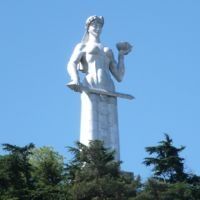
The 1958 statue of Mother Georgia (Kartlis Deda, above left), watching over the city of Tbilisi, well into its much needed reconstruction after the neglect of the Soviet period and the Russian invasion of 2008 – which did not quite reach the capital – epitomises this tension: if you approach me with aggression, I will defend myself with the sword; if you come in peace, I will pour you wine. (I was told that restoration of many ancient buildings in Tbilisi and other major cities, along with other development projects in many different sectors, is funded by grants from the US and the EU in support of the independence and geopolitical importance of this little country. Some of this money has benefited the wine producers and allowed the Georgian Wine Association to train producers in tasting and assessing wines and send them to Germany, for example, to see parts of the wine world outwith the confines of their long-isolated country.)

This statue of a tamada (toastmaster; apologies for the car in the background), the focal point of the Georgian supra (feast), modelled on a 6th-century original and relaxing comfortably in one of the rejuvenated old streets of the capital, is also quintessential Georgia, where feasting, polyphonic singing, energetic and exuberant traditional dancing (see below) and public expressions of appreciation of others are a regular occurrence.
Just before I made the rather gruelling journey to Tbilisi (no direct flights from London, almost all flights during the night), I read a prose translation by Katharine Vivian of the 12th-century epic poem that every Georgian knows and loves, and probably identifies with in some way: The Knight in Panther Skin by Shota Rustaveli. It is a love poem to Tamar, queen of Georgia 1184–1213 during Georgia’s ‘Golden Age’, dense with knightly quest, the pursuit of love to the ends of the earth, and loyalty unto death, not forgetting frequent accounts of hunting, feasting and fine wine. American John Wurdeman, infectious proponent of qvevri wines (see below), owner of Pheasant’s Tears winery in Kakheti, and as (emotionally and spiritually) Georgian as any Georgian I met, recommended the book when I asked him what to read to prepare for my trip.

The journey itself was part of the second International Qvevri Wine Symposium (see Umay Çeviker’s 2011 report on the first symposium in In Vino Qvevritas as well as his excellent 2010 overview of the country and its wines in Georgia undaunted). I peeled off from part of the trip, missing the long drive to the western wine region of Imereti in order to taste a broader range of wines, including those made ‘conventionally’, not in qvevri, the traditional clay vessels buried underground that were the fermentation vessel of choice as far back as the Stone Age, apparently.

(This photo shows qvevri remains in the grounds of the sixth-century monastery of Ikalto, home to a 12th-century wine academy.) Woe betide you if you refer to a qvevri as an amphora, a clay vessel usually kept above ground – also increasingly popular for fermentation among ‘naturalistas’ today – and of Roman rather than Georgian descent.
This brings me to Georgia’s wine dilemma. How do you make the most of a unique selling point (qvevri) without giving the impression that it is your only selling point? While this is hardly of the same order as the ontological dilemmas listed above, it is a critical question for Georgian wine at its current staging post. And one I will take up in the rather longer part 2 tomorrow.













