Let’s start with the basics: Amontillado is a category of sherry comprising wines that start life as a Fino or Manzanilla, maturing under the influence of flor film-forming yeast which floats on the surface of the wine, and end in an oxidative manner without the protection of this yeast.
This process enriches the wine with the desired aromas of biological ageing (oxidised apple, fresh bread, cream, lees, biscuit) but also gives an intense oxidative character (pungency, walnut, hazelnut, toast, caramel, toffee, chocolate) as well as increasing colour.
Amontillado sherry has a long history. In classic literature it has served to trick people, as in Edgar Allan Poe’s 1846 short story The Cask of Amontillado, and is admired by many sommeliers and wine lovers worldwide.
However, the Spanish wine community seems recently to have been more attracted by Palo Cortado, probably due to the huge success of a documentary entitled The Mystery of Palo Cortado featuring an array of Spanish wine professionals. [Grupo Estévez chief winemaker Eduardo Ojeda described it as follows during my two-day trip with him last year: 'Palo Cortado is basically an Oloroso, even if it has had a short time under flor, ie it is basically an oxidative style. Amontillado is thinner because it started life as a biologically aged wine, with more flor influence and selected for that style.' – JH]
Although both sorts of sherry are highly regarded, and exceptionally good value (the estimated average retail price for a bottle of Amontillado is just €15), Amontillado represents 1.8% of all sherry produced while Palo Cortado is just 0.5% of the total.
However, quality-oriented sherry is finally waking from a long sleep. Oxidative sherries (Amontillado, Oloroso, Palo Cortado) increased their sales by 14.4% in 2015 and 6.7% in 2016.
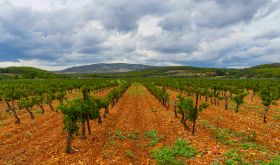
The increase may be the result of the uprooting of excess vineyards through a programme promoted by the EU. This began in 2013 and has reduced the total sherry vineyard from 10,000 ha (24,710 acres) to 7,000 ha. The measure has stabilised and increased prices of Palomino grapes. Today, supply and demand are more in balance, and the amount of wine available to replenish the soleras has been reduced, leading to a slow but steady increase in price.
I am sure most wine lovers are aware that sherry has been one of the most undervalued wines on the planet, which is why I am particularly glad about the consequences of the vine pull scheme.
Amontillado can be made in two different ways. The most easily controlled consists in adding alcohol twice, first at the beginning of the process (to strengthen the new wine to 15% and encourage the development of flor), and then secondly after a few years to increase the alcohol level to 17%, making the flor disappear.
However, an increasing number of Amontillados are now produced by a single fortification. Seeking an explanation of this fashionable technique, I rang Celsar Saldaña, the widely admired general manager at the Jerez Consejo.
This second technique seems to be more qualitaty-oriented, with the alcohol added just once, to increase the strength of the wine to 15%. The flor will naturally disappear during the journey of the wine through the solera system. Yeasts consume the nutrients of the wine (mainly glycerine). After five years the level of nutrients is very low, providing such an unfavourable environment for the flor that it starts to disappear. In addition, as the flor fades, the water evaporates and the alcohol increases. The ecosystem becomes increasingly inhospitable for the yeasts which finally die, allowing oxidative ageing to start.
In recent times there has been an increase in Amontillados produced with single fortification, following on from wines such as the Manzanilla Pasada and Fino en rama that burst on to the market 20 or so years ago. Vinicola Hidalgo with its Manzanilla Pasada Pastrana and Barbadillo with its Sacas Estacionales were benchmark wines representing this trend.
Let’s imagine we take a young Palomino wine, fortify it up to 15% and leave it for four years under flor to obtain a Fino. Then imagine the same wine matured for 10 more years to become an Amontillado. It is quite revealing to note the thrilling change in composition. The Amontillado will naturally gain 3.5% alcohol and the acetaldehyde (the aroma of oxidised apples formed by the action of the flor) will be halved while the dry extract – related to the concentration of the wine – and the colour will be double in intensity. Furthermore, the glycerine will be increased almost ten times, giving a more viscous and sweet sensation. Finally the level of acetic acid (vinegar) increases fivefold, but remains below the sensory detection threshold.
This is why Amontillado is extremely complex in terms of flavours. A taster needs to be really focused when facing these wines. That's why I decided to divide the profile of each bottle into five distinct features and, in order to explain the stylistic silhouette of each wine, I rate the different features (1 to 5):
- Concentration/pungency: Related to the intensity, the saltiness, the residual extract of the wine and the sharpness of the taste.
- Biological character: Aromas related to ageing under the film-forming yeasts. Oxidised apple, fresh bread, cream, lees, biscuit.
- Oxidative character: Aromas related to ageing without flor. Nutty, hazelnut, toast, caramel, toffee, chocolate.
- Integration: The balance and harmony of all gustatory perceptions.
- Persistence: How long the aroma and flavour last after drinking.
With this information, and bearing in mind that sensory perception is never precisely translated to a number, I have developed the following infographic, with the aim of expressing how varied are the wines grouped under the name Amontillado.
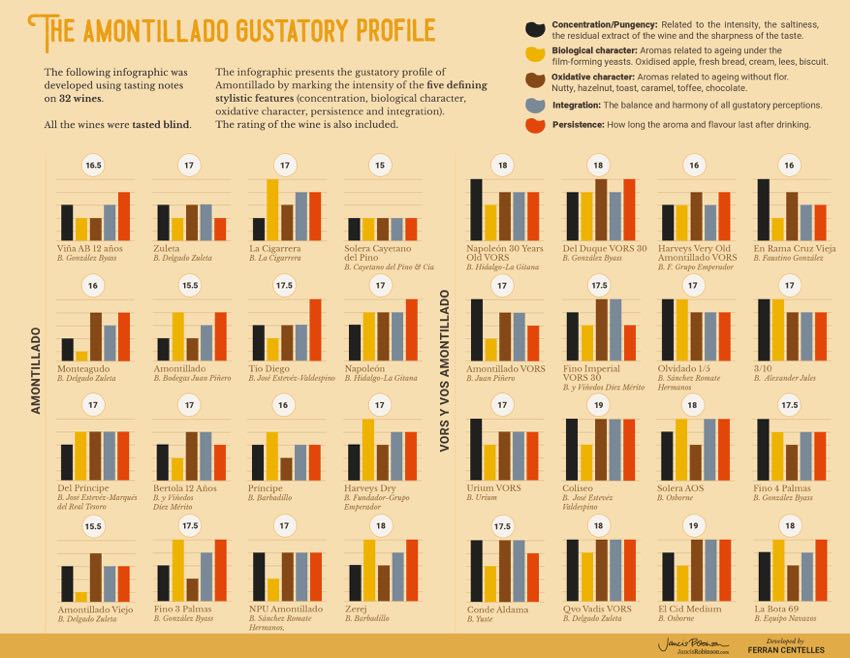
It needs to be remembered that almost all sherries are non-vintage. The solera is a dynamic system (involving replacing a portion with younger wines). The references to different ages in my descriptions below are purely averages.
You will see drinking windows from 20 to 30 years. However, they are just suggestions as the following wines can last much longer.

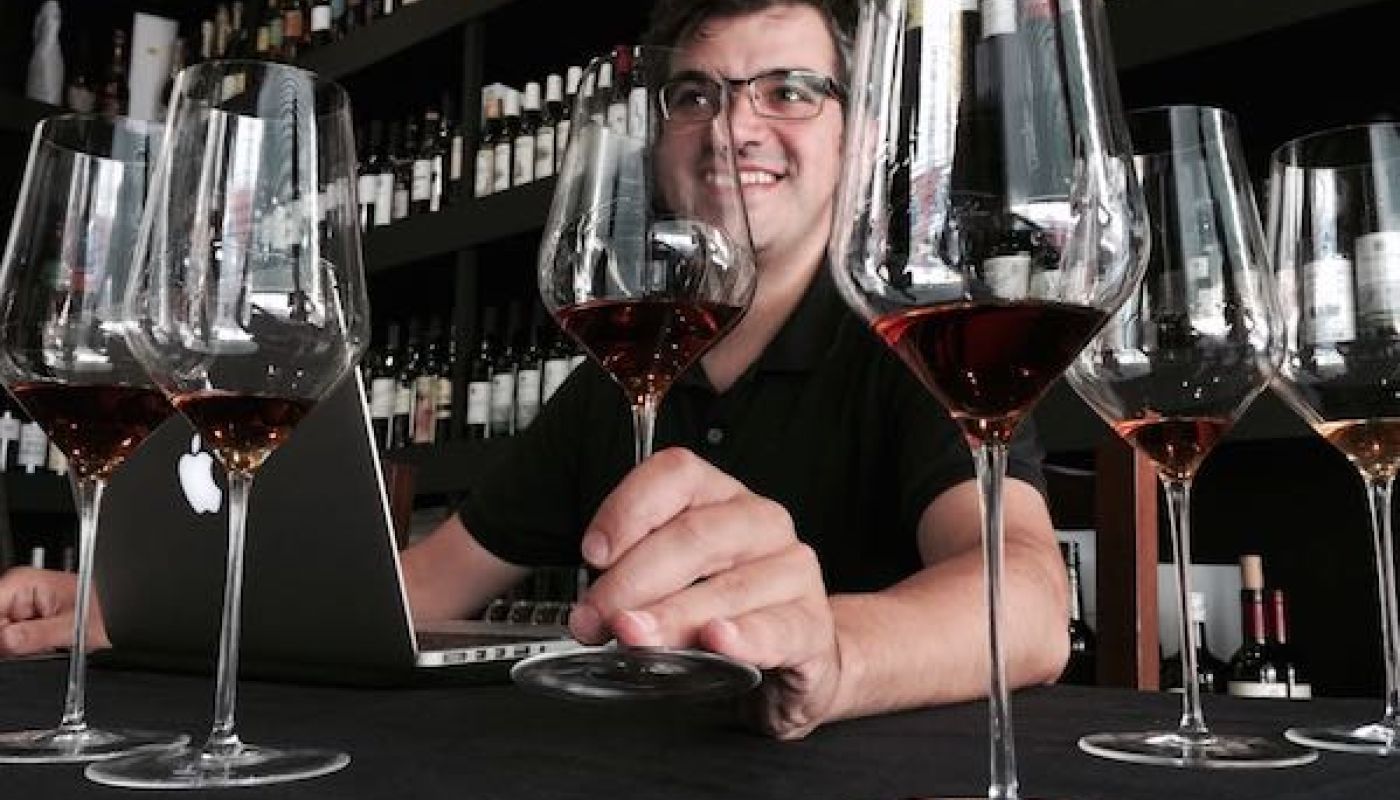
Below I present the results of tasting blind (plus Bota 69 from Equipo Navazos that was not tasted blind) from a selection of the very best Amontillados that are produced today. I had the opportunity to taste them at Taberna der Guerrita in Sanlúcar de Barrameda, a top traditional gastro tavern that really merits a visit. The selection was kindly prepared by Armando Guerra, part of this family-owned tavern. He is one of the most prestigious sherry personalities, today collaborating with Barbadillo. I am very grateful to him, not least for providing terrific Zalto glasses for my tasting.
Armando pointed out, ‘In my humble opinion, Amontillado is the maximum expression of classical sherry ageing. The sum of biological and oxidative maturation contributes to a personality that is impossible to imitate: saline, vertical, complex and elegant.’
This was one of my top-rated tastings since I started writing for Jancis Robinson.com. As many as 22 wines of the 32 I tasted were rated 17 points or above. The selection was accurately made by Armando himself, which may explain such successful results.

Those seeking bargains should look for:
La Cigarrera, Amontillado
Valdespino, Tío Diego Amontillado
Marqués del Real Tesoro, Príncipe Amontillado
Díez-Mérito, Bertola Amontillado 12 Años
All of them are high-class bottles costing less than €15 retail in Spain.
I gave six particularly outstanding wines 18 or 18.5:
Barbadillo, Zerej Amontillado NV Manzanilla-Sanlúcar de Barrameda
Hidalgo La Gitana, Napoleón 30 Year Old VORS Amontillado
González Byass, Del Duque 30 Year Old VORS Amontillado
Delgado Zuleta, Quo Vadis VORS Amontillado
Osborne, Solera AOS Amontillado
Equipo Nazavos, La Bota 69 de Amontillado
Beyond them two wines reached 19 points and represent liquid jewels:
Valdespino, Amontillado Coliseo
Osborne, El Cid Amontillado
These are hair-raising wines – in the very best sense.
The 32 wines are presented in the order I tasted them. The regular cuvées were tasted first, followed by the older cuvées, VOS (wines more than 20 years on average) and VORS (for wines over 30 years).
REGULAR CUVÉES

Average age of 12 years, four years of biological ageing and the...
This fortified wine is the result of a Manzanilla undergoing...
Ageing and shipping bodega dating back to 1758. Average age of...
Aged over 20 years in criadera and solera system.
Tasted blind...
Aged in solera system for an average of 12 to 14 years.
Tasted...
Quite a young bodega established in 1992. Eight years under a...
Palomino Fino vines grown in Pago de Macharnudo. Tío Diego has...
The bodega was founded at the end of the 18th century, prior to...
Average age above 15 years, eight of them aged biologically with...
Amontillado aged eight years under flor plus six more of...
After a very long biological ageing the wine is transferred to...
Average age around 15 years. An ageing and shipping bodega that...
Amontillado produced in Sanlúcar de Barrameda.
Tasted blind...
Very old Tío Pepe taking biological ageing to the limit. After...
In 1781, the Sánchez Romate brothers laid the foundations of...
Barbadillo is located in the historic centre of Sanlúcar de...
OLDER CUVÉES
Historic bodega founded in 1792. Palomino Fino grapes come from...
Palomino grapes intended for Del Duque start as Tío Pepe. After...
The history of this ageing and shipping bodega dates back to...
Unfiltered Amontillado. Winery-owned vineyards are located in...
A bodega launched 25 years ago in Sanlúcar de Barrameda after a...
The wine is aged for the first stage under flor. The yeasts are...
Palomino Fino, aged in traditional soleras and criaderas...
Alex Russan is an American sherry connoisseur. In 2013, he began...
Family-owned bodega located in the historic centre of Jerez...
Palomino grapes from a single vineyard called Pago de Miraflores...
100% Palomino Fino grapes from Pago La Balbaína, aged in El...
This is a selection of one cask from the six that are used in...
Ageing and shipping bodega founded in 1991. The average age of...
Bodega with more than 270 years of history. Very old VORS...
100% Palomino Fino aged in El Puerto de Santa María. Very old...
A moderately young Amontillado of 18 years released by the...