26 September 2005 I’m lucky enough to roam widely around the expanding world of wine, and to have as my base a country with only the most modest claims to produce wine, England. This, I hope, gives me a fair degree of impartiality when viewing the Old World v New World tussles that seem increasingly to dominate today’s wine scene.
I know it is popularly believed that all English wine writers are hopeless traditionalists in the pockets of the French, besotted by their propaganda and tales of terroir, but perhaps I can convince you otherwise. I made my first visits to the wine country of California and South Africa in 1976, and was one of the first British wine writers to visit Australia professionally, in 1981. By that stage I was secretary of the Zinfandel Club, a society designed to convince the Brits that good wine was made in California. While most of the very, very finest bottles I’ve been lucky enough to share were filled in France, a substantial and increasing proportion of the wines I praise to the heights in print and on my voracious website are from what is so carelessly called the New World.
This is why I am so distressed about the completely false impression that is being peddled about the wines and winemakers of the New World to and by the French. Nowhere was this more marked than in the hullabaloo that was stirred up by the documentary movie Mondovino, which was such a commercial success in France a few months ago. The line promulgated by the film, and by the extensive coverage thereof in the French press, is that all New World wine is ‘industrial’, made from factory-farmed grapes transformed into wine in massive volumes on soulless production lines.
I’m quite sure that one of the reasons the film was so popular with the French was that it pandered to their view of themselves as sole upholders of the noble, atavistic traditions of hand-made wine production in an increasingly wicked world.
But what do I see when visiting vineyards and cellars around this supposedly industrial New World? The very opposite is more and more the case.
Take Drew and Raegan Noon of South Australia. They make two to three thousand cases of wine a year in one of the simplest wineries I have ever seen. Between a rough floor and low rafters are two tiny basket presses (surely more suitable for experimental lab microvinifications?), old wooden vats of all shapes and sizes, three-quarter-ton fermenters, all cooled by a miniature dairy cooler. And, while Noon wines may sell at the sort of prices that the combination of high quality and low quantity inevitably attract, the Noons themselves are the very opposite of fat cats. Decidedly skinny, in fact. 'I worry if someone’s paying $50 for a bottle of my wine', says Drew, a Roseworthy contemporary of Barossa winemakers Chris Ringland and Rolf Binder who managed to fit in Master of Wine studies and persisted with the exam for seven years before finally qualifying in 1998. 'How can we possibly deliver on their expectations?'
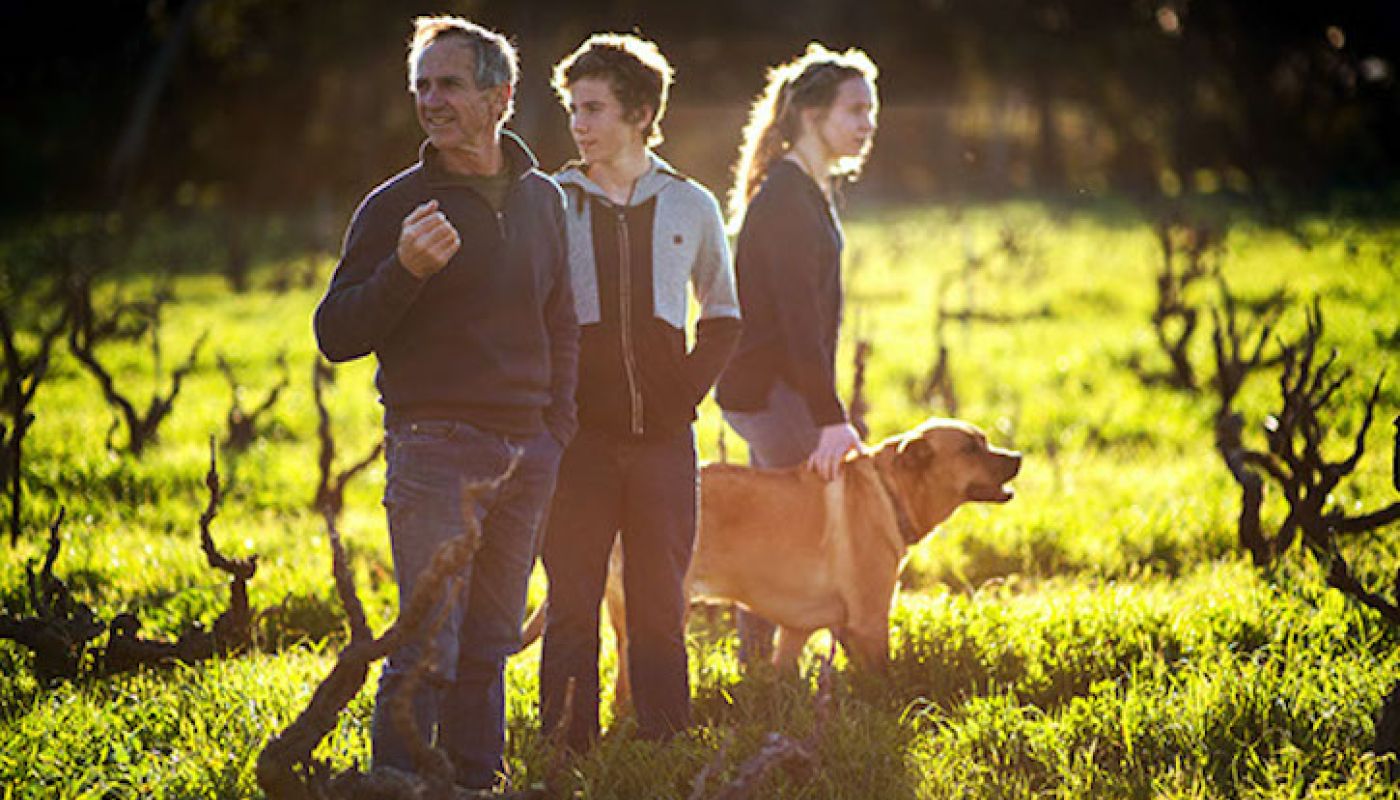
They show me their wines, in between rocking the pram in the corner (presumably containing one of the children shown in the picture of Drew and family here), in the simplest of kitchens, stone-flagged floor and furniture that looks as though it was knocked up in a carpentry evening class. They have pitifully few vines themselves round their low cottage in McLaren Vale – just four hectares (10 acres) of bushvine Grenache planted in the 1930s and 1940s – and depend for volume on fruit from the Borrett family of Langhorne Creek. 'No we don’t have a contract. They have a hundred acres and they sell the same blocks to us every year as they sold to Dad', Drew tells me.
Or one could cite Eben Sadie of South Africa, who commutes with his young family between his two hectares (five acres) in Priorat, northern Spain [since relinquished], and the seven hectares he leases in Swartland – again including, coincidentally, 55-year-old Grenache bushvines which he claims constitute one of the oldest vineyards in South Africa. When I question whether the size of his bi-hemispherical operation isn’t uneconomically small, he says, 'it has to be like that because I’m a control freak. I’m just mesmerised by my bottles.' His modest whitewashed winery in South Africa could hardly be called industrial, nor could his average yields: 550 grams per vine in South Africa, 190 grams per vine for his Dits del Terra Spanish red.
There are hundreds of similar examples of total commitment to hand-made wines throughout the New World, even in wine regions commonly thought to be inhabited only by well-heeled glitz-seekers as in the Napa Valley stereotype, as the hands-on likes of Bill Jenkins of Wing Canyon and Steve Lagier of Mount Veeder, who know every single one of their vines themselves, can attest.
But it is not just the small, homespun operations that serve to disprove this myth about ‘industrial’ New World wine. There could hardly be better-funded wineries than California cultmakers Araujo and Harlan Estate, and here every bit as much effort is put into refining every detail of vine growing and wine making as at France’s first growths – perhaps more because they don’t have a centuries-old track record to fall back on. I am far from the only wine traveller to feel that there is no one in the wine world more meticulous than California’s top vintners, with their precision viticulture and yield monitors in their vineyards and the most expensive oak in the world in their cellars.
So, all this anti New World stuff is without doubt a slur on the current reality. (Of course there are wine producers more industrial than those described above, in Australia and California in particular, but the reason the French resent the likes of Constellation, Hardys, Gallo and Yellowtail is that they are so much more successful at branding and marketing than their French counterparts such as Grands Chais de France, Val d’Orbieu, Castel and the Bordeaux négociants.)
But I am concerned about the prevailing myth about French wine producers supposedly being so much more ‘pure’, noble and artisan than their New World counterparts not just because it is inaccurate. As one who loves French wine, I am worried that this sort of inaccuracy will encourage the average mediocre vigneron in France to believe that there is no need to make any effort to improve the quality of what he or she produces. It is enough, according to this myth, simply to be French. If they all start listening to these sort of ideas the French will find themselves even further behind in the global wine race to find buyers for the huge surplus of wine they produce than they are already.