In July 2019 I added five days onto our trip to Georgia to dip a tentative toe into the Armenian wine scene; there isn’t much on Purple Pages and nothing in the World Atlas of Wine [there are 169 words on Armenian wine in the forthcoming eighth edition – JR], so I thought I’d write a little about it.
Both countries claim to be the cradle of viticulture and winemaking and each is suggesting they have evidence of this going back more than 6,000 years (see Julia’s 2016 article Digging in Armenia). Armenia’s trump card is the Areni 1 cave, although Julia wrote in 2017 of an 8,000-year timeline in Georgia. Doubtless is the fact that wild Vitis vinifera comes from around these parts and was used to make wine long before there were arbitrary and constantly changing national borders. But the Soviet era nearly eradicated winemaking in Armenia as the economic compulsion for Armenians was to produce vast quantities of brandy distilled from wine using non-native varieties. Thankfully isolated farmers and families continued to make wine behind the scenes which survived, and this factor is the sole basis for the contemporary winemaking culture which is rapidly emerging from a standing start from around 1994.
Due to cultural and political legacies, Armenia turns out to be quite different from Georgia. The effects of the hostilities with Turkey and Azerbaijan are on-going and respective borders are closed. The country relies heavily on support from and trade with Russia, which individual Armenians do still tend to see as a friend and ally. Conversely, the country ranks higher than France in the 2016 Index of Economic Freedoms. To a visitor it’s clear the infrastructure needs major investment. Dilapidation abounds, and there are still all-too obvious echoes of Soviet rule, in terms of abandoned industrial facilities – particularly around the capital, Yerevan. And everyone drives a battered Lada.
So, travel to Armenia is most obviously from Georgia, from where you can go by air, rail or road – some car hire companies allow cross-border trips – or use a shared minibus or taxi. A taxi at least doesn’t take literally all day, but six to seven hours from Tbilisi should be reckoned on, and it costs between £100 and £150 one way. We stayed in Yerevan at a very decent apart-hotel near to the modern cathedral and hired a 4x4 Duster from Sixt which also came with a pre-loaded GPS device – hallelujah!!
Including a day without a car, and a Sunday, our winery tour was never going to be comprehensive. I’d made a shortlist of 13 producers from the spectrum of business size, all of whom had websites of sorts, and in the end managed to visit nine of them.
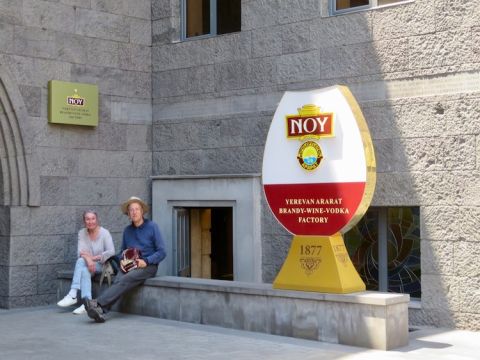
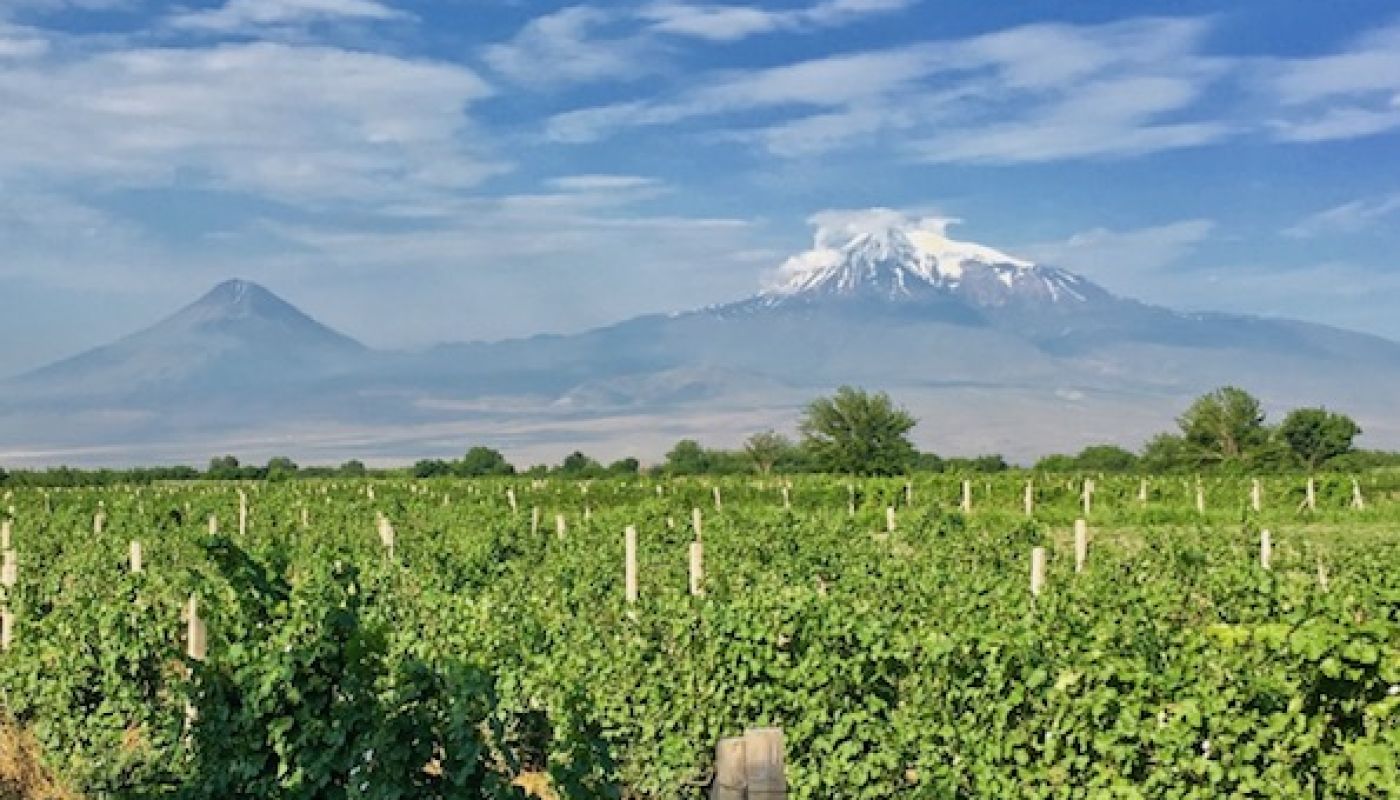
Within the city, the monolithic Noy-Ararat Brandy & Wine Factory offers a tourist-level tour and tasting for a small fee. Noy is Armenian for Noah and references the constantly imposing presence of Mount Ararat to the south, that is when not shrouded in haze or cloud. (That it is located in modern Turkey is another constant running sore for Armenians). Founded in 1877 and now privately-run, Noy-Ararat has great historical interest and still is the official brandy (which they brazenly describe as ‘cognac’) supplier to the Kremlin. But it has no table wine production. Here ‘wine’ refers to fortified port and madeira styles. They offer a 1924 vintage ‘port’ for 1.2 million AMD (about £2,000) a bottle which, surprisingly, was included in the tasting – but it resembled a cheap supermarket tawny if I was being generous.
Next day, I devised a day’s circuit to the west of Yerevan (Aragatsotn and Armavir districts) to visit some proper wine producers, merely choosing the first four to respond positively to advance enquires. All of them provided a warm welcome, informative-level English language tour and discussions – plus generous tastings, for very modest charges. And, unlike in Georgia, spittoons were provided!!
Voskevaz winery was established in 1932 and was abandoned when the Soviets left, but was acquired in 1997 by David Hovhannisyan and his Los Angeles-based artist brother. What could be salvaged was reused but massive investment in building and equipment has been ongoing since, aiming to create a winery and educational complex in an architectural style reminiscent of the bonkers-in-a-good-way Castello Amoroso in Napa. We were shown around by the owner’s daughter Mary who emphasised the social enterprise nature of the scheme. Only Armenian varieties such as Areni Noir, Voskehat and Haghtanak, are used and they buy grapes from local farmers – aggregating about 40 ha – and from the Vayats Dzor (VD) region. The premium range is fermented and matured in karas, the Armenian word for qvevri.
Next – to ArmAs which was a massively ambitious 2007 start-up bankrolled by Armenian ex-pat made good, Armenak Aslanium. Vast quantities of rocks were cleared from fallow farmland before planting the estate and building a perimeter wall. Varieties on offer are Kangun, Voskehat, Karmrahyut (actually a hybrid) and Areni Noir, which notably is cultivated on-site rather than trucked-in from VD.
A long round-the-houses route, with many diversions due to subsidence and upgrading works, takes you into Aragatsotn and the huge 200 ha Karas estate started in 2002 by ex-pat Armenian Eduardo Eurnekian, better known for his winery Bodega Fin del Mundo in Rio Negro, Argentina. Here too the consultant oenologist is Michel Rolland. The soil is rocky and volcanic. Neighbouring Armenian wineries are a little sniffy as Karas has a) attempted to monopolise as a trademark the word karas, even though they only use modern ‘western’ vinification techniques and b) have planted mainly western European varieties. ‘It’s so that we can build a quality reputation from wines we already know – but we intend to introduce Armenian varieties soon,’ is how the winery explains it. The company only employs local residents and has a comprehensive social support package for its workforce much like our Victorian-era Titus Salt. The views from the vineyards are awesome….
In complete contrast, three exiled ‘Western Armenian’ (ie now Turkey) brothers – the Machanyans – have set up the small garage winery, Alluria to produce natural wines from their five hectares of vineyard with ungrafted Haghtanak, Karmrahyut and Khndoghni vines. The family still owns a vineyard in Turkey – just on the other side of Mount Ararat – and there is a scheme to try and bring cuttings from there and replant in Armenia.
(Two other wineries could be visited if time – Van Ardi and Voskeni, but they missed our cut.)
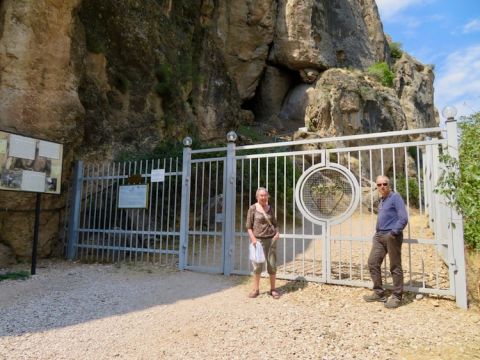
On the second day we travelled east to the ancient wine region, VD, around Areni. En route the road rises twice to 1,800m passes, and some vineyards are planted here – making Armenia the location of [some of] the highest vineyards in the northern hemisphere (see elevation). Near to Areni village is the eponymous prehistoric cave excavations which revealed winemaking circa 4000 BC. Nowadays it can be visited – merely turn up at the gate, shown below, and wait for a guide; admission is 1000AMD, about £1.60.
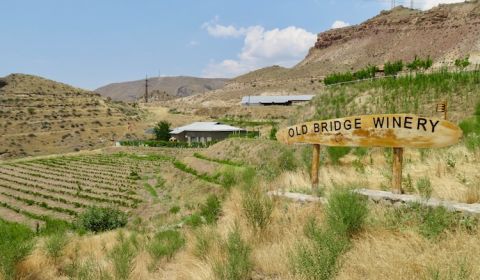
There is a VD wine route incorporating just four bona fide wineries along the E117 between Areni village and Old Bridge winery – a 14km route. Here is the home of the ancient variety Areni Noir, the region’s signature grape that is so like Pinot Noir, yet apparently is unrelated – unless presumably you go back to the Beginning. When harvested fully ripe and matured in old Armenian oak barrels, the wine can be sublime. Two modern start-up boutique wineries Trinity Canyon and Old Bridge offer tasting flights of their range, the former having a larger portfolio. The Old Bridge Areni Noir Reserve 2015 was the finest wine we tasted that day.
In Areni itself, apart from local farmers selling their dubious wares in large plastic containers by the roadside, there are two wineries, located in the same building – Hin Areni and Areni Wine Factory. Originally one business, a partial buy-out created the former which modernised its processes and presents as a fairly ordinary winery with average, though competent wines…. and disinterested staff. The latter is a much more interesting proposition. It has a back catalogue going back to 1994, the oldest unfortified wines we saw in the country, and still uses old karas for some of the range. The tasting flight includes Areni Noirs from 1998 and one stand-out vintage was the 2001. In true Armenian tradition they also offer pomegranate wine (absolutely disgusting), other fruit concoctions, and apricot brandy (not too bad).
Modern Armenian winemaking is in its infancy but is looking eagerly at the international market, and it has a sound basis for success – its native and unique varieties, the climatic conditions and well-suited terroir, together with an ancient viticultural legacy trumped only by its neighbour Georgia. Whereas the origins of its wine culture are in VD, around the town of Areni, it’s relatively remote and expansion here would be hampered by the poor infrastructure and limited available workforce. The region most likely to become a wine focal point is around Yerevan and the Ararat region. We saw signs of a promising future for wine tourism here, and in fact our day in this area was one of our all-time highlights.