In 40 years of observing the wine scene, I have never known it to be in such a state of flux. Until a few years ago, all of the world’s winemakers seemed to be going in the same direction, roughly in pursuit of a local copy of the French classics, more or less styled to appeal to the perceived tastes of the most powerful American critics. So big and bold held sway for many years.
But today a new subculture, or perhaps more accurately a counter culture, has emerged. All over the world a new generation of producers is turning its back on the conventional archetypes and is making wines quite different from the old icons. Many of them have been inspired by the natural wine movement whereby chemical additions, particularly those associated with sulphur, are kept to a minimum. (Sulphur dioxide, a natural by-product of fermentation, has been used as an antioxidant and preservative since ancient times and is still found in substantial quantities in fruit juices and dried fruits.)
New-wave wines are typically: fermented without added yeast, lower in alcohol, less likely to be exposed to new oak, less likely to have added acid or tannin, earlier maturing and more likely to carry a wild and wacky label than conventional wines. When they’re successful they taste like a revitalising breath of fresh air blown in from another, thrilling, planet. When they’re not, they can be more like five day-old cider with a more than a hint of mouse droppings.
Such wines are being made throughout Europe (often outside the strictures of the heavily regulated appellation system) and in almost all significant wine-producing countries outside it: South Africa, Chile and California certainly, and there are the beginnings of such a movement in Argentina and even New Zealand. Perhaps the least likely location for the requisite hipster beards and defiant t-shirts is Australia – but, boy, is the movement alive and well there.
Having tasted various examples from UK-based importers of off-piste wines such as Les Caves de Pyrène, Indigo Wine and Swig, I was keen to sample as many of them as possible during a recent brief stay in Sydney. I asked my (generously bearded) colleague Max Allen to recommend some suitable names and he suggested I also consulted his fellow wine writer Mike Bennie, who had recently assembled a collection of such wines for the list of the Danish restaurant Noma during its temporary relocation in Sydney.
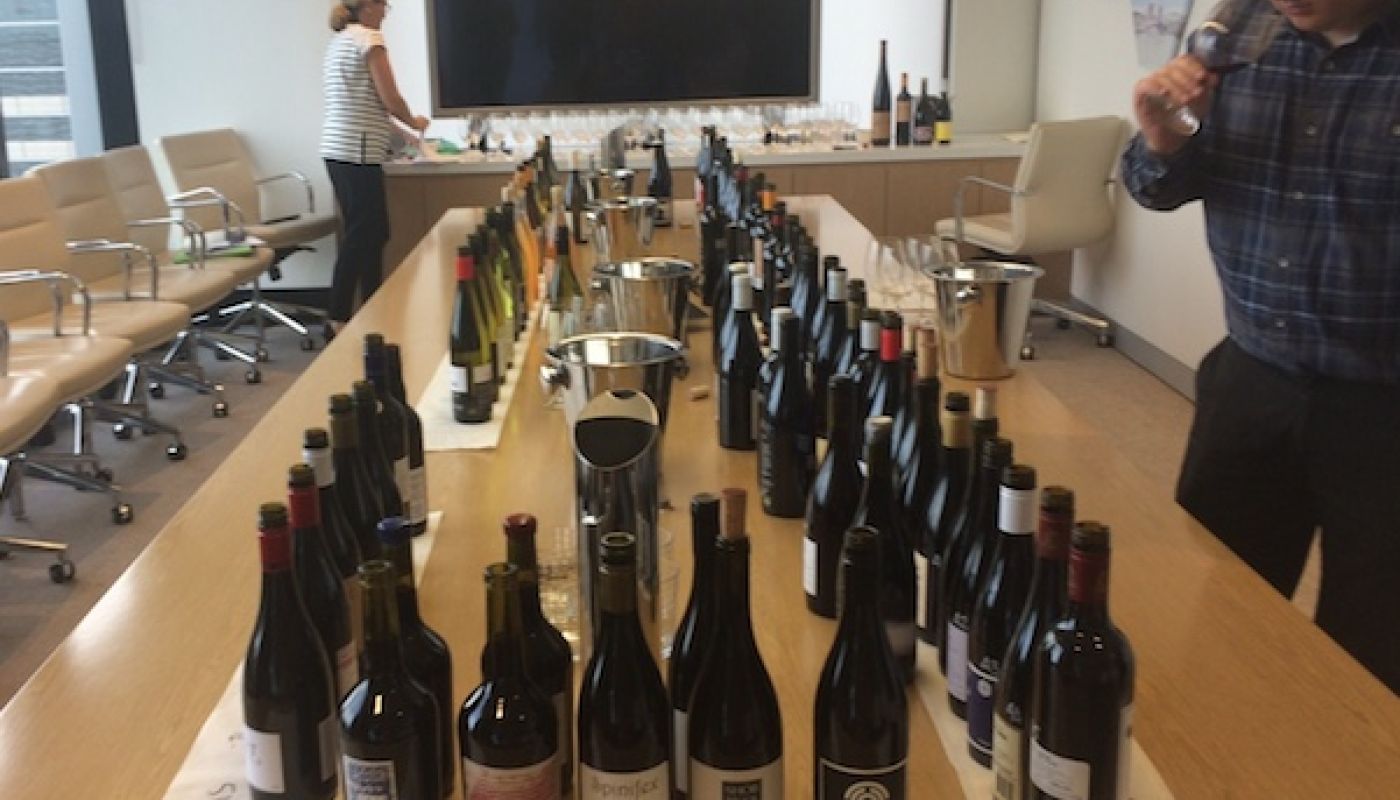
The result was a fascinating day spent tasting 83 new-wave Australian wines, a selection of wines headed Artisan Tasting by Wine Australia in their offices in Sydney. The chair of this generic organisation Brian Walsh, recently retired as chief winemaker of one of the most respected family-owned wine producers in the country Yalumba, flew in from Adelaide for the tasting. ‘I’ve never seen as many corks in this room', he observed as he surveyed the Wine Australia staff, more used to the screwcaps that now dominate the Australian wine scene, struggling to open the bottles.
Mike Bennie was our guide for this exercise. I’d suggested we were also joined by my friend Huon Hooke, wine columnist of the Sydney Morning Herald,who has in the past expressed some doubts about new-wave wines, and talented Sydney-based sommelier Kavita Faiella, who is a convert. Mike, definitely a convert, explained that Australia’s wine artisans often choose cork over screwcaps because their wines are made in small batches and it’s cheaper to cork the bottles by hand than to pay for an automated screwcap line. That argument I buy, but I also groan at the amount of time needed to undo the thick wax seals that are so often applied over the corks, although I do recognise that someone who has to open multiple bottles at a time is atypical.
Another very obvious common characteristic in these wines was the preponderance of creative names. From Western Australia, La Violetta’s Riesling aged, most unusually, in oak was labelled in powerful Teutonic lettering Das Sakrileg. The Tasmanian producer Glaetzer-Dixon, 2011 winner of Australia’s most totemic wine award the Jimmy Watson, calls its Riesling üBERBLANC. Pinot Noir, meanwhile, is labelled Impeccable Disorder by Ochota Barrels and Skin’n’Bones by BK Wines (‘single vineyard Adelaide Hills wines focused on Quality and Creativity not Conformity…’). The latter owes its name to prolonged ‘skin contact’, a common new-wave technique that involves keeping the nascent wine in contact with the grape skins for days rather than hours. It can turn white wines into orange wines and add astringency to red wines. Another popular technique, an alternative in some ways to adding acid, is what they call ‘whole bunch’ whereby grapes are not separated from their stems before fermentation.
Mike explained that he wanted to explain the ‘intentions’ of all these winemakers, laudable in this particular tasting exercise but difficult to achieve in most retail environments. Mind you, his intriguing sketches of the background to these wines made clear that many of them depend heavily on being hand-sold from restaurant wine lists by wine waiters. And not a few of them represent the current trend of sommeliers turned winemakers, thereby cutting out the middle person.
All of us ended up enjoying the majority of these wines, Huon possibly even more than me. Some of the old hands in the Australian wine business mutter dismissively about these new-wave artisans, few of whom follow the precepts of conventional wine-school training. But after this unique chance to see so many of them at the same time, Brian Walsh admitted they are ‘a good thing to add to the Australian wine story and when we have visitors from overseas we’re happy to let them go and visit their makers. I just hope they don’t think the dodgy ones are representative.’
The added diversity and creativity is hugely appealing to me anyway, but there is one cloud on the horizon. A new consultation document on the WET rebate, a substantial tax benefit for wine producers of which some ‘virtual winemakers’ have been taking unwarranted advantage, proposes that from 2019 the rebate will be withdrawn from producers without their own winery. Since many of the most exciting of these new producers have very little capital and make their wines from relatively cheap grapes in the corner of someone else’s premises, this threatens to rob the Australian wine tapestry of one of its richest threads. Let us hope that officialdom realises this.
NAMES TO LOOK OUT FOR
Most of these wines are made in very small quantities, so below I recommend the producers who have made at least one great wine rather than listing specific wines you may not be able to find. Wine-searcher.com may help.
BK Wines, South Australia
Brash Higgins, South Australia
Circe, Victoria
Cobaw Ridge, Victoria
Collector Wines, Canberra
William Downie, Victoria
Eperosa, South Australia
Mac Forbes, Victoria
Glaetzer-Dixon, Tasmania
Jamsheed, Victoria
Luke Lambert, Victoria
Lark Hill, Canberra
Latta, Victoria
Lucy Margaux, South Australia
Murdoch Hill, South Australia
Ochota Barrels, South Australia
Punch, Victoria
Ravensworth, Canberra
Savaterre, Victoria
Schmölzer & Brown, Victoria
La Violetta, Western Australia
Serrat, Victoria
Shobbrook, South Australia
Simão & Co, Victoria
Stoney Rise, Tasmania
See also my tasting notes on these wines.