
As Purple Pagers know well, when writing tasting notes on wines whose prices I know (which is not always the case, alas) my practice is to append GV or even VGV for those I think are good value or very good value.
I was tasting a wide range of Austrian wines the other day and found myself scattering GVs like confetti on the reds. Admittedly many of the wines are listed in the UK by The Wine Society, which is famously non-grasping in its pricing policy. But I’m not alone in thinking Austria’s reds are in general underpriced.
Clemens Riedl runs an online wine retailer in Austria, Trinkreif, specialising in mature fine wines from all over the globe. He regularly complains that too few Austrian reds achieve the price they deserve in view of their quality.
‘Top Austrian red wines are still very low-priced compared to their international peer group. Also the increase over time reflected in secondary market prices is too little. Good for the consumer, not for the merchant. Just a pity that Austrian consumers are hardly willing to wait for the wine to mature to really demonstrate its potential and complexity.
‘That’s why we started some years ago to invest among others in the best Austrian red wines to be released from our cellar at least five years after release from the wineries. With Blaufränkisch we have a fantastic local grape variety when it comes to longevity and improving over time. I am sure it is just a matter of time that this will be acknowledged more widely and will also be reflected in the prices.’
For the moment, only a handful of Austrian reds command prices of more than €100 a bottle in Austria and they tend to be closer to the concentrated, oaky style of reds admired by Austrians in the past rather than fresher, contemporary styles. Obvious examples include René Pöckl’s Mystique blend, The Wild Boys of Club Batonnage’s blend of producers and grapes, Clemens Strobl’s Hengstberg Pinot Noir and the wines of Schloss Halbturn. Not that many Austrian reds are priced at more than €50 and the great majority very much less.
Perhaps it is because Austria is so closely associated with white wines, those made from their own Grüner Veltliner grape (another sort of GV) in particular, that the prices of the reds have lagged.
Riedl is planning an event next year during which a few influential professionals can compare the best examples of Austrian Blaufränkisch with some of the world’s most celebrated red wines. (Pöckl boast on their website that one vintage of their mystery blend Mystique – not 100% Blaufränksich – ‘beat’ Bordeaux’s famous Ch Lynch-Bages.) Like most wine-producing countries Austria went through a phase at the end of the last century of undue worship of imported French grape varieties at the expense of their own. And there was also a marked vogue for elevating blends, or cuvées, of local grapes with, say, Cabernet or Merlot over single-variety wines.
But over the last 10 years or so the Blaufränkisch grape has increasingly been recognised as an Austrian speciality to be proud of and many of Austria’s most respected reds are now made exclusively from Blaufränkisch. This is the variety that’s known as Kékfrankos over the border in Hungary, and variants of Frankovka and Limberger elsewhere. It produces deep-coloured wines with real character (red fruits and pepper), tannin (so they have longevity) as well as freshness and the ability to express terroir (both of these fashionable, 21st-century qualities). The wines can differ enormously and have, variously, reminded me of a tip-top beaujolais cru, a fine red burgundy and, in those with the most backbone, a Syrah from the northern Rhône. Perhaps they just taste of Blaufränkisch?
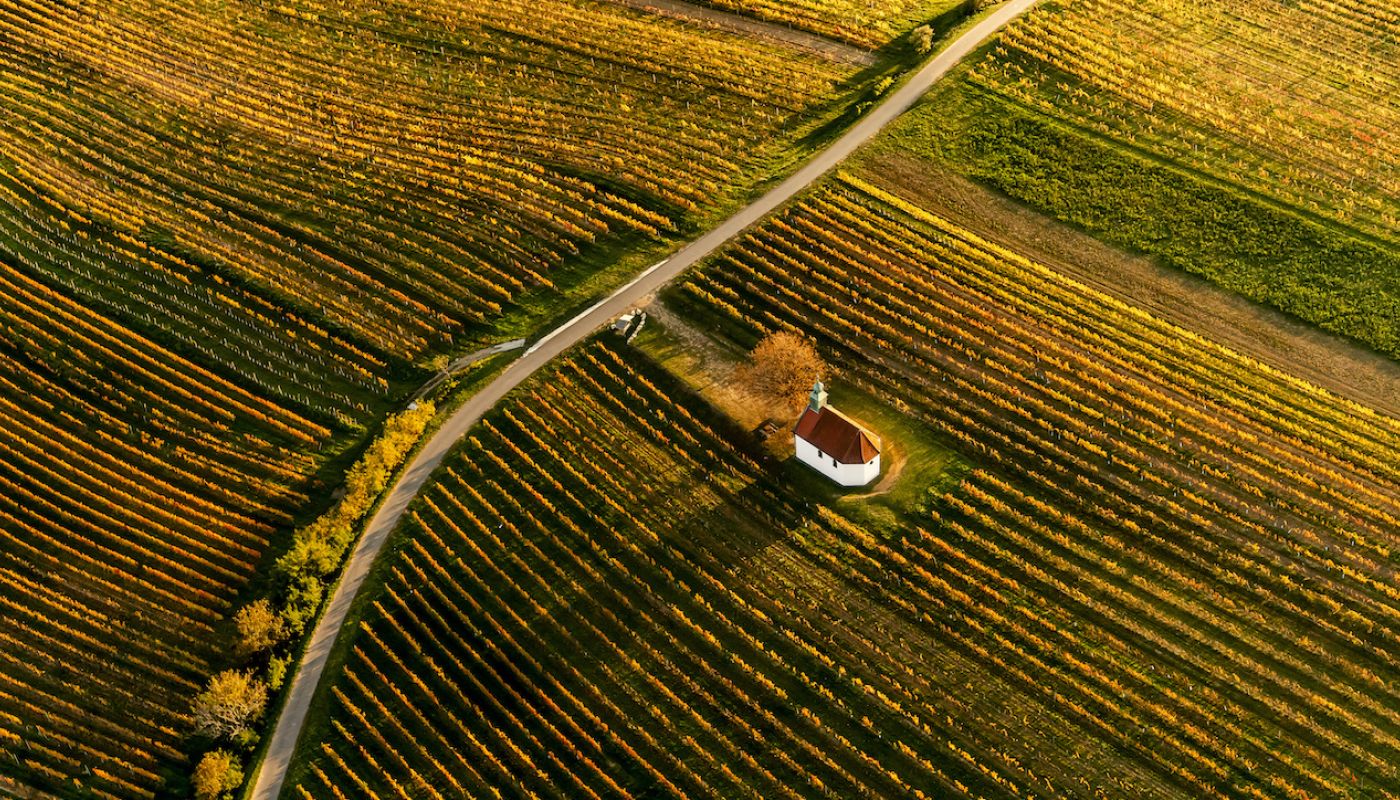
The variety is particularly at home in Burgenland, in the far east of the country (see this map), with the schist and limestone of Leithaberg and the ferrous soils of Eisenberg providing the raw material for intriguingly varied expressions. A bit of elevation helps mitigate Pannonian warmth from Hungary and it was on the best, higher sites of Mittelburgenland, between Leithaberg to the north and Eisenberg to the south, that Roland Velich arguably set the Blaufränkisch revolution in train in the early 2010s with his geographically distinct bottlings of it under the Moric label. Above is the church in the vineyards of Neckenmarkt, one of the Moric bottlings. The vine is late-ripening – no detriment in a country where the harvest seems to be earlier every year.
The other hot spot for Blaufränkisch is Carnuntum, where Gerhard Markowitsch was for long the big name but he has been joined by wine publicist Dorli Muhr, who gradually and cunningly added to her grandmother’s vine-holding on the slopes of Spitzerberg by advertising in the local doctor’s waiting room and the church magazine – most of Carnuntum’s choicest old vines having been tended by equally senior smallholders. She is convinced of Blaufränkisch wine’s ability to age and, if she could convince her accountant, would only now be selling her 2012s.
From the current 2019 vintage The Wine Society are offering ‘The Society’s Blaufränkisch’ which is identical to the Classic bottling produced by Hans Igler a kilometre from the Hungarian border in Mittelburgenland and based just a little bit east of the famous Hungarian wine town of Sopron, which styles itself the Capital of Kékfrankos. (Grape varieties do not respect political borders.) A tasting of four older vintages of this wine back to 2002 demonstrated just how well Blaufränkisch ages – yet the 2006, 2013 and 2017 were all sold by The Wine Society at under £13 a bottle. Similarly mature vintages from Leithaberg made on the celebrated biodynamic Birgit Braunstein estate were offered at under £20 a bottle.
But it’s by no means only Blaufränkisch that makes Austrian reds of interest, especially to those keen on value. Much more widely planted than Blaufränkisch, and the country’s most common red wine grape, is Zweigelt, a crossing made in the 1920s between Blaufränkisch and another Austrian red wine grape St Laurent. It certainly hasn’t garnered the respect of its best-known parent but I’m a fan. It can produce exuberantly fruity wines that are full of charm in their youth. And St Laurent itself can produce velvety, flattering wines that are a bit like Pinot Noir on steroids.
All in all, Austria is rich hunting ground for lovers of red wine – particularly those seeking reds that are not too alcoholic. Of the 23 Austrian reds I tasted recently, only one was as strong as 14% – and that 2006 tasted like a blast from the past – while seven had alcohol levels of 12% or 12.5%.
Heaven knows how they do it in Austria’s continental climate, especially in Burgenland where summer days can be quite steamy, but national pride in the freshness of their wines strikes this palate as justified.
Recommended Austrian reds
Stift Klosterneuburg St Laurent 2019 Wagram 13%
£8.50 The Wine Society
Familie Mantler Zweigelt 2019 Niederösterreich 13.5%
£8.50 The Wine Society
Heidi Schröck, Wine Champion Blaufränkisch 2020 Burgenland 13.5%
£9.95 The Wine Society
Hans Igler, The Society’s Blaufränkisch 2019 Burgenland 13%
£9.95 The Wine Society
Pittnauer, Pittnauski 2015 Burgenland 13%
£17 The Wine Society
Dorli Muhr, Samt & Seide Blaufränkisch 2017 Carnuntum 13%
£17.08 Justerini & Brooks
Moric Blaufränkisch 2018 Burgenland 12.5%
£21–£25 various UK independents
Bründlmayer, Langenlois Pinot Noir 2017 Kamptal 12.5%
£25 The Wine Society
Gernot und Heike Heinrich Blaufränkisch 2017 Burgenland 13%
£28 The Sourcing Table
Dorli Muhr, Spitzerberg Blaufränkisch 2017 Carnuntum 13%
£62.68 Justerini & Brooks
Tasting notes in Don't forget Austria! International stockists on Wine-Searcher.com.
As is usual in August, Andrew Jefford will be occupying my slot in Saturday's FT Weekend for the next four weeks.
Image © Austrian Wine/Robert Herbst.













