
13 March 2018 Bordeaux commentator Bill Blatch supplies his usual annual report on one of the most difficult years ever to generalise about. See also Blatch on Bordeaux 2017 – the wines and Blatch on Bordeaux 2017 – the stats.
Jack Frost strikes and for many it's all over by April, while others, including most of Bordeaux's top 250 wines, were spared and went on to produce an excellent vintage.
Winter 2016/17
The feature of this winter, unlike the subsequent one, was heat. As soon as the 2016 harvest was completed, the final two months of the year became progressively warmer and warmer under the influence of an unusually long high-pressure system. The average temperature in November, at 13.8 ºC (56.8 ºF), was slightly higher than normal, but then December clocked in at a full 2.2 ºC (4 ºF) above average. Christmas was spent on the veranda, yet nobody seemed concerned about the old adage Noël au balcon, Pâques au tison (Christmas on the balcony, Easter in the fire). This would come to have an ominous ring but for now the concern was not with regard to frost danger, rather that the absence of a cold snap prevented the vine from having a good rest (after the effort of providing a very prolific 2016 crop under drought stress) and there were no really low temperatures to prevent all the precursors of vine pests and diseases from proliferating.
Fortunately, in January there were two freezing periods, totalling 15 days of very welcome hard frost, and the month ended up the coldest January in 30 years. This was to be but a short respite, however. In early February, the warmth returned in force, with average temperatures 2.5 ºC above normal in February and +2.9 ºC in March.
Meanwhile, the all-important winter rainfall was almost totally absent in December and January but luckily, under the influence of some big Atlantic storm systems, rainfall returned to just about normal in February and March
By mid March, this warmth and late-winter rainfall made it abundantly clear that the year would get off to an extremely early start. In a mood of great optimism, there was much talk of a repeat of 1990 and of 2009, those two vintages that had so superbly benefited from starting so early.
Spring 2017 and budburst
The very high nighttime temperatures of early March could have precipitated a budding right there and then, but for some reason (maybe the ongoing effect of the sap having been driven down by such a cold January, maybe of the previous year's hydric stress) the vine wasn't ready and held back. It wasn't until the middle of March, when daytime temperatures soared to as high as +10.7 ºC (+19.3 ºF) above normal on 16 March that budding started with a vengeance. The ensuing four days of comparatively cool weather were not enough to calm it down, and when the warmth returned on 24 March budburst was universal and fast, the ‘cotton stage’ being immediately reached everywhere, pointe verte a few days later, and leaf-burst by the end of the month. This was crazily early. (This photo of budburst courtesy of the Australian Wine Research Institute/P May.)

Fear of frost now started to be the main subject of conversation among vine growers and the mood quickly changed from rejoicing at the early start and its attendant quality potential to the dangers of frost and consequent possible vintage catastrophe. We had got away with it in 1990 and 2009, and to a certain extent in 1997 and 2011, but could we hope to be spared the predations of spring frost for a fifth time? Some biodynamic growers thought not, and were talking about the impending combination of the moon being simultaneously new and closest to the earth on 27April.
Everyone's fears were briefly allayed by the slow-down of growth at petit chou stage during the first week of April, when the temperatures returned to normal, but as soon as the extraordinary June-type warmth returned a few days later, often up in the high 20s, the shoots literally galloped ahead and, by mid April, were out to 30 cm, with five or six fully formed leaves on each, even more in some areas. The arid ground from the almost non-existent April rainfall was not enough to stop them growing (as it was for the unfortunate, already-withering early-sown corn in the Landes). On 20 April there had even been a July-type 1,100-hectare (2,470-acre) forest fire in Cissac-Médoc and on 21 April the relative humidity had hit a 65-year record low of 10%. These were hitherto-unseen conditions for the month of April. It all spelt trouble.
The first wave of frost hit on the early morning of 20 April, the same night that the Champagne region was savaged at -9 °C (15.8 ºF), Chablis at -5 °C, the Languedoc at -4 °C and Muscadet at -3 °C. In the Bordeaux region, such a dry frost was much less damaging, more like a classic spring frost such as we experience most years, with the burning of some shoots situated in the low-lying areas. The Bordeaux and St-Émilion appellations are said to have lost just 10% at this time, far less than elsewhere in France. It had been just dry enough: frost can kill at -2.5 °C in dry conditions; at 0 °C in damp ones.
A week later, such damp conditions were exactly what hit Bordeaux. On 24 and 25 April, humid air and showers came up from Spain, covering Bordeaux in a swathe of moisture. Then, on the night of 26 April, just like on 21 April 1991, the wind suddenly dropped, and in the stillness of the early morning of 27 April, the temperature fell below zero, then in many areas progressively to -2 °C and on to -3, -4, even -6. In some places the early-morning sun wrought even more damage, burning the foliage through prisms of ice. The damage was immediate and, as if this were not enough, the following two nights of 28 and 29 April saw further sub-zero temperatures, finishing off any shoots that were still struggling to survive. The biodynamic guys had nailed it to the day!

When the sun came up, many vineyards were a horrific sight, the affected vines keeled over into a brown and ugly tortured shape, leaves and embryo bunches hanging down parched and withered. In the aftermath, it was clear that the most damage had been done in a line roughly drawn from the Blayais to Barsac. Gavin Quinney's photo above, taken in St-Émilion, shows how the frost took out shoots, leaves and tiny unformed bunches.
The Entre-Deux-Mers was down 50–100%, Lalande de Pomerol 50–80%, the plain, côtes and sands of St-Émilion 50%, lower Graves 50–80% and Barsac 60–100%. Some areas were spared: the eastern Médoc of river-facing St-Estèphe, Pauillac and St-Julien, but not the western and northern Médoc; the plateau of St-Émilion and Pomerol but not their peripheries; the heights of Sauternes but not Barsac nor the lower reaches of Preignac. The distribution of the frost is shown clearly in Gavin Quinney's map below, taken from his detailed damage-assessment report.
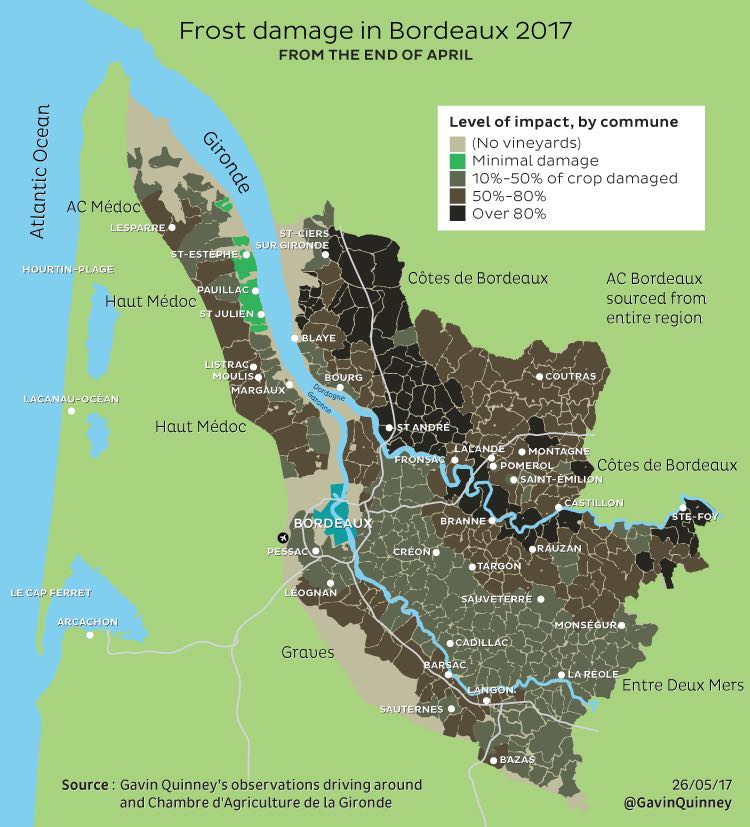
Thus the well-to-do red wine properties were the least affected; there is no justice in this world...
These figures are being constantly revised and refined (see later), but at the time, it was estimated that 60–70% of Bordeaux's vineyards had been affected and 40% potential production (the CIVB reported the equivalent of 30 million bottles) had been lost.
By any measure, this was a frost of epic proportions – apart from the totally different freezes of February 1956 and January 1985, which were winter rather than spring frosts. It was much more damaging than other spring frosts in living memory: 1945, 1977 and 1991. From this moment on, Bordeaux was going to be running three separate vintages at once: the totally frosted one, the partially frosted one and the unaffected one. Of these, the first continued to be almost total loss as many of the secondary buds had already sprouted before the frost and were destroyed with the rest. Such growers went from being players to mere spectators for the rest of the year. The second became the most difficult to manage, since these vineyards contained a mixture of unfrosted and regenerated shoots several weeks apart from each other. The third continued uniformly on a normal and regular ripening cycle as though nothing had happened.
Summer
As soon as the frost was over, the weather reverted to its previous warmth. At +4 °C (+7 ºF) above average, May became the hottest since 1950 with four spikes of heat over 30 °C (86 ºF). June was even hotter at +5.5 ºC, with a protracted two-week totally dry period mid-month in the high 20s or above 30 °C. Under such conditions, the flowering was swift and efficient, but of course spread over three or four weeks between the non-frosted bunches, which flowered early, and the frosted ones that had somehow regenerated from occasional secondary buds or from rebel shoots that had sprung up all over the vine stump. The harvest promised to be a gymnastic one.
Hopes began to rise a little for those who still had some bunches left. After all, the few bunches that survived the frost and rain of the flowering in 1961 had gone on to make a legendary wine. In such dry conditions, to enhance ripening and to avoid shut-down of the ripening process, all that was needed now was some invigorating rainfall, so sorely lacking in May and June apart from a few localised thunderstorms. As if to order, the last five days of June provided almost 100 mm (4 in) of sustained rain, enough to get the vineyard through July's heat (up to 37 °C/98.6 ºF on 18 July, not far off the previous record of 38.8 ºC during the Tall Ships' visit in 1990).
However, these short bursts of heat were exceptional and July became a generally cool to average month. The main point about July was the drought (a mere 28 mm), which, after such a dry early summer, put the vine once more into hydric-stress mode, just at the right time, starting the ripening and hardening of the skins (for the non-frosted vines) that would be perfectly completed at the end of August. The bunches of the non-frosted vines had started to change colour (veraison) from 20 July and preparations started to be made for an early and very plentiful harvest in mid September.
For the rest, it was a totally different story of a spun-out veraison well into August, of the prospect of tiny yields, of great irregularity and many bunches that frankly weren't looking good. Adding insult to injury, a hailstorm on 27 July over southern Graves wiped out most of what was left in that unlucky region.
August slowed things down a bit by alternating between cool periods in the low 20s and very hot ones well into the 30s. In addition, enough moisture was still in the ground from the end of June rains and didn't really need the topping up it received from the showers of August and the end of the month, just when drying conditions would have been more conducive to final ripening. August gave the impression of being an unseasonal month: until 21 August most days were unusually cool, in the low 20s by day and the low teens by night. It is very rare to have so many cool days in a row in August and it wasn't until 14 August that the southerly winds re-appeared. Exceptional heat returned from 21 to 29 August, making the average monthly figure look more normal than it had seemed and finishing off the ripening of the tannins. It was even feared at this time that the grapes would get just too high in sugar and too low in acidity by the time they reached phenolic ripeness.
September–October and the harvest
This final burst of heat accounted for the year's total lack of pyrazines in the grapes but a period without rain would have been more welcome at this point. Instead, it rained a little 27–30 August, setting the tone for the damp, drizzly, cool period that was to follow in the first half of September.
As usual, the early dry white Pessac-Léognans kicked off the harvest, being picked in the extreme heat of 28 August. A few pickings were reported as early as 23 August. Most carried on until around 12 September in much cooler conditions that ensured the health of the grapes and, in spite of the rain, these light-skinned grapes could be picked relatively leisurely, many in several tries (passes through the vineyard) in order to take account of the irregular ripening occasioned by the frost. The later areas of white Bordeaux production continued for a further week in, thankfully, even cooler conditions. It was wetter now but once again that didn't seem to matter. Everyone was pleased when the musts came in smelling vividly bright and varietal, with good acidities, plenty of backbone and with no excessive potential alcohol. In the end, this wet first half of September had been beneficial to the balance of these dry whites – and also, if everyone was honest, to their yields.
It was immediately time to start on the earliest of the unfrosted Merlots. For these, in spite of the rain and drizzle, the picking started relatively easily and swiftly, starting in some areas as early as 11 September and everywhere by 20 September. The rain had blown itself out on 16 September and ideal dry conditions set in from 18 September but rot was never very far away. It was at this time that occasional furry bunches could be observed, so harvesting dates began to be decided on the basis of the risk of rot more than for ideal ripeness. It would have been nice to see these Merlots hang just a little longer but the rain had softened them up and their absence of pyrazines, the sturdiness of their skins from the droughts and their satisfactory pHs meant that their quality had been maintained, even if they were of a less tannic and powerful kind than had been imagined at the end of August. Some Merlots never achieved a perfect balance before getting to phenolic ripeness and such vats were generally demoted. But the majority, if picked at precisely the right moment, were impressive.
Harvesting the frosted vines was a totally different matter, as each plot, each vine, each bunch presented grapes of widely divergent ripeness. It was a painstaking process for very meagre results and usually all the resulting wine had to be set aside for rosé or even totally discarded.
Meanwhile the Cabernets were ripening fast and were ready to pick from 22 September, unusually close to the Merlot harvest, at first under sunny skies but then the weather became warmer and damper. (Gavin Quinney's photo top right shows Cabernet Franc being harvested at Ch Petit Village in Pomerol on 26 September.) The skins started weakening and this second half of the harvest became something of a race against time. These Cabernets were originally planned to remain on the vine well into October, but with the return of the drizzle over the last two days of September and the first three days of October, some could wait, some couldn't; some did wait and some didn't. Many finished by 29 September while others continued until Friday 6 October after the skins had firmed up again. A few waited out the weekend, finished on the Monday ... and then wished they hadn't. But most of these tough-skinned Cabernets produced some very impressive dark, strong juice (provided of course that all the irregularly ripened grapes had been sorted out).
See also Bill Blatch’s report on the resulting wines and his compendium of statistics on weather and picking dates, to be published over the next two weeks.
















