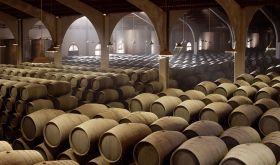

By blending raw wines together from barrel or tank, the world’s greatest bottles come into existence. There’s no recipe book, no vinous version of Hogwarts’ Moste Potente Potions. By sensorial wit alone, winemakers might assemble hundreds of different wines to create the finished product, with the hope of substantiating the adage that the whole is greater than the sum of its casks. Champagne cellarmasters are particular exemplars here, with Krug’s Grande Cuvée often put together from more than 120 different wines from ten or more different years.
Yet, on the other hand, unblended wine is held aloft as the most unadulterated expression of terroir there can possibly be. After all, if you blend too many colours together, as a winemaker once told me, you always end up with black. Perhaps, then, entirely unblended wines are the ultimate wine. Take for example the below barrel of Richebourg, which represents the entire production of the 2015 vintage of that hallowed Burgundy appellation at Albert Bichot’s Domaine du Clos Frantin. Surely this is the epitome of what makes wine special?

The two standpoints are of course totally incompatible. Let’s imagine that the solitary Richebourg barrel would be immeasurably improved by being blended with the three barrels of Chambertin they also made in that vintage. The resulting assemblage is unquestionably the better wine, let’s say. The problem is that you end up with 1,200 bottles labelled Bourgogne Rouge with an asking price apiece north of €400.
You know ... it’s so crazy, it might just work! Who’ll lend me half a million euros so I can prove it? Anyone?
Or what if it turned out that one of the key ingredients of an existing blend was discovered to be better off as a soloist? Like hearing The Long And Winding Road without Phil Spector’s bombastic orchestral overdubs, perhaps the beauty of the source can only show its true colours when it’s set free. Or perhaps this proves only that I’m as bad at mixing metaphors as I would be at blending burgundies.
Besides, the difference with wine is that once you remove a component, the original blend is necessarily diminished. If you were to remove a component of Krug Grande Cuvée, for example, and bottle it as a standalone wine, perhaps named after the single vineyard from which it was sourced, then isn’t it a logical inevitability that the quality of the former is compromised by the existence of the latter?

European appellation rules are notorious for monkeying about with blending regulations. For instance, it has recently been announced that basic AC Muscadet is soon expected to allow up to 20% of Colombard, Chardonnay and Sauvignon Gris to be blended with the region’s native Melon de Bourgogne. In Chianti, noble Sangiovese is already permitted to constitute only up to 70% of the blend. In both instances, the main purpose seems to be diluting the very qualities that make the key ingredient distinctive.
In fairness, perhaps these apparent subversions of quality are more reflective of the commercial realities of winemaking. The same logic allows American producers to use up to 25% of different varieties, vintages and regions to those stated on the label without disclosing them. In Europe, up to 15% is permitted. The defence states that this allows winemakers the ability to fine tune their blend without needing to complicate the label with undue detail. That may be so, but there is still something unsavoury about buying something labelled prime beef that might be 25% entrails.
So which is better then, blended or unblended? As always with wine, a straight answer is impossible. The single variety, single vineyard, single barrel concept is the very essence of terroir, yet the artful assemblage is fundamental in realising wine’s full potential. One seems to quench the thirst for minimal intervention wine that channels its origin without adulteration, while the other champions the arcane expertise of the winemaker.
Put simply, sometimes blending works, and sometimes it does not. What fails for the first lines of novels, for example, perhaps might succeed with their last. 'The only immortality had been the means of uniting them, as if by a magical thread.'
Or perhaps not. Either way, the decision is best left in the hands of the creator.