Purple pagers should see also my detailed notes on specific appellations and my detailed tasting notes and scores.
Perhaps the most exciting recent development in Bordeaux is that not only is the market and structure in full-scale meltdown, but a similar change is taking place in winemaking and wine styles. The trend detected in the 2001 vintage is even more in evidence with the 2002s. 'Even the vocabulary of winemaking is changing,' says John Kolasa, wine merchant and manager of Château Rauzan Ségla. 'You hear the word 'elegance' much more nowadays.'
While benefiting from greater knowledge and care of each parcel in the vineyard, and the widespread will to increase quality each year, wines are being made increasingly naturally, with less recourse to exaggerated interventions such as obviously toasted new oak, over-extraction and hot soaks. Even Michel Rolland, ubiquitous Pomerol-based wine consultant whose name has, rightly or wrongly, been used as shorthand for wines so ripe that they can lose their ability to refresh, is clearly producing more balanced, appetising wines. 'He's definitely calming down. He will listen to what we, the owners, want,' one of his clients told me.
Pomerol of course is the home of the Merlot grape and many of the most hyped red bordeaux of the late 1990s were Merlot-dominated. Towards the end of the decade, many proprietors on the opposite bank of the Gironde, in the traditionally Cabernet Sauvignon-dominated vineyards of the Médoc and Graves, were heard to say that they were planting more Merlot. But there has been a volte-face here too. The left-bank producers of note have fallen in love with their Cabernet Sauvignon once more – as well they might, to judge from the 2002 vintage in Bordeaux.
Until 10 September this looked like the vintage from hell for the Bordelais and, I have to confess, we all rather rubbed our hands and thought that, yes, they had it coming to them. The last less-than-lustrous red bordeaux vintage was 1997 and even for that they insisted on increasing their prices. Now, surely, it was their turn to produce a vintage so obviously disappointing that they would be forced to sell at ridiculously low prices.
Right from the start of the season in late March when a cold snap delayed the emergence of the later Cabernet buds, the time lag between Merlots and the Cabernets was particularly pronounced – which in the event turned out to be a good thing. The flowering of the vines took place in horribly mixed weather and spun out over a full month so that the fruit did not set at all on a high proportion of Merlot grapes, particularly old vines on the earlier-ripening, most favoured sites. And many other grapes suffered from poor or failed pollination. Already, the vines themselves were calling the tune in 2002, and the signs were that this would be the smallest crop for some years.
The most quality-conscious producers did their usual crop-thinning at the end of June just after flowering, but many of those already suffering reduced income from sluggish sales of the 2001s found it psychologically difficult to concentrate their remaining crop when they had just lost a significant proportion of Merlots. The constant refrain when discussing the 2002 vintage is that it sorted out the seriously conscientious farmers from the rest – and one can almost tell from the first, too often 'green', herbaceous whiff of a wine who took the trouble to cull the least satisfactory Cabernet fruit in early summer and thin the leaves of the remaining vines in August to encourage the ripening process.
The summer in southern France last summer was distinctly British – all cloud, showery and not especially warm. There were admittedly none of the heatwaves of recent hot summers that have tended to shut vines down completely. But by early September acid levels were still markedly high and showers in the second half of August threatened the health of particularly the thin-skinned Merlot grapes. It looked as though the Merlots would be ravaged by rot and the later-ripening Cabernet grapes simply would never reach maturity.
As British Bordeaux merchant Bill Blatch of Vintex points out in his admirably unbiased account of the vintage, last summer's reports of hail in Piedmont, floods in central Europe and an absence of weather warm enough for the Bordelais' traditional ocean outings for relaxation and reassuring gossip all served to deepen the gloom.
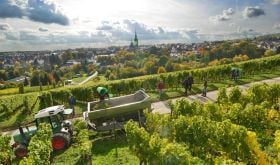
But, as in Germany in 2001, growers were saved by a fine, sunny autumn. After a wobbly first week in September, days were miraculously sunny and nights reasonably cool which meant that fungal diseases were held in check. Drying winds also helped keep rot at bay, but resulted in some shrivelled grapes, partly the result of very dry subsoils thanks to a particularly dry winter. But this late ripening period means that practically all the wines have a noticeable streak of acidity which, when the grapes were able to reach full ripeness, translates into graceful, refreshing wines. In those made from less ripe grapes, it has resulted in aggressively lean, green, mean liquids that will surely never really bring pleasure.
On the evening of 20 September there was also some localised hail in the far north of the Haut Médoc and some heavy rain in Pessac and on the right bank which undid some of the rapid progress of the previous 10 days. Such Merlot as remained on the vines was picked immediately. But the much slower-ripening, less disease-prone Cabernets could be kept on the vine until October, an unusually late start to the harvest which did not end until 17 October at Ch Latour. Cabernets, Sauvignon on the left bank and Franc on the right, are undoubtedly the stars of 2002.
With high levels of polyphenols (tannins, pigments etc) – as high as in 2000 in many cases – and high acidity too, conscientious winemakers were anxious not to overdo the astringency. Macerations therefore tended to be shorter, earlier and cooler than of late, without excessive pumping over in the fermentation vats.
The best wines have great structure, sufficient sumptuousness to counterbalance that streak of acidity, a real sense of terroir and the potential to age well – some of the purity of the best wines of the 1986 and 1996 vintages with perhaps a little more spice. The worst wines, and there were many, recall the olden days of wines which have tartness and rather unripe tannins but not enough fruit in the middle to distract from these disadvantages.
Everything about the wines has been late. The malolactic fermentations took place later than usual (initial malic acid levels were high) and there were very real fears that the wines would be too backward, introverted and difficult to taste in early April when they are nowadays presented to the world's wine commentators and merchants prior to being released en primeur as futures.
In the event there were very clear differences between producers and appellations (just as rainfall was particularly varied between Bordeaux's wine villages with August tallies varying between 30 and 140mm on the right bank alone) but most of the wines even at this early stage seemed able to communicate them.
The wines on the right bank from St Emilion, Pomerol and the like were generally much less impressive – or perhaps simply less expressive so far? – than those from the Médoc on the left bank. Their most common fault – and a common shortcoming in many of the lesser Graves and Pessac-Léognan wines too, which were relatively pale – is an unattractive greenness with a hollowness of flavour. On the other hand, fewer and fewer producers on the right bank seem to be making pastiche wines, a style that was anyway extremely difficult to achieve in this underripe, non-Merlot year. This may be not unrelated to the apparent lack of demand for the so-called 'garage wines', small batches of highly priced essences of Merlot. To make good wine in 2002 you needed a seriously good vineyard.
This was a particularly good year for the late-ripening, spicy Petit Verdot which at Ch Kirwan managed to reach a natural alcohol of 15 per cent. Even in the Médoc however there was no shortage of evidence of unripeness and attempts to disguise it. Although over the last few months in barrel all wines have tended to put on flesh, much to the relief of the château owners, some are still desperately skinny.
There is a pretty wide gap between the best and the worst of the Médocs, but few generalisations can be made about location and quality. Some of the most surprising wines came from addresses which are not usually associated with winemaking triumph: Chx Rauzan-Gassies of Margaux, La Tour Carnet of Haut-Médoc, Clarke of Listrac for example, all performed unusually well in 2002.
The first growths certainly merited their status and all the care lavished on them, with Mouton and Latour showing particularly strongly.
After tasting a generally lacklustre line-up of red wines from Graves and Pessac-Léognan, it was a surprise and a treat to taste such delicious dry white wines from these neighbouring appellations. The Sauvignons are wonderfully pure and aromatic yet have enormous richness. (Pavillon Blanc de Château Margaux managed a natural but deliciously disguised alcohol of 14.8 per cent.) Some wines show a certain underripe Sémillon greenness but all in all this was a much more exciting crop of dry white wines than is usual in Bordeaux.
And as for the often-overlooked sweet wines, 2002 is not as miraculous and rich as 2001 but there are some very successful wines indeed from those who took the trouble to select the most botrytised berries from the first and last picking periods and knew how to manage the shrivelled ones. As usual, taking into account the painstaking care that goes into making these elixirs, these are the real bargains of Bordeaux.
My top ten reds
- Ch Latour
- Ch Margaux
- Ch Mouton
- Ch Haut Brion
- Ch Lafite
- Ch Léoville Barton
- Ch Palmer
- Ch Cos d'Estournel
- Ch Rauzan Ségla
- Ch Pichon Lalande
Some likely bargains
- Ch Duhart Milon
- Ch La Tour Carnet
- Ch Kirwan
- Ch Malescot St Exupéry
- Pavillon Rouge de Ch Margaux
- Ch d'Armailhac
- Ch Haut Batailley
- Ch Lafon Rochet
- Ch Les Ormes de Pez
- Pagodes de Cos
- La Fleur de Boüard
- Ch Joanin Bécot