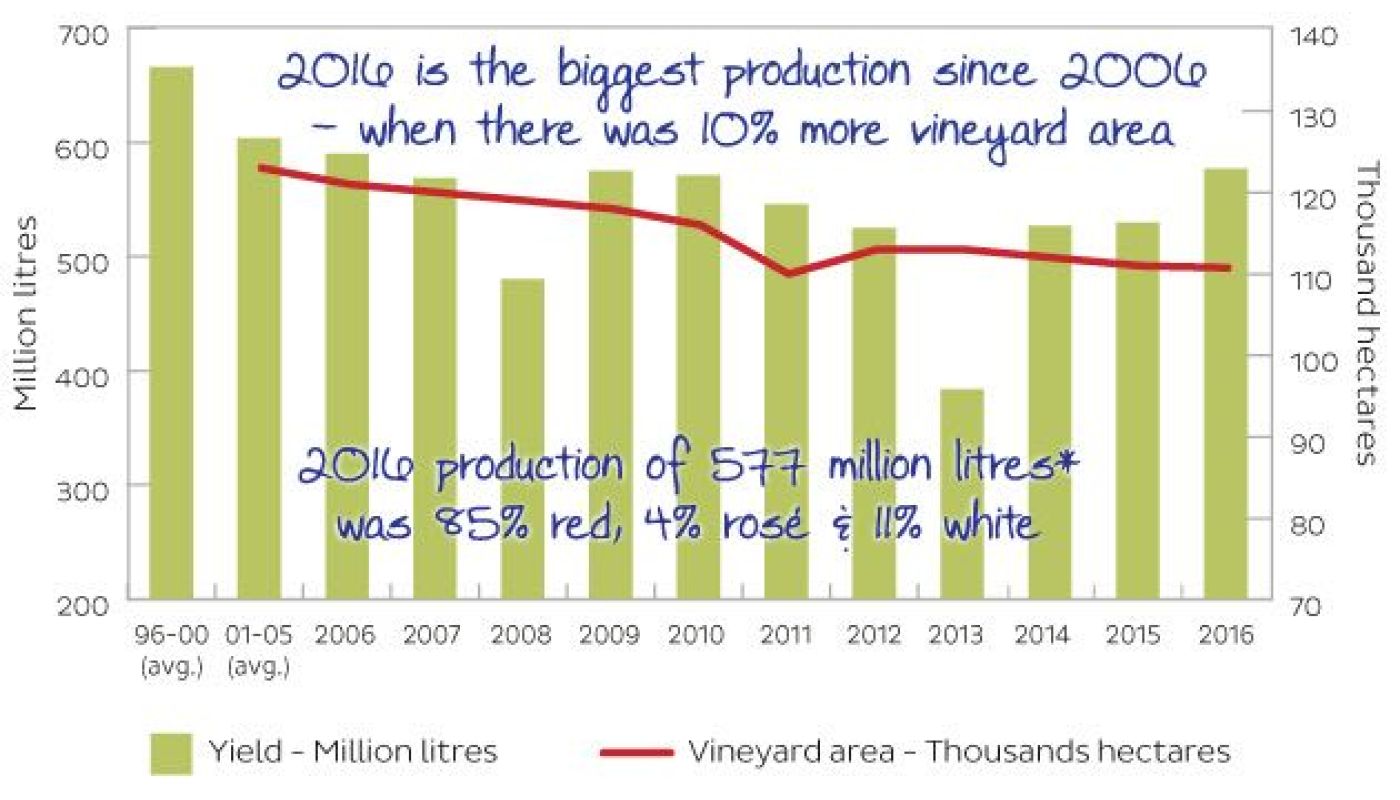
2016 was the biggest Bordeaux harvest in over a decade, according to official figures. The production of 577.2 million litres – the equivalent of a staggering 770 million bottles – was the largest since 2006, when there was 10% more vineyard area. Strong harvest figures for Bordeaux are, of course, in stark contrast to many less fortunate regions across France in 2016. (See, for example, Beaujolais 2016 – reduced but in recovery, Time to buy Chablis 2014 and 2015 and Jancis's article yesterday, Can you afford to ignore the Loire?)

At an average of 52 hectolitres per hectare (hl/ha), 2016 saw the highest yield per hectare since the largest crop of the century to date in 2004, which came in at 54 hl/ha. ‘The yield on the Merlot’, I wrote last October in Bordeaux 2016 – quality and quantity, ‘is the biggest I’ve seen since 2004 and the quality is far superior to that attractive but uneven vintage. As Bordeaux is 89% red and Merlot accounts for two thirds of that 89%, it’ll be a big crop out in the sticks.’
It’s the third good Bordeaux vintage in a row, following on from the minor disaster that was 2013 (34 hl/ha), and with the en primeur tastings due to take place in late March and early April, the trade and the press will soon be able to judge if 2016 lives up to its billing of quality as well as quantity. Red wine accounted for 85% of production in 2016, plus 4% rosé, 10% dry white and 1% sweet white.
As ever, and not unreasonably, the focus for the primeurs will be on the top 300-400 wines from the leading appellations. I've put together the yields for seven of these appellations since 2006, and 2016 saw the highest yields in several years for five of them (see below). I've highlighted years showing the significant yields. It should be noted that the majority of the top estates green harvested their crop from early summer onwards, reducing the potential yield in order to improve quality. Or, in some cases, to stay within the permitted maximum quota, which, for reds in 2016, was from 50 hl/ha (eg St-Émilion Grand Cru) up to 58 hl/ha (eg Graves), depending on the appellation.
The Cabernet Sauvignon was less plentiful than the Merlot – often the result of less even flowering in June and smaller bunches – and this is reflected in more modest yields at some leading châteaux. Younger vines on more porous soils suffered during the summer drought, when a tenth of the normal rainfall fell from 23 June to 13 September in some areas, and this also reduced the crop size.

As you can see, the appellations above, in their entirety, make up just 10% of the total area of the Bordeaux vineyard. The bigger picture in terms of production for 2016 looks more like that shown in the table below. As there are 60 appellations for Bordeaux, I've collated the figures into logical, digestible chunks.

Generic red Bordeaux makes up 35% of production, with over 200 million litres and yields of 56.6 hl/ha across 35,700 ha. It may not sound much, but this was a significant increase on the 51.1 hl/ha and 51.7 hl/ha in 2015 and 2014 respectively. Bordeaux Supérieur notched up almost 60 million litres, with yields of 50.4 hl/ha across 11,850 ha.
Most, but not all, Bordeaux rouge and Bordeaux Supérieur comes from the Entre-Deux-Mers and the loosely defined ’right bank’. If you know a little of the geography of the region, you'll see that the red and red-toned segments are those of the right bank and the Entre-Deux-Mers, and they’re responsible for two-thirds of the whole output. Merlot, which is widely planted here, saw some spectacular yields in 2016. The Cabernets rather less so.
Meanwhile, the bluer sections of the left bank account for markedly less wine. The entire Médoc and Haut-Médoc – including Margaux, St-Julien, Pauillac and St-Estèphe – and the Graves and Pessac-Léognan combined produced 100 million litres of red. That's a lot of wine but it represented little more than one-fifth of the output of Bordeaux red in 2016. Again, by volume, most of the generic dry white comes from the Entre-Deux-Mers.
Here are the yields for the major groups of appellations.

In every case for red wines and dry whites, the combined averages for each appellation group show higher yields in 2016 than for any other vintage. It was also a good year for sweet white wines in terms of yield.
Vins de France, Vins de Pays
Non appellation contrôlée wines are very much in the minority in the Gironde but it's interesting to note that the combined production of Vins de France and Vins de Pays (de l'Atlantique) doubled from 16 and 15.5 million litres in 2014 and 2015 respectively to 31.5 million litres in 2016. 90% of this was Vins de France.