Another harvest safely landed and, like the timing of the crop, my weather report on the Bordeaux vintage arrives a fortnight earlier than usual.
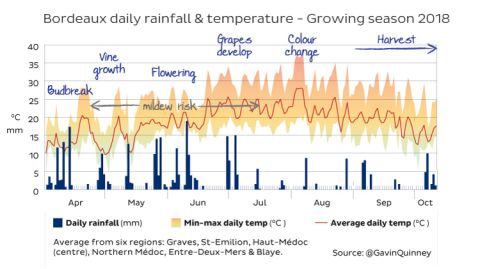
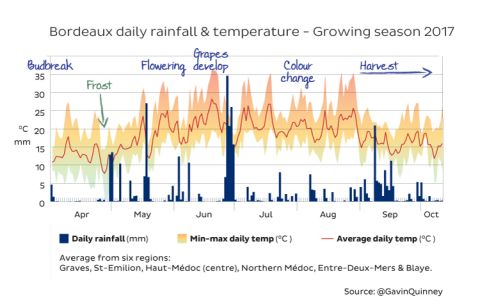
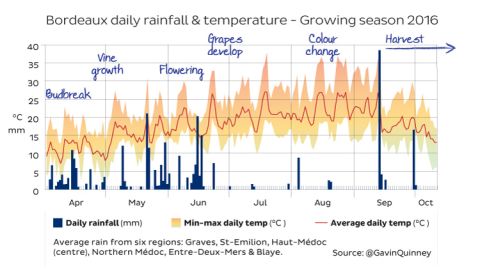
2020 has ended up being a really good but variable year with wines of outstanding potential for many Bordeaux estates. The growing season follows a similar pattern to 2016, 2018 and 2019, in that we had a wet spring followed by a dry, hot summer, topped off by a warm, dry harvest. Unlike 2016 and 2019, it was an early vintage – not unlike 2018 in terms of timing. I’ll highlight the differences with recent years via my ever-expanding series of unique tables and graphs.
Ten things about 2020
Timing
2020 was an early harvest but there was some pretty fortuitous timing. The early budbreak led to an early flowering in May, which was really lucky – as we shall see, and the vast majority of red-wine grapes ended up being picked in September, just before heavy rain in October.
Temperature
From December to May, five of the six months saw average temperatures at around 2 °C/3.6 °F above the 30-year average. Later, a long hot patch in the summer and again during the September harvest left a significant stamp on the vintage.
Thirst
From 18 June to 11 August, 54 days of drought, then 20 more days with no rain at all after the last weekend of August. This left many vines parched, given the serious heat at the end of those stretches.
Thunderstorms
My stats show a lot of rain. But this was more about thunderstorms in May, June and August than boring old downpours. These double-edged storms, more often than not at night, ended up being welcome at most vineyards, though unlucky for those which were hit by hail.
Territory
With thunderstorms, the rain could be heavy in one village and almost non-existent in the commune next door. There was also a noticeable difference in the amount of mid-August rain on the left bank compared with the right bank.
Treatments
Rather like 2018, the threat of downy mildew early on was considerable. How growers treated their vines during the spring was crucial – and challenging when the ground was sodden. Some vineyards lost a fair amount of volume through mildew.
Terroir
The make-up of a vineyard is always important but rarely more so than in 2020. The soils, subsoils and slopes had to ward off late March frosts, withstand copious amounts of rain in the spring, and provide just enough sustenance during the periods of drought and heat in the summer and mid September.
Testing
The vines give no concessions and it was a challenge to manage people and tasks from the start of the growing season, just as COVID-19 lockdown came into play, all the way through to the harvest. The work in the winery continues, of course.
Trainers
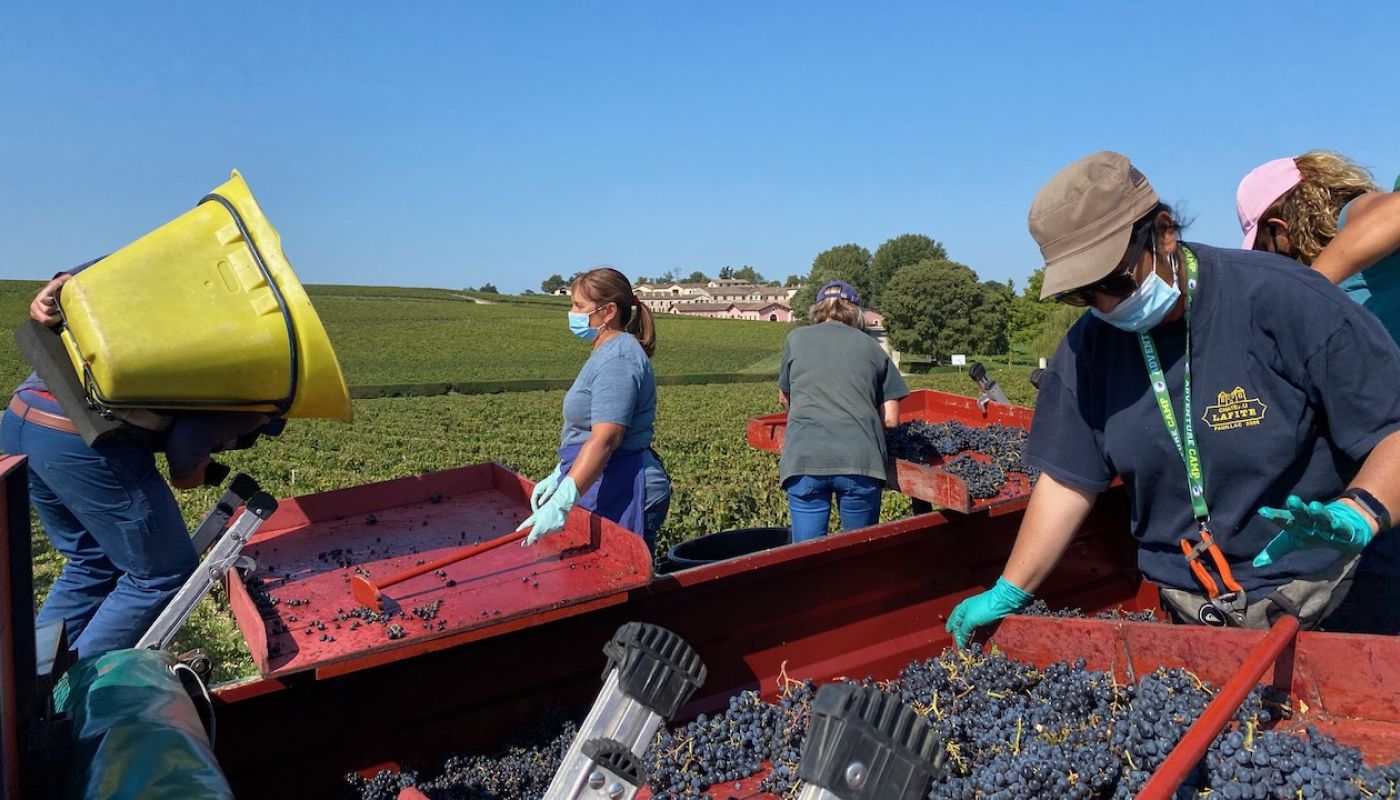
I can’t recall ever before seeing pickers wear trainers for a full month during harvest, from the crémants and dry whites in the second half of August through to the rainy weekend of 20 September. This one was early, prolonged, warm and dry.
Triumph
We treat this imposter just the same but there’ll be some terrific wines from 2020. Yields for many estates are lower, with less juice due to heat and drought, but the quality is high – albeit variable.
Production
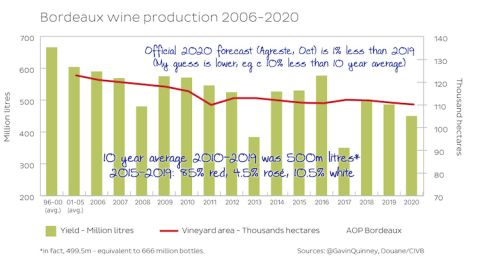
To put some numbers on this, Bordeaux makes the equivalent of 666 million bottles of wine a year – that’s the average per annum from 2010 to 2019. Official estimates on 1 October from Agreste, the French Ministry of Agriculture, put Bordeaux production at 1% lower than 2019. My guess is that there will be less wine than that, as yields will be lower. Of course the famous châteaux, whose wines sell en primeur, make up a small fraction of these figures.
The harvest
The harvest began in mid August for the crémants and the dry whites and continued into the early part of September in fine weather. The cool nights and clear days were ideal for the final ripening of the reds in the first half of the month, and there wasn't a drop of rain from 30 August to 18 September. The Merlots were coming in earlier in the precocious vineyards (such as those in Pomerol) but the red harvest, beginning as ever with Merlot, mainly kicked off from the week beginning 14 September, and was all but over within two and a half weeks. The Cabernet Sauvignon was mostly harvested from 21 September onwards.
The middle week of September was marked by hot days in the low to mid 30s (90s Fahrenheit), which concentrated the fruit and potentially reduced the amount of juice, and the weather turned somewhat from 20 September, with rain at the end of that week. There was, however, a final harvest window of three clear days from Monday 28 September. I've seen absolutely no rot on any of the reds, incidentally. A few Cabernets were left until early October – most notably some later-ripening Cabernet Franc in St-Émilion. October has been wet.
The 2020 growing season
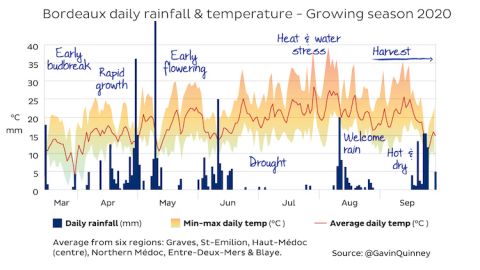
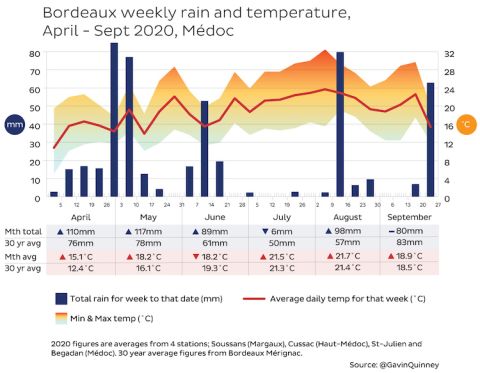
I usually line this chart up from April to October, but we had budbreak in mid March and most of the red-wine grapes were picked by the end of September. (Most, but not all.) And with a month’s worth of rain in the first week of October the picture might have become, well, distorted.
The all-important flowering took place early, and mostly in the second half of May, sandwiched in between rainy periods. This was incredibly lucky, as most estates enjoyed good flowering and fruit set. The storms on 9/10 May, by the way, broke the chart with an average of 70 mm/2.8 in in 24 hours. Some areas were also hit by hail.
Rainfall
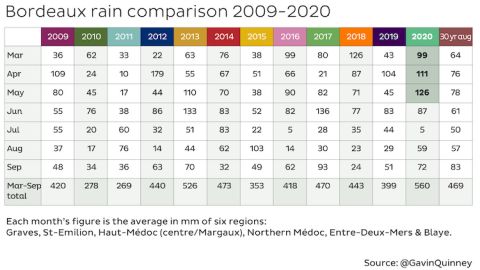
2020 saw a wet spring and dry summer. Like the rain in May, most of the August rain fell over just a few nights. It was a year of contrasts, with more rain overall from March to September, inclusive, than in any other year in the last decade or so. And yet it was also a year of drought.
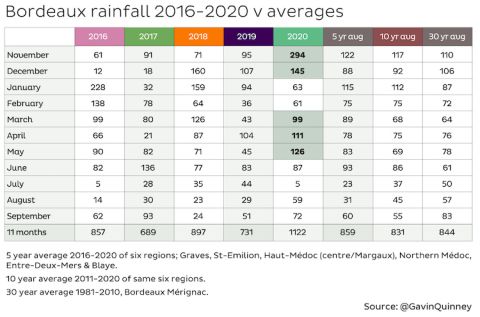
All these graphs have been produced using the daily data from six weather stations, to give a wider perspective than the figures from a single location. As you can see, the winter of 2019/2020 saw a lot of rain in November and December, and again in the spring. What seems to be changing is just how dry the summers are becoming – compare the five-year average for these regions with the 30-year average. In contrast, June has been wetter of late – again, often down to occasional storms.
Temperatures
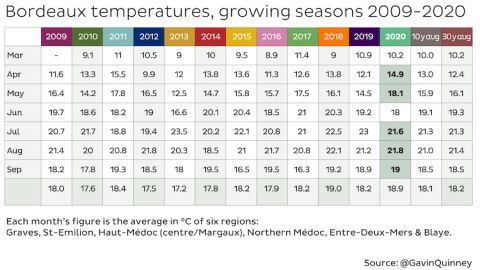
I thought it time to put together a table charting the average daily temperature each month, and to compare it with previous vintages. It took me some time.
I was quite surprised to see that the 10-year average temperatures for these six regions each month over the last decade were broadly in line (April apart) with the 30-year averages for Bordeaux Mérignac from 1981 to 2010. Given how warm it's been in the last three years, I had a closer look at the last five years as a whole.
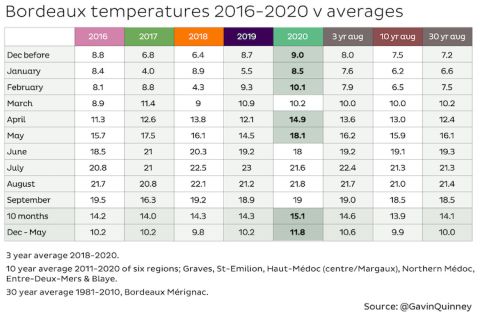
The winter and spring of 2019/2020 was mild, and that’s to put it mildly. As you can see, average temperatures from December to May were considerably higher than the norm, with the exception of March. The first half of June was quite a lot cooler than usual, then late June, July, August and September ranged from warm to hot. The 10 months from December to September in 2020 saw a higher average temperature than previous years on the table, and an average of 1 °C/1.8 °F higher than the 30-year average from 1981 to 2010.
I've also included a three-year average in this table for comparison with the 10- and 30-year ranges. While March, May and June have been broadly level-pegging with those, the three winter months plus April, July, August and September have all been warmer, on average.
Temperatures and stages of the vine
Here’s a new table showing the accumulation of heat and the progress of the vines during the growing season in each vintage.

By adding up the daily average temperatures since 1 January, but removing any average temperatures below 10 °C (50 °F) each day, the grid shows how recent vintages compare at different stages of the growing season. The temperatures are taken from Pompignac, 10 km (7 miles) east of Bordeaux, and from the famous appellation of St-Julien in the Médoc.
The thinking behind this is that when 400 °C is reached, it’s an indication of mid flowering (mi-floraison), 800 °C is a guide to the end of the formation of the bunches (fermeture de la grappe) and also the start of véraison or changing of grape colour, and 1,500 °C is an indication of maturity – and the harvest. In theory.
It’s useful in hindsight to understand the stages of development in past vintages, and in advance so you can see how things might pan out. When you consider 2009, 2010, 2016 and 2019, arguably the best vintages in this series, it’s rare for an ‘earlier’ vintage to be included. Perhaps 2018 and 2020 can break the mould?
How 2020 varied across Bordeaux
A map is called for here because in 2020 there was quite a difference between regions.
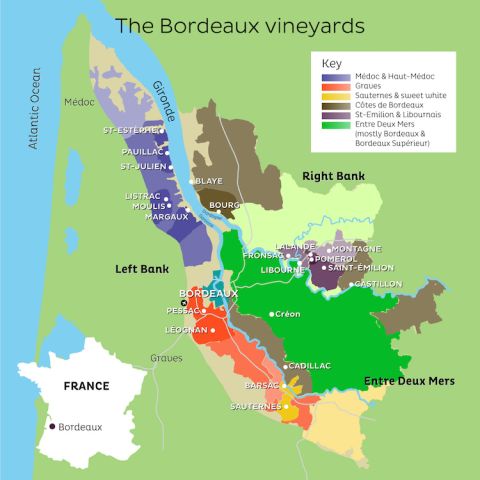

This shows how each month compared with the 30-year average. Once again, great for the flowering in late May, then hot and dry in July and early August. The average rain in August – which was seriously needed – was similar to the Bordeaux average for the month at 59 mm/2.3 in.
The cool nights at the end of August and in early September were great for both harvesting the dry whites and the maturation of the reds. The heatwave in the middle of September reduced the amount of juice.
On the left bank, in the Médoc, there was around 100 mm/4 in of rain in mid August, depending on the commune. Most of it fell during storms from 11 to 16 August. The Merlot grapes were often noticeably plumper here in September than on the right bank.

The right bank saw much less rain in August – about a third of the amount which fell on the Haut-Médoc. In the three months from 19 June to 18 September, both St-Émilion and Pomerol had 45 mm/1.8 in in total – less than a third of the 30-year Bordeaux average. July, August and September were hotter than the norm.
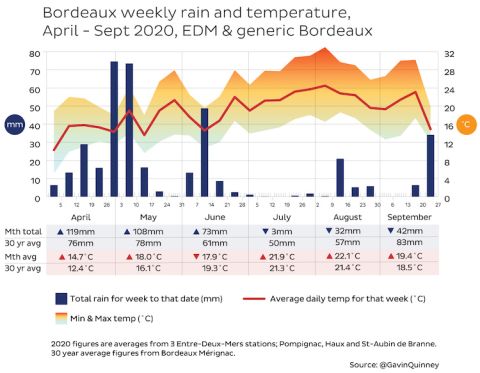
It was a similar story in the Entre-Deux-Mers (see above), where much of Bordeaux’s red wine comes from as plain AOP Bordeaux or Bordeaux Supérieur.
We are in Créon, shown on the map above. It’s extraordinary that in the 20 weeks from early May to late September, the average daily maximum temperature was 26.7 °C/80.1 °F, in the 13 weeks from 20 June to 20 September it was 28.8 °C/83.8 °F, and in the nine weeks from 20 July onwards the average maximum daily temperature was 29.6 °C/85.3 °F. It was even slightly hotter in St-Émilion.
Appendix – growing seasons for 2020 back to 2016