
9 June 2020 Caroline Gilby MW brings us up to date on the transformation of the Bulgarian wine scene.
I always look forward to a trip to Bulgaria. It’s beautiful, dramatic and intriguing though sometimes scruffy and shabby round the edges, but always welcoming. Bulgarians proudly tell a tale of their country’s origins. The story goes that God forgot them and all he could do was empty out the last of his sack of goodies, giving Bulgaria a bit of everything – mountains, forest, lakes and rivers and, in spring, wildflowers that can be breathtaking. There are also stunning monasteries and Thracian treasures, including some of the richest ancient gold ever found.
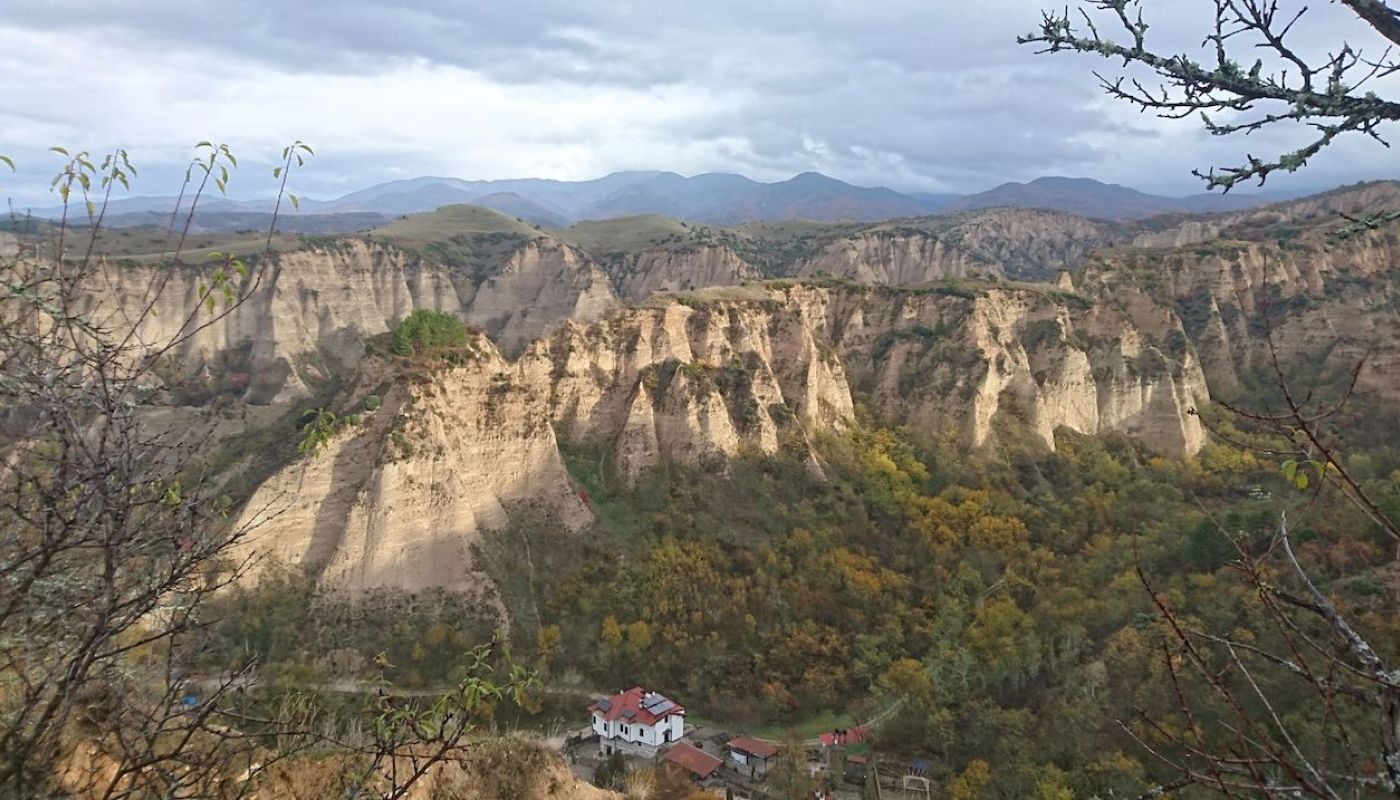
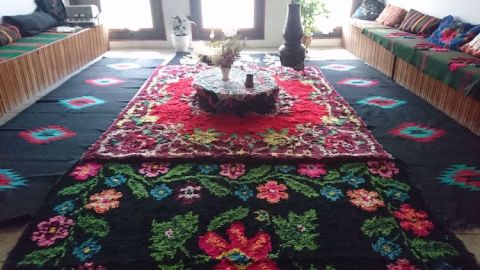
My picture above is of the dramatic sand pyramids of Melnik. Below is traditional Bulgarian decor inside the National Revival Kordopulov House in Melnik, a wine merchant's house built in 1754.
What takes me back time after time is Bulgaria’s wines, and today the wine scene is an incredibly dynamic place (at least it was until coronavirus did its worst). Few people outside its borders have any idea of how different this modern era of Bulgarian wine is – indeed it is actually quite hard to track down straight Bulgarian Cabernet Sauvignon unless you’re looking at bottom-shelf supermarket wines.
That is why I, and some passionate Bulgarian friends, set up the Modern Wines of Bulgaria tasting in London in 2018 and 2019 (and we hope to again in 2021) to bring some of those new-generation producers to the attention of the UK trade. I kind of grew up in wine alongside Bulgaria. I’ve been following the wine industry there for close to 30 years. Every time I visit there are new producers popping up and more wines to taste. Not everything is rosy by any means, but the best are well worth seeking out.
Even if reliable statistics can be hard to come by, it’s still worth looking at a few numbers to give context. The Ministry of Agriculture’s 2019 Agrarian Report gives a total vineyard area of 64,400 ha (159,135 acres) in 2018 (a decrease from 101,434 ha in 2009). More importantly, the area of vineyards actually harvested for wine production has fallen to just 29,382 ha (72,605 acres). This is split between 18,055 ha of red wine varieties and 11,327 ha of white wine varieties, though the harvest is close to 50:50 due to the higher yields of white wine vines.
In 2018, the official harvest of wine grapes from the vineyards was 182,569 tonnes, of which wineries processed 151,938 tonnes (giving 1.04 million hl/27.5 million gal) and the rest going to home-made wines. Forecasts for 2019 suggest that wine production was down to 908,000 hl from 126,800 tonnes, so a further decrease. At the same time, the number of registered producers has increased from 268 in 2018 to 282 in 2019. The only public data on varieties grown dates back to 2013, based on more than 60,000 ha of vineyards, and while it shows Merlot followed by Cabernet Sauvignon as most planted, this isn’t much use today as nearly half that area has fallen out of production.
Another area of concern for Bulgaria is its wine laws. Since it aligned with the EU in 2005, it has had two PGIs that split the country into the northern region of the Danubian Plain, and in the south, the Thracian Lowlands (shown on this World Atlas of Wine map). These account for nearly 40% of Bulgaria’s wine production. Almost everyone believes that they don’t reflect the climatic or soil differences on the ground. For instance, it’s not hard to see distinct differences between the hot, dry Struma Valley in the south-west and the Black Sea-influenced east coast, though both are officially Thracian Lowlands (sometimes written Thracian Valley).
The previous era of wine legislation divided the country into four regions with one significant subregion (the Valley of the Roses), based on real science according to sources who worked on it then. And it seems the current authorities agree, with tentative identification of five regions (rather similar to the historic regions) in the national wine strategy plan up to 2025. PDOs are even more useless – 52 are listed – but they account for less than 1% of production. Wine producers have explained that the rules are too strict, specifying things like row spacing, making them almost impossible to use in practice. There are also complaints that Bulgaria’s bureaucracy hampers the establishment of new PDOs, something that producer groups in South Sakar and Struma Valley would like to do.
Back when Bulgaria actually joined the EU in 2007, the country had ambitions of increasing plantings towards 130,000 ha, but as it turns out, the industry has gone in a different direction. To a large extent what’s happened is that small and fragmented land holdings in the hands of part-time farmers producing poor grapes have gone and what’s left is a much more quality-focused, but more niche, industry. Most wineries, especially the new ones, aspire to make seriously good wine and thus own their own vineyards or have long-term supply contracts in place.
The rise of numerous small, independent wineries has also been hugely significant – bringing dynamism, personal vision and variety to the industry. There’s much more detail on the politics of all this, as well as the personal stories of many wineries, in my book The Wines of Bulgaria, Romania and Moldova. The Ka&Ta Bulgarian wine catalogue, which is updated every year (and in English), is also a useful guide as to who is producing what.
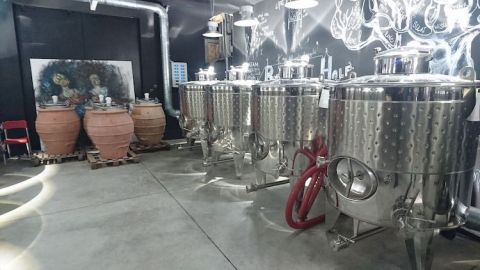
The last five years or so have seen a sea-change in attitude and mindset that has resulted in many diverse and interesting wines. One positive aspect to those huge PGI zones is that producers have lots of freedom to experiment with new varieties, to rescue old varieties and try out unusual blends, along with pet-nat, orange wines, concrete eggs and amphorae such as those below at Better Half winery. Cabernet Sauvignon (the grape that built Bulgaria’s past reputation) on its own has fallen out of favour among the top reds – many of which are now blends.
Bulgaria’s developing home market has been a huge support – now Bulgaria drinks more of its own wine than it exports. Domestic wine sales have increased 14.2% by volume and 19.9% by value in the last five years, suggesting consumers are drinking better. It’s notable that wine events in Sofia are full of glamorous younger faces – on both sides of the table (a similar event in the UK would be dominated by grey hair), showing real enthusiasm for learning more about wine that is a world away from the homemade stuff of their grandparents. One of the most instructive, if not exactly fun tastings, I ever did was with my much-missed winemaker friend Ogy Tzvetanov (co-founder of Borovitza). He insisted that I taste a selection of homemade wines bought from the roadside so I would understand what village people believed to be authentic wine. I tasted every fault in the winemaking book that day, but the point was well made about the gulf between these and what most of us would regard as sound wine.
It’s not that long ago that the first generation of premium Bulgarian wine appeared (Jancis will remember a tasting we both attended in 2003 at which the first signs of a new era were evident). Many of these early wines were all about power and concentration, with lots of oak, because winemakers needed to show a point of difference to the old stuff. I was lucky enough to re-taste the wine that won that competition and upset the established names (Santa Sarah, Privat Cabernet Sauvignon 2001) late last year thanks to Emil Koralov and it was still very impressively alive.
From then, wine quality has moved on a long way and winemakers are now better at understanding drinkability. They can rein back on extraction and oak with confidence that their fruit is now good enough to stand up for itself. And, unlike neighbouring Romania, most of the winemaking talent is home-grown, though there's a handful of notable foreign investments such as Miroglio, Bessa Valley, Midalidare and Eolis. The first wave of new plantings in the 2000s are old enough to benefit from deep root systems and give better balanced wines, too. I can’t help thinking that Bulgaria’s women have a lot to do with this new wave of wines. There is quite a group of impressive women winemakers and women owners who help shape their winery visions.
Bulgaria's grapes
One question I am often asked is about which grape has the best potential to be a flagship local variety for the country. This is a subject that causes much heated debate, first of all around whether a single flagship is actually required, and, if so, which variety it should be. Among the reds, the leading candidates are Mavrud, Rubin and Melnik 55, with some arguing for Gamza (though as Kadarka/Cadarca it’s strictly a Balkan grape rather than Bulgarian).
Mavrud is the most widely planted and the oldest. Not much is known about its origins or parentage – though there’s a tale that it is named for a young man who saved a city from a lion. He owed his courage to drinking the produce of a vine his mother had secretly saved in the face of Khan Krum’s edicts to uproot vines in the ninth century. Mavrud is a vine that is easy to over crop, with tannins that can be rustic, though better producers are making increasingly appealing and classy wines.
Rubin is a cross of Nebbiolo and Syrah created in 1944. It produces really deep-coloured wines with potentially high levels of sugar but can easily lose acidity if picked a day or two too late. Konstantin Stoev of Dragomir is a believer in Rubin. ‘You have to work much harder with Mavrud to get the same quality as Rubin', he maintained. Alberto la Rosa at Miroglio disagrees. ‘I’m a Mavrud guy. Rubin can’t give age-able wine due to the proportions of norisoprenoids [see flavour compounds] and anthocyanins', he explained.
Shiroka Melnishka Loza (broad-leaved Melnik) is another ancient Bulgarian variety, but it’s hard to ripen, even in the sunny Struma Valley. Philip Harmandjiev of Damianitza complained to me once, ‘I lost seven years of my life struggling with Shiroka.’ Its most enjoyable expressions are currently as sparkling wines (such as Logodaj’s Satin), in rosé or adding a local character to blends. Its offspring, Early Melnik or Melnik 55 (a cross with Valdiguié approved in 1977 and also known as Ranna Melnishka) ripens a couple of weeks earlier and has more generous fruit and softer tannins. It was first vinified by Stoycho Stoev (now winemaker at Medi Valley), who is still a strong supporter of it, though it can be a flagship red only for the Struma Valley, where it can admittedly be excellent. Anyone who has tried growing it elsewhere, including Kapka Georgieva (chief oenologist) at Korten Wines and La Rosa at Miroglio, think it’s only good for rosé.
As for white wine grapes, the country’s native varieties can make appealing wines for drinking young but really that’s as far as they go, at least so far. It is also a marketing nightmare explaining the differences between all the various grapes named Misket (Cherven, Sandanski, Vrachanski, Varnenski, Kailashki to name but a few). Mostly they produce grapey pleasant wines without any ageing potential. The most widespread local grape is Dimiat/Dimyat, which probably arose in the Middle Ages as it’s been identified as the likely offspring of Coarna Alba and Heunisch Weiss (aka Gouais Blanc), and almost certainly didn’t come from Egypt as is often claimed. High yielding, it tends to produce neutral wines with plenty of acidity, though there have been some interesting attempts at orange wines (The Wine Society has a version from Bulgarian Heritage).
Producers are searching out unusual local grapes such as Gergana at Tsarev Brod or resurrecting old varieties such as Kokorko (aka Berbecel), at Yalovo, and the low-acid Keratsuda, at Villa Melnik, in the search for a point of difference. Unfashionable as it may be, Chardonnay produces some of Bulgaria’s best whites in my view, with increasingly strong showings for Vermentino and Viognier. Sauvignon Blanc is popular locally and there are now some really expressive, fresh versions from the cooler north and near the Black Sea.
Markets and importers
The UK is still Bulgaria’s number three export market and growing (1.7 million litres in 2018) after Poland and Sweden, but to find Bulgaria’s most exciting wines in the UK (and the US) you mostly have to go to specialist importers. In the UK, The Old Cellar and Vaskovino have good selections online, while Alliance Wines brings in Bessa Valley, Swig has Miroglio, Delibo Wine Agencies ships Chateau Burgozone, and Top Selection has some Terra Tangra wines. Among retailers, better-than-bottom-shelf Bulgarian wines can be found at The Wine Society, Laithwaite’s, Theatre of Wine, Waitrose, Turton Wines and Novel Wines, among others.
In the US specialist importers include Kristova Family Partners (Rossidi, Miroglio, Orbelus Villa Yustina), Mister Wright Fine Wines (Miroglio and Bessa Valley) and GB Importers.
I can also highly recommend a visit to Divino. Taste every November (if and when we are allowed) in Sofia where everyone who is anyone in Bulgarian wine will be showing their latest efforts.
The wines
The following are some tasting notes from wines and wineries that have impressed me in the last 12 months, though only a handful are available in export markets such as the UK. It’s not meant to be definitive list – just wines that I’ve managed to taste and have found exciting and or intriguing. I’m bound to have missed some that should be here, but even so, I’ve come across so many good wines that I limited myself to one per winery.
These 31 wines are grouped by style/colour (sparkling, white, rosé and red). Within each group the wines are listed alphabetically by producer (sur)name but you can reorder the wines within each group as you wish.
Sparkling

The serendipitous outcome of a winery struggling to get the high...
100% Chardonnay grown on cool north-facing slopes. New in 2019...
100% Pinot Noir, traditional method, 24 months on lees.
Pinot...
100% Riesling. Almost certainly Bulgaria’s first pet-nat...
White
Svetlana Slavova’s personal project launched in 2013, though no...
Nikolay Dalakov has been involved in so many of Bulgaria's new...
Three generations of women and three grapes (Chardonnay plus...
A strict vineyard selection from 25-year-old vines of local...
Local variety Dimyat has spent four months on skins in barrel.
H...
One of Bulgaria's few certified organic producers with a winery...
This is the personal vision of a well-known winemaker.
Stefan...
Expressive floral wine with masses of Turkish delight on the...
Classical pianist Ivo Varbanov is the owner of this small estate...
Rosé
A 70-ha estate not far from the Black Sea.
Daniela Stamatova...
Red
Elizabet Porteva’s tiny and quirky winery has almost no...
This is the top wine of the Bessa Valley estate, one of Bulgaria...
Gamza is getting more attention as an important local grape in...
Bulgaria’s first ‘terroir’ wine, intended to show that the cool...
Single-vineyard selection from Elenovo village with 12 months in...
The tale here is of a father and sons bringing the family...
The personal vision and boutique winery of a husband and wife...
A tiny Swiss investment in the foothills of the Rhodope...
From the Struma Valley. 65% Grenache.
The majority Grenache here...
From the Struma Valley. A single-vineyard blend of 36% Melnik 55...
A uniquely Bulgarian blend of Rubin, Melnik 55, Mavrud and Gamza...
From the Struma Valley.
Cabernet Franc may have been in Bulgaria...
Small independent winery based in a Sliven warehouse. The Syrah...
Mavrud specialist near Panagyurishte (where the Thracian gold...
Wife, husband and daughter run this small family estate with...
A single-vineyard blend from a plot at 400 m lying over marble...
Owner Reni Slavova has been growing vines for 25 years, but a...













