In his speech for The Wine Society's AGM, Pierre Mansour, head of buying, announced that they are in the process of reducing the bottle weight of their own-label wines.
‘The glass bottle accounts for approximately 40% of a 75-cl bottle of wine's total CO2 emissions throughout its life, and so an easy way to improve efficiency is by reducing the weight of glass. In light of this we are in the middle of an exercise on our Society and Exhibition bottlings. For example our Exhibition Beaujolais wines (two wines) and the Society’s Rioja Crianza will now come in a slighter lighter glass bottle. This bottle meets our quality specifications so lighter doesn’t mean more fragile. But this reduction in weight equates to a possible saving of just over 100 g CO2 per bottle from production to pulling the cork. To put this in context, based on the number of bottles we expect members to buy of these three wines over a 12-month period, the total saving is the equivalent of flying me to Rioja (and back) 94 times, or Freddy to Australia (and back) seven times. These are quick wins and we will continue to explore these while we develop the business’s strategic approach to all matters ethical, social and environmental.’
As outlined in Glass dismissed? glass bottles account for wine's biggest contribution to carbon emissions by far. So I’m rather excited about two new forms of low-carbon, space-saving, lightweight packaging suitable for the small samples of wine that have become so popular for the online tastings that have proliferated during the pandemic.
The Tring connection
Back in March, Alex Taylor and Jamie Smith launched an Online Wine Tasting Club from their urban winery in Tring, Hertfordshire, sending out five small wine samples every month. They explain, ‘in February we opened what is possibly the smallest winery in the UK at just 18 square metres but, with COVID-19 hitting us hard, we had to innovate quickly. Our customers came to our first online tasting out of curiosity, but they kept coming back and we had to start adding dates.’
When they tried sending out the wine in small bottles, they realised how wasteful it was. Their early tastings involved eight 50-ml samples in glass vials, so less than 400 g of wine. They’d assumed they could send it out as a parcel under 1 kg but it turned out to be well over the limit.
Alex wrote to me, ‘I immediately thought back to your conversations on glass; the problem is exaggerated with smaller bottles as the glass becomes proportionally more of the overall weight. I was an engineer before I started making wine, so came up with a solution and we had a production line custom-built. The main challenge is avoiding oxidation of the wine.’
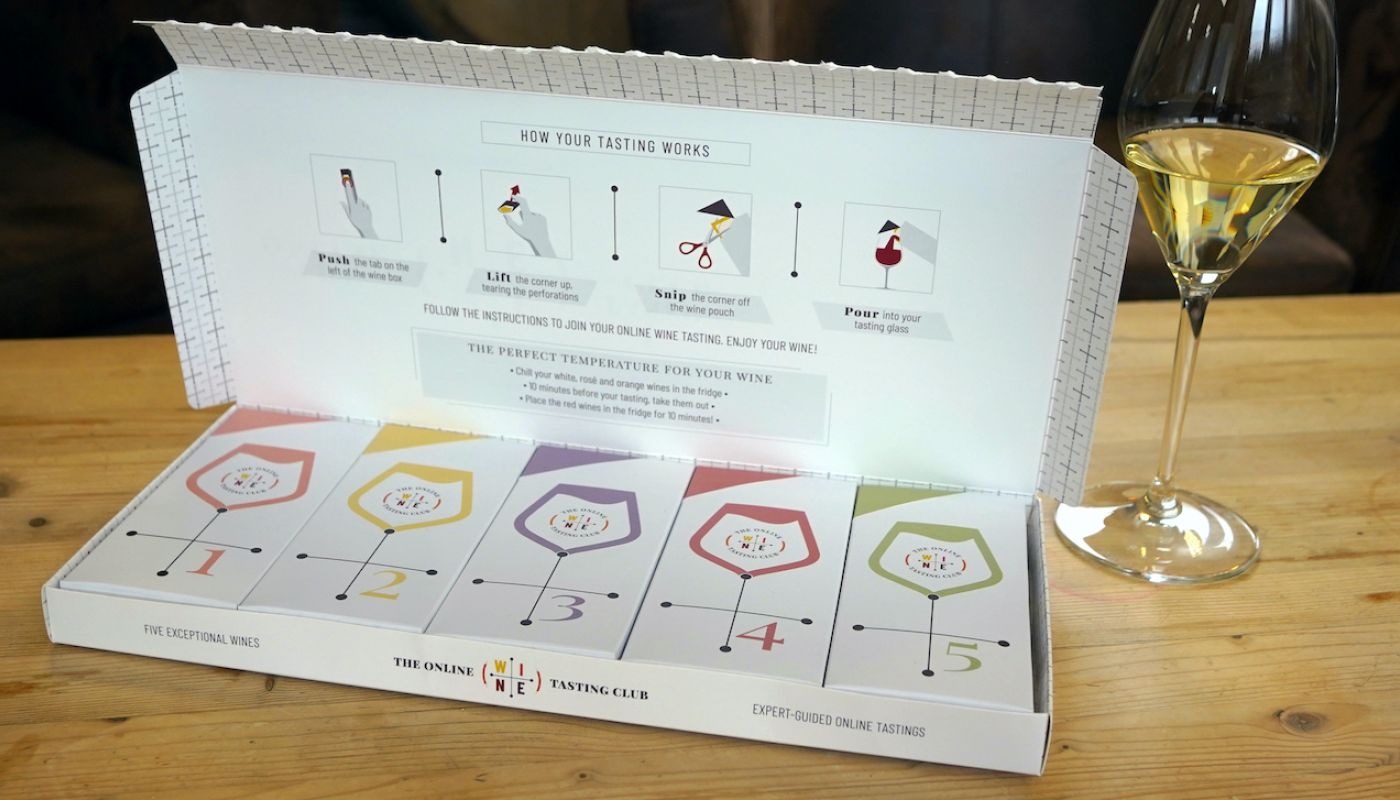
Creating the system involved building a custom packaging line from scratch that would blanket the wine under inert gas at every step of the process, then seal it into pouches. These use a bespoke, three-layer film protecting the wine from oxygen, light and physical damage. Five of these pouches can fit into a single mailing box that fits through letterboxes.
Compared with shipping wine in sample bottles, they managed to save more than half the weight while packing 25% more wine into less than half the space. Carbon savings come from the small packs (allowing more to fit in a delivery vehicle), reduced fuel consumption because they are so much lighter, and the vastly reduced carbon emissions from making the lightweight packaging rather than five glass bottles.
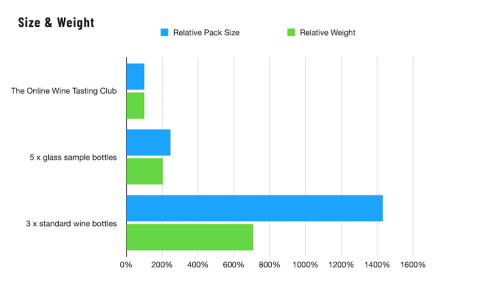
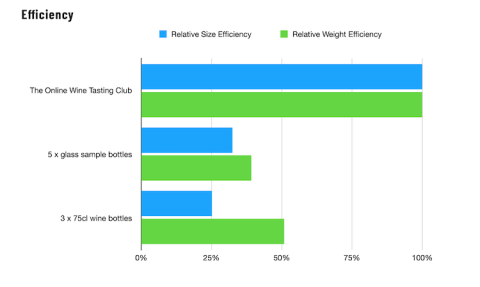
They are looking to receive wine in large containers so that bottles are never needed, leading to even greater carbon savings. For now, handling the glass-recycling themselves allows the different colours of glass to be kept separate. By weight, more than 90% of The Online Wine Tasting Club's packaging is easily recyclable cardboard from sustainable sources. Overall, the team estimate that the carbon savings are around 10 times those of using small glass bottles.
Alex admits it was: ‘difficult to get right and we’re still conducting longevity trials to understand what shelf life the samples can get. We can currently produce samples between 20 and 125 ml. Our standard 5 x 125 ml box for a couple to share weighs less than 750 g. There are a huge number of possible venues we can take this packaging aside from The Online Wine Tasting Club: for example, virtual trade shows and sample sets for distributors, wineries, "Wines of XXX" tasting sets for regions, and lower-cost WSET sample packs.’
Of course this packaging does not have to be limited to the five-packs they are currently using for their online tastings. The single 125-ml pack can be seen more clearly below on the right of the five-pack.

So far, they wish to fulfil orders in the UK only (shipping wine halfway round the world rather defeats the object) but hope to expand production facilities to other countries eventually. If you're interested, email [email protected].
BIB wine
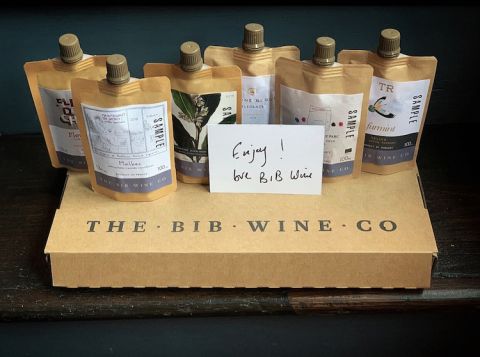
Rebecca Roberts of The BIB Wine Company, which specialises in superior bag-in-box wine, has come up with a similar novel packaging method of wine samples that will fit through a letterbox. Her plans to open a bar this summer were scuppered by COVID-19 so, as she put it in an email to me:
‘… we have developed taster pouches as an easier way for people to try our wines at home (we send them out with invitations to online tastings to our customers).
‘Because the pouches are so much lighter than glass, they produce significantly less greenhouse gasses, require less water, and use less fossil fuels than a glass bottle. They weigh less, pack smaller, don’t require bubble wrapping to protect them, making them one of the most carbon-efficient forms of transporting small amounts of liquids. The pouch spout and cap are recyclable as household plastic. The pouch itself is recyclable, but only with the help of specialist services. We are currently working together with such a specialist, alongside our delivery partners to offer a returns scheme in an attempt to close the loop.’
I asked Engineer Alex of Tring to compare the two systems and here is his analysis:
‘I had spotted the BIB company's sample set and have heard lovely things about the company but haven't tried it yet. They are certainly doing great things in terms of improving the reputation of bag-in-box wine and making the environmental argument against heavy glass bottles more widely heard.
‘A distillery near us (Puddingstone) use similar pre-made pouches for their samples, so we had evaluated these early on in our process. See below.
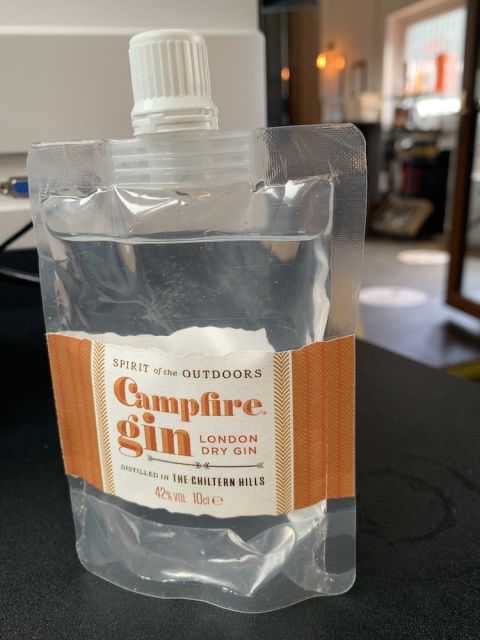
‘Without knowing the exact details of The BIB Wine Company's pouches, it's hard to make an exact comparison, but my understanding from Puddingstone is that they are bought pre-made in boxes, are typically made from fairly simple materials, they have a plastic moulded spout and cap attached, and they are available widely. You can buy filling machines that you hold the bag up to the spout of, then they output a fixed volume of liquid to fill them, but I didn't personally come across any that do inert gas protection. Both share the weight/size advantages, so both are excellent solutions for tastings and have vastly reduced carbon when compared to glass but are quite different in practice.
‘The main advantage of our new packing system is that, as it is continuous and fast, we can scale up and solve a much bigger problem: how to get wine samples into the hands of tens or even hundreds of thousands of people each month. In turn, that scales up the environmental benefit significantly. I would hope that our shelf life will be longer too, but am waiting for the trial to complete and Campden BRI to do some analysis.
‘However, the pre-made pouches are undoubtedly a lot easier for smaller sets of tastings, and there is less of a barrier to entry. I recommended them to a few of the international wineries that approached me and that we cannot yet serve.’
|
The Online Wine Tasting Club |
Pre-Made Pouches |
|
~2 g plastic per pouch |
~8 g plastic per pouch |
|
Made around the wine, simple design |
Pre-manufactured, complex design |
|
Snip to open |
Moulded plastic spout and cap to dispose of |
|
Automatically filled and nitrogen-protected |
Manually filled |
|
3-layer laminate film with lower oxygen transmission rate and good light/heat protection |
Single-layer film (it’s worth noting that some suppliers of pouches use material that's inappropriate for alcohol, so buyers need to be careful) |
|
Shipped as a single, tiny reel that makes 5,000 pouches |
Shipped as large boxes of empty pouches |
|
Continuous, fast filling process |
One-off, slow filling process |
When I drew Rebecca’s attention to Alex and Jamie’s system and Alex’s analysis she commented:
‘Couldn't agree more with both options being great ways to reduce the carbon footprint of wine samples, and believe that the overall weight of both finished packs to be extremely similar. Funnily enough we also considered both options, but for us it made more sense to go with pouches. We love the design aspect of the corner tear plastic bag in a box (not sure if this has a better name!), and were obviously attracted by it being a mini bag-in-box.
‘Neo, a cocktail company, started doing something similar [to the Tring system] last year so we looked into it then. In the end though, we felt that for what we're doing, the pouches made more sense. We believe that sustainable packaging options will only work if they fit around the consumer by offering greater convenience. We wanted to send 100 ml samples, as this allows two people to share. However, we also felt that for one person, not everyone would want to finish 600 ml in one go, so the ability to squeeze the air out of the samples, replace the cap and stick them in the fridge to come back to them the next day, would be an attractive option and would reduce waste. It also made more sense in terms of both unit price and minimum order quantities, making the whole idea of sampling more accessible (we are getting an increasing number of requests to help other wine companies with their sampling).
‘We have been filling under gas and while to date this has been something of a manual approach, we are investing in some semi-automated machinery which will allow us to top with a small amount of gas prior to capping and increase the scale at which we can send these out. The pouch system is quite well-established in other industries, and so the ability to scale is pretty well built in, and there are multi-layer options using materials proven suitable for alcohol/wine use and offering a low OTR [oxygen transmission rate]. In the end the biggest barrier to longevity with non-glass bottle samples is the sample size. Reducing sample size inevitably means losing the volume-to-surface area ratio advantage of larger formats, and even the most rigorous sample bottle filling practices don't produce results that can comfortably sit on shelves for months.
‘In order to achieve an even lower OTR and better recycling outcomes, we're developing new pouches and are currently working with our packaging partners, carrier and a specialist recycler, so that we can offer an easy-to-use freepost return scheme so that we can offer 100% recycling.’
I wish both enterprises the very best of luck in spreading use of these admirable alternative forms of packaging, and would be very happy if wine producers used either of them for sending out samples to wine commentators such as me.
Although I know neighbours who would miss helping me out with my usual raft of almost-full wine bottles.