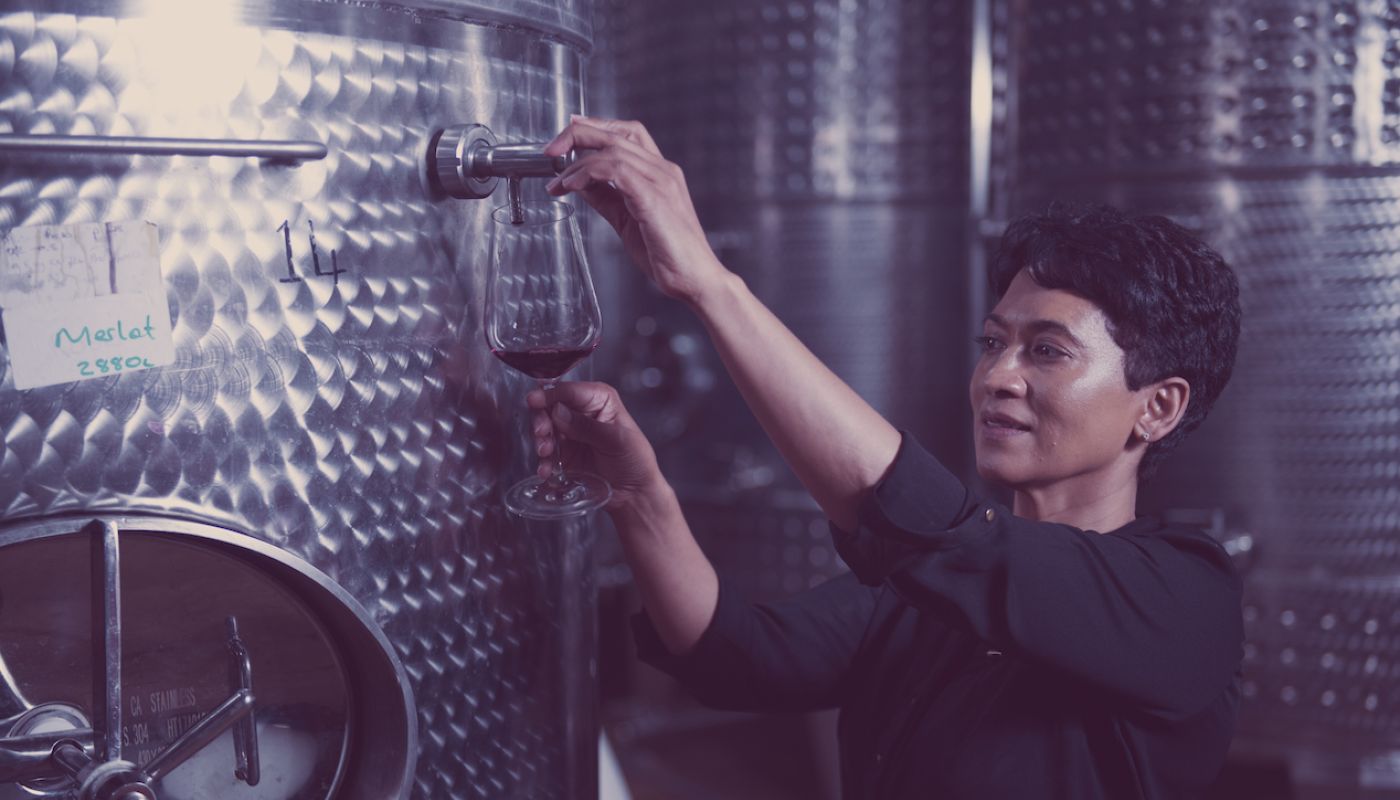
What is your role in the South African wine industry?
My aim is to make sure that the wine I produce is of premium quality to ensure that Carmen Stevens Wines will still exist in years to come. We need to rid Black-owned wine brands of the stigma of being seen as of inferior quality to wines from a white-owned cellar.
Winemaking facilities and infrastructure: most Black people do don’t have their own winemaking facilities and therefore are reliant on white producers for their private-label wines. We need to address the fact that often these wines are sold to Black-owned brands at excessive price points and often contracts are not being honoured, with price changes on wines once orders have been confirmed.
I also feel obligated to talk openly about the subject of transformation and how slowly the wheels of change are turning. Black-owned brands are finding it extremely difficult to enter the local market and the industry bodies seem to be dragging their feet in combating this. My role is also to speak openly about how rarely these brand owners are asked to take part in industry decisions, decisions that are made on our behalf. I want to make it clear that Black-owned brands such as mine are here to stay and they should be one of the industry’s top priorities and not the last point on the agenda or an afterthought. I also want to point out that skills development is important but so, even more, is enterprise development and ownership.
What achievement are you most proud of?
There are so many but l will highlight just two. I am most proud of the fact that we have our own cellar facility. We registered as the first 100% Black-owned winery facility in the country in January 2019, owned entirely by me. (That is in itself very telling, when you consider that South Africa’s first democratic elections were way back in 1994. The wheels of change turn extremely slowly!) I’m also proud of being able to mentor the three men who work with me every day, giving them the prospect of a better future.
Then, with the help of Naked Wines’ angels network, we have since 2016 provided a breakfast and lunch for 22,603 learners at school. During the 2019 school year alone we provided for 10,310 learners every school day at 53 schools from 25 communities and in doing so created 79 job opportunities for unemployed mothers in these communities. We are now working with community kitchens (‘soup kitchen’ has such a negative connotation …) since not all kids are at school yet due to the pandemic. This food assists these learners to focus in school and achieve better results, eliminating the short-term hunger that a lot of our learners are faced with every day.
Has the filmThe Colour of Wine in which you featured made a difference to your life?
The Colour of Wine showcased Black winemakers and Black wine industry participants. To a great extent it also showed the rosy side of the industry. It is a well-made documentary but it does not address or highlight the plight of Black participants in the industry. It does not even talk about the farm workers and the role they have played in the building of this industry. Nor does it feature any of the big South African retailers and their view of Black-owned brands.
I have seen that the documentary has made white South Africans very uncomfortable. I have heard them say things such as ‘I was not aware that Black students were having a difficult time at these institutes’, even though they were attending the institutes at the same time. I guess the same can be said about the wine industry – people just don’t want to acknowledge the obvious.
I wonder how many members of industry bodies have seen this documentary? So in short, no, the documentary did not make a difference to my life.
What have been the main challenges you have encountered?
Almost too numerous to mention. Some of the major challenges:
- Growers delivering fruit other than what we contracted with them.
- If I make this known to some of the bigger players, they just shrug, yet they have the ability to make a difference.
- Absurd bottling contracts when it comes to payment terms.
- Ridiculous cellar space costs.
- Not getting any exposure through generic bodies.
- Having to think twice before opening your mouth because most people have an opinion on how you should conduct and express yourself, without walking a day in your shoes.
What changes would you like to see to make life easier for people of colour in South African wine?
There should be far more Black people on boards and at top management levels throughout the South African wine industry value chain. Black winemakers should be in senior winemaking positions, not just as tokens but as experienced winemakers who are genuinely part of the decision-making process. The same can be said of Black viticulturists. So many of these winemakers and viticulturists opt to find a completely different career path because there are so few growth prospects for them within the South African wine industry.
When it comes to our youth – farm workers’ children – we need programmes to develop and grow these 15–25 year olds. When I say ‘grow’, I do not mean grooming them merely to take over from their parents as farm workers, but to help and assist them to become future farmers, farm owners, winemakers, viticulturists, teachers and lawyers. We need to help these children to see the beautiful side of what the industry can offer. The future for these learners currently is bleak and if we as an industry do not take action now, we will have another generation lost, and more excuses for why transformation is so slow. These young adults have no access to recreational activities on most farms, so drugs and alcohol provide an escape. Should the right programmes be in place, these adolescents would be able to develop their leadership skills and build the confidence that comes with the right exposure.
I’d also like to see more than one or two Black people at board level of the South African wine industry bodies, and there should be different board members for different wine industry bodies. People who can benefit from board decisions should not be serving on such boards, irrespective of colour.
There should also be land ownership for Black people in all wine regions. Stellenbosch alone has about 1,308 ha (3,232 acres) of municipal land on 50+ year leases. Some of these long-term (50- 99-year) leases on 1,308+ ha of land owned by the Stellenbosch municipality were issued in 1934 (the 99-year leases) but most were issued in 1991 and 1994 (50-year leases). The cost of leasing that land was R2194.22 per ha per month for the year 2017/18, for example, and a lot of this land is not being used but is protected from ‘outsiders’ by these lease contracts paid months or a year in advance. Compare this to the current cost of land in Stellenbosch, which sells for R2–3.5 million per ha. What is Vinpro doing to help Black farmers acquire some of this land from their white members?
We need a platform whereby Black brand owners, winemakers, viticulturists and sommeliers can speak and make known the obstacles and challenges they face without the fear of being excluded as a result. Because only if these obstacles and challenges are out in the open can we all grow and see backhander deals eliminated.
I’d like to see much more transparency about what is happening to the €15 million of EU funding that is supposed to be utilised to support the transformation agenda and restructuring of the South African wine industry post-apartheid. It was proposed that the €15 million be utilised as follows:
- €10 million on long-term capital projects similar to the Brandvlei and Clanwilliam dam projects.
- €5 million on short-term projects, such as enterprise development initiatives for Black-owned wine brands.
The question is: what proportion of Black-owned farms or farmers will benefit from a project (1) as proposed? And if the money is being spent in the name of climate change and sustainability – as we are being told – why is the industry itself not funding such a project? Why is it relying on funds earmarked for a transformation of the South African industry that is already long overdue? Maybe Vinpro and the South African Liquor Board Brand Owners Association can shed some light on how the industry is applying these EU funds towards transformation and restructuring the South African industry?
Jancis adds I asked managing director of Vinpro, Rico Bisson about this last issue and received the following reply:
'No, that is not factually correct. The EU €15 million grant has a long history and was part of the original Economic Partnership Agreement (EPA) in the 2000s. This funding is earmarked for transformation-related projects in the South African wine industry. We (transformation unit) have been working very hard to unlock the funds over the past few years, but notwithstanding our best efforts the funding is still not disbursed.
'The EU proposal is that the funds should be allocated as follows: €5 million towards enterprise development (working capital, market support) and people development for businesses such as Carmen's and €10 million towards land reform and infrastructure (vineyards, wineries, value chain). One of the scalable considerations for land reform that we developed with key stakeholders and government was a project where government will increase the capacity of a large irrigation dam (Brandvlei) and beneficiaries can, via a combination of grants, euro funding and subsidised loans, gain access and acquire vineyards. The potential of this project is significant and could develop 2,500 hectares of 'Black-owned vineyards', wineries and create a significant number of jobs.
'I trust that this brief synopsis is helpful.'
Philip Bowes, manager of enterprise development, Vinpro, added:
'Rico has asked me to try to help clarify this matter.
'There are two dams which the South African government has targeted for expansion, namely the Brandvlei dam and the Clanwilliam dam. The additional water available from these dams shall be allocated primarily to Black-owned vineyards, orchard owners and cash croppers. The government is developing strict application criteria for the water. Neither of these dam projects is related in any way to the Development Cooperative Initiative (EU fund touted below). The dams are to be expanded under an infrastructure programme funded by the South African government called Sip 11 (information is available online at https://www.namc.co.za/sip11/).
'The EU fund is at an advanced, sensitive stage of negotiation. The EU typically contracts with counterparts in any government, and not directly with privately owned entities or groupings. In this instance, their counterpart is the South African Department of Land Reform, Rural Development and Agriculture. Once the EU fund is activated, Black wine-brand owners shall be in a position to apply for business grants or subsidised loans along similar lines to funding provided by various government development agencies over the past 15 years. This time around, however, we expect wine- or grape-related businesses to benefit to a more significant extent than in the past, given that competing enterprises (fruit, grain or livestock for example) will not be eligible to apply.'
Carmen's comment on Rico Bisson's response:
'I read this mail from Rico. What is interesting is that the information in my mail to you, I took directly from a document signed by two people, one of them being Rico. The heading of the document reads Vinpro SALBA [South African Liquor Brand Owners] EU Funding Facility Proposal, South African Wine and Brandy Industry.
'But then again Rico does serve on the boards of Vinpro, SALBA, Winetech, WOSA [Wines of South Africa] and SAWIS [South African Wine Industry Information and Systems]. I guess the question I should be asking is: who will be the custodian of the funds once they are transferred to South Africa, and who will be disbursing those funds and how?'
















