
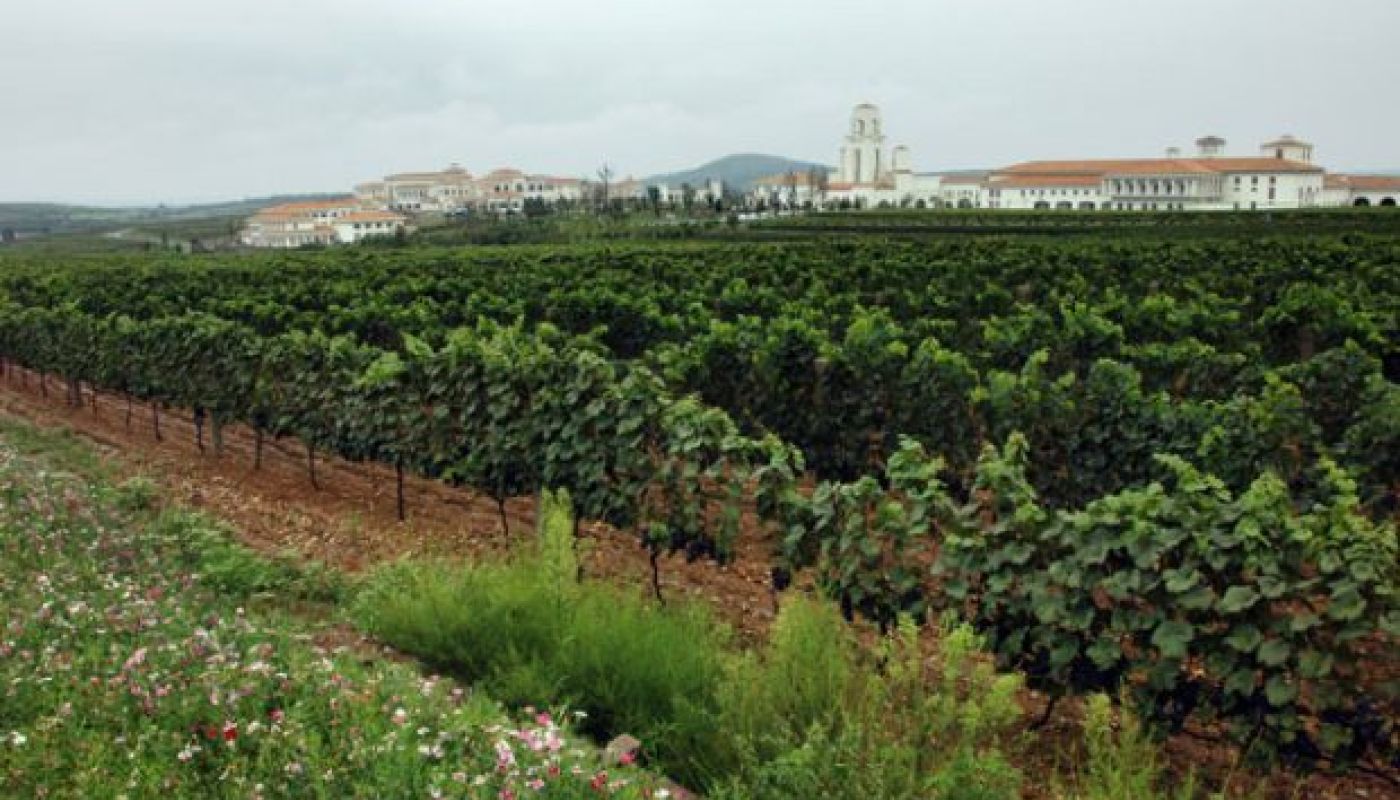
It struck me while wandering round the dusty, cavernous cellars of Chateau Junding (above) in China’s eastern province Shandong that in a way it symbolises what has happened to Chinese wine over the last few years.
During the heady years of China’s wine boom this vast winery, hotel and golf course complex with its 400 ha (1,000 acres) of vineyards and a village-worth of buildings in an architectural style that could best be described as imperial hydro was the showcase winery of the state-owned Cofco. As one can see from the framed photographs of groups of boozy Chinese businessmen and officials that are still mounted on easels on the way in to the cellars, the director of Chateau Junding used them and the associated dining rooms heavily for entertaining.
Then in 2012 came President Xi’s crackdown on ‘gifts’ and general lushing up of government officials and business associates. The result was that in 2016 Chateau Junding, presumably already the rather ghostly, down-at-heel edifice it is today, was put up for sale for just one RMB, to include the assumption of debts totalling 392 million RMB (£42 million at the rate current then).
Amazingly, they managed to sell it, to Wang Yihan, whose main business is contemporary art. Responsible for China’s biggest art fair, she seems slightly dazed by the responsibility of running this vast wine and hospitality operation and told me she’d bought it only because her husband is from Yantai, the nearest city. We ate lunch in a rotunda at a round table swagged with crimson satin that would easily seat 24 – far too big for the usual lazy susan. Instead, about two dozen dishes appeared at and disappeared from our elbows every few minutes.
It had been three years since I had been on one of my periodic wine-scouting trips to China and it definitely felt as though the boom years were over. Sipping wine has been a huge social signifier in modern, urban Chinese life, clearly marking the adoption of western ways, so very different from the old baiju spirit drinking and the tradition of stupefying ganbei toasts. Last time we were in Shanghai it seemed that, even though there were tales of unsold, overpriced Bordeaux classed growths sitting in warehouses, new wine bars and salons for wine collectors were opening all over the place.
And the statistics suggested that China had come from nowhere to be the world’s biggest consumer of wine, the world’s second most important grower of grapevines, and one of the world’s most important producers of wine. Everything seemed to be going swimmingly.
But now, in a faltering economy, things are clearly rather different and China’s wine producers are having to get used to a different direction of travel – rather as Manchester United supporters had to do on the departure of Sir Alex Ferguson, for instance.
At last month’s China Wine Summit in Shanghai, a get-together for leading wine producers organised by the wine website TasteSpirit, Zuming Wang, vice general secretary of the China Alcohol Circulation Association (basically head of the wine board), pulled no punches. ‘We think we’re the world’s fifth biggest wine producer, and so does the world, but we’re not. Internal statistics are misleading. Customs statistics are much more precise, and they show that imports were down by 10% last year.’ He also warned that China’s big companies had found it much more difficult to make money out of wine than they had at first thought and were currently in retreat.
CITIC, the state-owned investment company, is no longer involved with the new venture in Shandong initiated by China’s favourite Bordeaux first growth Château Lafite. Many a Chinese wine importer has gone out of business recently as the market, admittedly overcrowded, has become much more cautious. Thanks to cunningly negotiated free-trade agreements, Australia and Chile are challenging France as the leading wine exporter to China, with wines that are so much cheaper than the red Bordeaux that was the Chinese staple choice for so many years. (Burgundy is all the rage now, and because quantities are so limited, Chinese demand is having a perceptible effect on burgundy prices.)
French statistician-turned-wine-writer Bernard Burtschy gave a presentation at the China Wine Summit using all his skills at ferreting out elusive facts. According to him, only about 10% of China’s vineyards are devoted to wine production, the great majority of them supplying table grapes. If he’s right, China’s wine-dedicated vineyard total is only about the twentieth most extensive in the world rather than the second.
He has also researched the dramatic variation in average yields between rainy – not to say sub-monsoonal – Shandong, where vineyards produce as much as 135 hectolitres per hectare (hl/ha) on average and dangerously dry Ningxia and Xinjiang, which he calculates produce an almost uneconomic 16 hl/ha and 25 hl/ha respectively. He reckons the average national yield is still pretty high, 96 hl/ha, but even this means that China’s annual wine production is only about 8.4 million hl in an average year, less than either Germany’s or South Africa’s (and it has been falling for the last four years, suggesting a weakening of domestic demand).
Burtschy warned the assembled wine producers that they had better work on assuring their water supply, and on reducing their production costs, which he reckons are twice the global average, boosted by the expensive need to bury and then uncover vines against fatally low winter temperatures every year in most Chinese wine regions.
That’s the rather shrivelled quantitative picture. How about Chinese wine quality? Even though there have been some well-publicised prosecutions of sellers of counterfeit bordeaux in China, there is still too much unreliable wine on the market, particularly but not exclusively at the bottom end. Yantai, where many wine producers are based, imports vast quantities of cheap wine in bulk.
On each of my eight visits to China I have tried to taste the best wines available, selected by trustworthy contacts. The number of producers making decent wine is slowly continuing to increase but, unless my wine professional contacts lead extremely sheltered lives, that number is still quite low for a country 17 times the size of France.
And the great majority of wine is still based on Cabernet Sauvignon, which Burtschy reckons accounts for 63% of all Chinese vines. Merlot and Carmenère (another red Bordeaux variety the Chinese call Cabernet Gernischt) are also popular, and there is a current fad for Marselan, a fairly recent crossing of Cabernet Sauvignon with Grenache. (Viticulturist Richard Smart who has worked quite a bit in China commented on reading this article: I have observed Marselan for a while. In Hebei, now Ningxia, it does very well. It may be China's signature variety. However, it is exceedingly sensitive to trunk disease, I suspect even more so than Sauvignon Blanc. And trunk disease is a big problem in China, essentially unrecognised and untreated in the vineyards, being spread there by local and foreign nurserymen, and burying vines in wet soil.)
The few whites tend to be Chardonnay or Italian Riesling but the range is broadening and there are some sweet wines made from Vidal in Inner Mongolia and Petit Manseng around Beijng. I even encountered a convincing Pinot Noir, made by the award-winning (female) winemaker at Helan Qingxue in Ningxia.
Chinese wine will get there in the end, just not as fast as we once thought.
Image, and figures for the sale of Chateau Junding, courtesy of Decanter.com
SUPERIOR CHINESE WINE PRODUCERS
These producers have all made some very decent wine, though I cannot vouch for their entire output. Some good examples are available in Hong Kong as well as in mainland China but few are exported further – except for Changyu Moser XV, and Ao Yun, which is offered by the Bordeaux merchants.
Ao Yun, Yunnan (LVMH)
Ch Bolongbao, Beijing
Canaan, Hebei
Chandon, Ningxia (LVMH)
Ch Changyu Moser XV, Ningxia
Ch SunGod, Hebei
Dom Franco-Chinois, Hebei
Grace Vineyard, Shanxi and Ningxia
Guoan, Xinjiang
Helan Qingxue, Ningxia
Helanshan Manor, Ningxia
Huailai Amethyst Manor, Hebei
Kanaan, Ningxia
Ch Martin, Hebei
Silver Heights, Ningxia













