
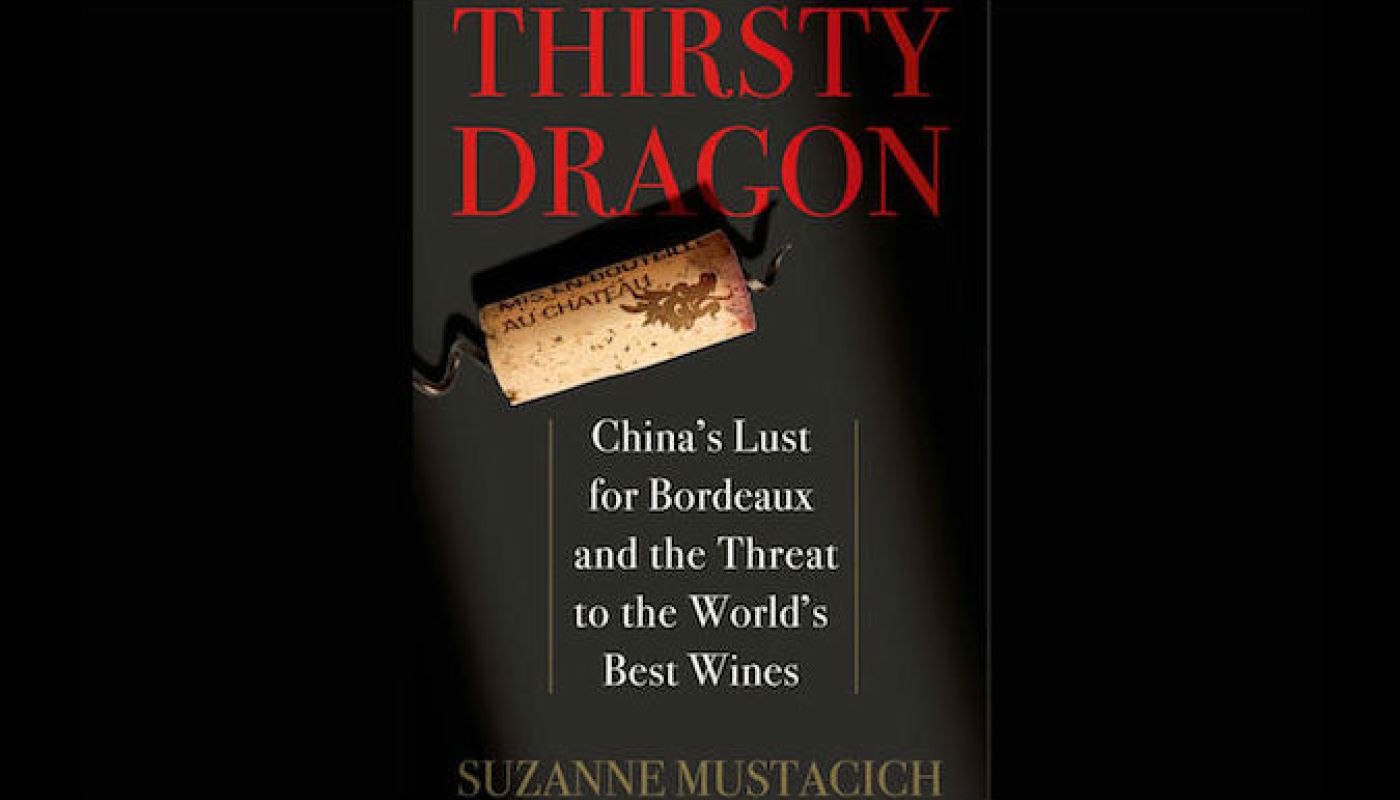
‘The question is not if a Chinese investor will acquire a classified growth, but when.’
This prediction about Bordeaux’s most revered wine estates, on the penultimate page of Suzanne Mustacich’s riveting new book Thirsty Dragon, is just one of many arresting observations by this hard-working journalist who displays a deep understanding of the wildly differing but now heavily entwined cultures of Bordeaux and China.
A Chinese female executive long resident in France who in early 2011 oversaw the first Chinese acquisition (of dozens) of a Bordeaux petit château summed up the prevailing imperatives thus: ‘in China we do not have so many laws and we will do anything for money. In Bordeaux, people take care of their land and they do anything for good business.’
The Bordelais completely misread what looked like the beginning of a Chinese love affair with its famous classified growths. In most cases this was not love but speculation pure and simple. Although many of the buyers had zero experience of and interest in wine per se, en primeur orders for the last pair of great vintages 2009 and 2010 flooded in, many worth millions of euros. The zeroes often trumped due diligence and when the Chinese saw prices falling, orders were cancelled on the most terrifying scale.
Mustacich describes how a one-man band négociant had to run upstairs to get his lawyer wife to try to sequester stocks of mature wine warehoused on the outskirts of the city during a meeting with one Chinese client (whom she had required, unusually for Bordeaux, to sign a contract) who had dropped in to cancel an order of 2010 classified growths worth $8.5 million.
This négociant is still fighting to acquire the mature wines as compensation, but another 11 who dealt with the same Chinese company have simply given up, preferring to save face. Vincent Yip of one of the most respected Hong Kong wine importers Topsy Trading, whose father Thomas was the first to import fine bordeaux into China, is reported as being ‘exasperated with the Bordelais’ incomprehension of Chinese business culture … The Chinese cancelled their orders because they refused to lose money. The Bordelais honoured their orders with the châteaux because they refused to lose face.’
It would be no exaggeration to say that the current dismal state of the Bordeaux fine-wine trade was determined by a toast delivered at the Chinese National People’s Congress in 1996 vaunting the virtues of red wine over the local baiju grain spirit, and then by Xi Jinping’s anti-austerity edict in late 2012.
Chinese buyers’ initial enthusiasm, bolstered by a business culture in which ‘gifting’ wine was so common that there was a secondary market for bottles slipped to government officials, has given way to extreme caution in a climate in which few officials would dare be seen in a five-star hotel.
Initially the Chinese looked to the Bordelais like the perfect substitute for the Americans who began to fall out of love with bordeaux at the turn of the century. Even after the Chinese exit from the en primeur market, China with Hong Kong still accounts for a quarter of bordeaux exports. But given how dependent Bordeaux now is on China, it does seem strange that gulfs of understanding persist, and that the Bordelais did not realise that so much of their livelihood depended on a graft culture that could disappear overnight. As Mustacich writes, ‘the classified growths were disastrously slow in comprehending the impact of the crackdown … despite warnings, the châteaux, giddy with their singular success [in selling their 2009s and 2010s], had priced their wines for opportunists, not for wine drinkers.’
It’s not as though the Bordelais never travelled to this new market. Between 2007 and 2011, it seemed to me it was easier to find a prominent Bordeaux producer or merchant in Shanghai or Beijing than in Bordeaux. In fact my only criticism of Thirsty Dragon is a lack of descriptive detail of this period of slavish courtship of the Chinese market, heavy on winemaker dinners but lighter perhaps on genuine cultural understanding.
Mustacich does acknowledge, however, how rapidly Bordeaux adapted to these important new customers back home: ‘Château managers and négociants memorised Mandarin greetings … chopsticks were requisitioned … Soon, no one was batting an eye at the public spitting, belching and farting that were accepted on the mainland.’
She is also drily observant about the legion of Chinese ‘interpreters’ who flooded in to Bordeaux to negotiate between the two factions. ‘As a whole the women spurned the staid, local style – a Hermès scarf and driving moccasins – preferring a tiny miniskirt paired with six-inch stiletto heels’ (improbable vineyard wear). Their translations always took far longer than what they were translating, apparently. ‘More and more, the translators were adopting the role of gatekeeper to Chinese buyers and demanding a sales commission, often from both sides.’
Fine bordeaux has for centuries depended on a range of négociants selling each château’s wines, but the Chinese have a visceral distaste for middlemen. One aristocratic Bordelais persuaded a range of classed growths (Mustacich tactfully omits their names) discreetly to bottle their wine under a label exclusive to one Chinese importer, state-owned like most successful Chinese enterprises, in exchange for substantial en primeur purchases. This agreement was abruptly cancelled after three years early in 2012.
Other dealings exposed in the book that might seem normal in any business sphere outside the Bordeaux Place include Château Latour’s wily, and considerable, direct sales operation and one Hong Kong banker’s bold tour of the top châteaux with a group of high rollers and the US$34 million they had allocated to spend on wine there.
Less savoury passages describe the vast extent of counterfeiting in China (put ‘Chinese fakery’ in our search box and choose ‘Everything else’ for images of an extraordinary number of counterfeit labels), about which the Bordelais prevaricated to a disastrous extent: wholesale registering of trademarks (one Chinese individual registered no fewer than 300 Bordeaux château names); Chinese ploys to increase the selling price of imported basic bordeaux sometimes 20-fold; and high-level allegations of money laundering through some of the many petits châteaux in Chinese hands.
Bordeaux society has now been fully infiltrated by the Chinese, not least students soaking up wine expertise at the university. Mustacich is in no doubt that China’s plan is to become an even more important wine producer than it already is, and outlines how provinces such as Ningxia are already taking welcome steps towards quality control. The biggest companies are well on their way with international expansion plans and for the moment, the still-growing Chinese market is most interested in wines cheap enough to drink, wherever they come from.
However, there are still millions of dollars worth of classified growths sitting, unsold and unloved, in Chinese warehouses. ‘That wine threatens a glut that can disrupt any number of established markets’, according to Mustacich. An observation that must cause the odd nightmare in and around Bordeaux.
CHINESE FAKERY
Anti-counterfeit lawyer Nick Bartman spent several months in China in 2010 and 2011 recording instances of fake wine. The following are just some of the examples of wine names pictured on this site, most based on red Bordeaux and specifically Château Lafite, for long the most popular wine in China.
Bordeaux Port
France Bordeaux Cabernet Gernischt [a Chinese grape name] 1992 [long before the Chinese wine boom]
Grand Vin de Graves 2005 Vin de Pays de l’Herault Pinot Noir Medaille d’Argent
Lafite Gooditem Minervois
Vin d’ Alsace Lodovicoa Viticoltore Louis Vin 1998
Chateau Tola-Wine, Domaines de Barons Rothschild (Lafeir) 2006 Sarah Grand Cru Classic Languedoc
Royal Lateet
Thirsty Dragon by Suzanne Mustacich is published on 10 November by Henry Holt.













