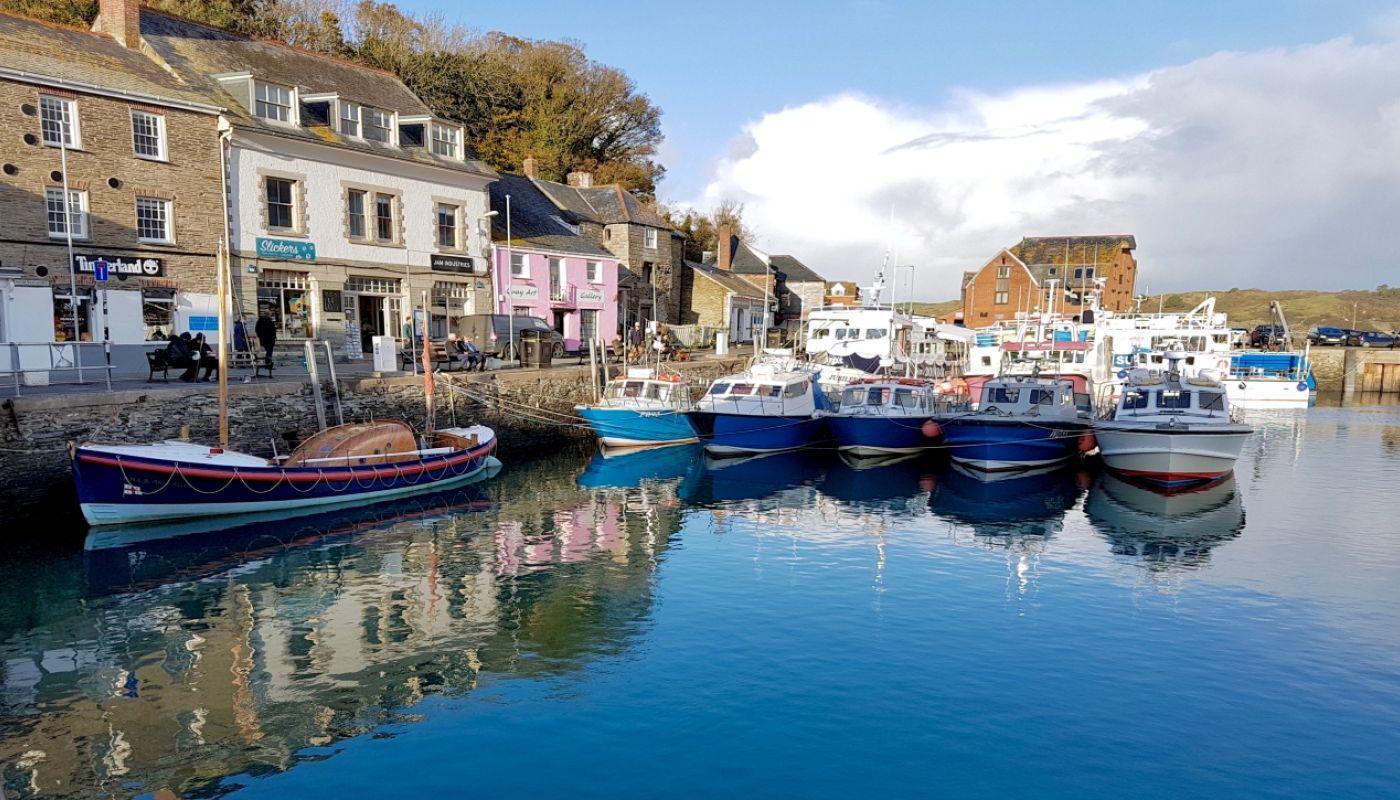
25 January 2021 More escapism (see Travel by bottle) and a survey of what those attending the G7 summit in June may sample. Jonathan Reeve, who took the picture of Padstow harbour above, surveys Cornish food and drink and asked a few interested parties to sum them up in a phrase.
‘Pasties with clotted cream and local cider’ was Cornwall resident, writer and performer Dawn French’s reply. ‘Rick Stein’s haddock and clotted cream pasty with Cornish Blanc de Blancs’, was another. Jancis’ mouth-watering contribution was ‘Top-quality fish straight from the boat, preferably prepared (but not necessarily cooked) by either Shaun Searley or Nathan Outlaw – with one of Cornwall’s ever-improving sparkling wines’. These were responses to my challenge to capture ‘Cornwall in a mouthful’. All three of these answers do indeed capture Cornwall, but at different points in time. I set this challenge in order to test a disquieting theory of mine: that the moment I left Cornwall, in 1998, my home county suddenly started getting rather cool and classy.
The puzzle
On returning to Britain after many years abroad, I immediately noticed a dramatic shift in how Cornwall, the peninsula in the far south-west of England, was perceived in food and wine circles. Something had seriously changed in the last 20 years. The three replies above confirm it and each marks a waypoint on Cornwall’s gastronomic journey from traditional to modern. Dawn French’s reply captures traditional Cornwall – hearty and historic. Rick Stein’s haddock and clotted cream pasty represents evolving Cornwall – both traditional and innovative (that latter recipe surfaced in the late 1990s). Jancis’ answer represents modern Cornwall – denoting a county which has arrived gastronomically speaking. ‘Straight from the boat and … not necessarily cooked’ show freshness and finesse in modern Cornish cuisine (ever tried Cornish scallop ceviche?). And note the two chefs Jancis mentioned – one in London, one in Port Isaac – highlighting that Cornwall exports its prized produce as confidently as it imports top chefs and Michelin stars.
I returned from abroad to find menus and labels specifying Cornish everything – sea salt, tomatoes, potatoes, honey … even tea. I glowed with pride when dining at The Quality Chop House in London whose menu specified ‘Cornish mackerel with cucumber, pear and horseradish’, ‘Cornish tomato with peach, broad beans and samphire’ and ‘Cornish Dover sole with sauce vierge’. Cornwall had stepped up its drinks game, too. Twenty years ago it was all about beer and cider. Today, the county produces fine sparkling wines, progressive natural wines, inspirational gins and world-beating vermouths (see Knightor’s glory in Tam and Arnica’s recent vermouth tasting).
So, how and when had Cornwall become so foodie and trendy? For answers, I contacted some leading names in Cornish food and drink – Stein, Outlaw, Wing of St Mawes, Camel Valley, Padstow Distilling, Knightor and Trevibban Mill. Each story clicked like a jigsaw puzzle with the next, gradually revealing the answer.
Padstein
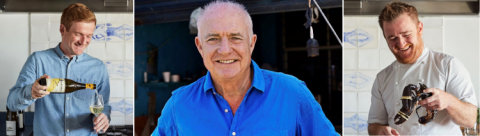
I started with the biggest name in Cornish cuisine: Stein. For decades, that name, associated with multiple and extremely popular BBC food and travel TV series, has worked wonders for Padstow and Cornwall, and Rick Stein (in the middle below) is now joined by his sons Charlie (below left), who runs the wine and business side of things, and Jack (below right), who oversees the all-important food.
Charlie was my natural choice for a chat, given the wine connection. He’s as interested in wine as his father is in food. In 2010 Charlie left Cornwall to spend several years working for progressive London wine merchant The Vintner. Although still based in London, Charlie spent summer 2020 in Cornwall, reconnecting with Cornish life. When we spoke one bright but very chilly morning, he was contemplating going out for a surf.
It was fascinating talking with someone who refers to Rick Stein as ‘dad’, and casually pops out from one of Britain’s top restaurants to go surfing. ‘Dad’ moved to Padstow (from Oxford) in the 1970s. Originally he ran a disco, but after years of defusing the harbourside brawls it engendered, he selected a safer métier – cooking. Rick learned his now-famous culinary skills by copying basic dishes from French recipe books. Early-1980s Cornwall wasn’t quite ready for haute cuisine, and Rick experienced some resentment as an ‘up-country’ imposter. He persisted, nonetheless, and over time made his name. In tandem with David Pritchard – the brains behind the camera on Keith Floyd’s TV shows – Rick’s television career blossomed, attracting ever more attention to him, his restaurant, the little seaside town of Padstow where it is located, and Cornwall in general. When I left Cornwall in 1998, business has just begun to boom for Rick. A few years later he launched his Food Heroes TV series and book with their avant-garde emphasis on food freshness, origin and seasonality – the pillars of modern Cornish cuisine.
The Stein recipe for success remains true to its original ingredients: persistence, personality and freshness (on both plate and screen). Rick’s contribution to Cornwall’s change has been to not change, and to continue doing more and more of what he – and now his family – does so well. The Stein presence has helped Padstow become Cornwall’s culinary capital over the last 20 years. It is now home to several world-class and Michelin-starred restaurants. It’s a sort of golden triangle – quite literally when the sands are exposed at low tide.
Padstow overlooks the beautiful estuary of the Camel river, which connects several protagonists in this story. To develop the story that Charlie had provided, and to pursue the wine angle, I went a few miles upriver.
Follow the Camel
Follow the river 10 miles inland from Padstow and you’ll reach Camel Valley – an established success story and Cornwall’s poster-child winery. Camel Valley is owned by Bob Lindo who moved there with his family in the 1980s. The Lindos tried sheep-farming initially, but soon switched to winegrowing, producing their first vintage in 1992. When I left Cornwall six years after that, Cornish wine was a strange novelty, and Camel Valley was only just beginning to find its feet. Today, Cornish wine is a recognised reality, and Camel Valley stands firmly on a reputation for consistent quality. Replacing sheep with vines proved a brilliant decision. Now run by Bob’s son Sam, in 2017 Camel Valley's Darnibole vineyard was granted single-vineyard PDO status (just like Romanée-Conti), and in 2018 it became the first English winery awarded a royal warrant, being quite a favourite with Prince Charles, aka the Duke of Cornwall.
Sam’s parents moved to Camel Valley because, he says, ‘at that time, Cornwall was the only place they could find a decent plot of affordable land. The timing was lucky – a few years later and land would have been too expensive.’ Also fortunate is how perfect the site proved for winegrowing. This is largely due to its position in the rain shadow of Bodmin Moor and exactly halfway between Cornwall’s two coasts; the valley avoids both heavy inland rain and damp coastal breezes. One of Cornwall’s driest places, Camel Valley can look more like southern France than north Cornwall in late summer.

With Camel Valley approaching its thirtieth birthday, Sam is tasting library stocks, impressed by the wines’ development. And not just the sparkling wines – the 2007 Bacchus has evolved beautifully, into something ‘seriously Riesling-esque’. As with the Steins, Camel Valley’s success hasn’t come from revolution or reinvention – consistency and constant improvement seem to have been the key.
Now that I had a story from the two longest-established names in fine Cornish food and wine, I wanted context from someone who joined the evolution a little later. The clear choice was a star chef who arrived in Cornwall exactly when I left, in 1998: Nathan Outlaw.
New fish
Outlaw, like many of us, spent childhood holidays in Cornwall. Clearly it made an impression on him because (despite seriously contemplating a career as an animator) he headed to Padstow in 1998 to train as a chef with Rick Stein. He trained at Stein’s Seafood Restaurant for several years and remembers feeling ‘like every time I had a day off, I was on holiday’. Nathan’s stellar solo career began in 2004 when he started his first restaurant, The Black Pig, adding fresh momentum to Cornwall’s culinary development. That momentum continued to build over the next 16 years.
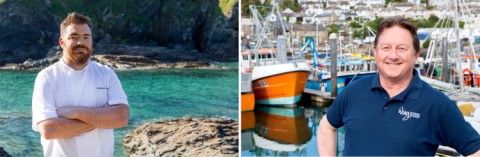
In 2021 Nathan (below left) is developing a new chapter in his career. Having diligently earned three Michelin stars for his Port Isaac restaurants, he has just given up two of them. He closed the doors of his two-starred Restaurant Nathan Outlaw for the March 2020 lockdown and has not reopened them. Instead, he has opened a new restaurant where diners can enjoy more space – a direct response to the need for social distancing. Still in Port Isaac, the new venture is fittingly named after its street address: New Road. The focus of Outlaw’s New Road is on ‘real’ food (meaning fresh, local, seasonal, diverse) and an environment where customers can relax. The new venture has been working well, without the benefit (and constraints?) of Michelin stars and he hopes to reopen it after the current lockdown next month. Nathan’s intention wasn’t to overtly shun Michelin stardom, he simply saw this as the right way to address creatively the new (post-COVID) needs of his customers and his business.
Outlaw’s key contribution to Cornwall was making his home there, doing his own thing, and spreading the word about freshness, origin and sustainability. Those three words arose repeatedly in my conversations. I asked him how he and other top chefs ensure those qualities in their fish. And where do they source it? The answer ‘Rob Wing, invariably’ led to my next conversation, and a truly fundamental piece of the puzzle which pre-dates even Rick Stein’s arrival in Cornwall.
Quality stock
Rob Wing (above right) has been supplying fish to top British chefs – Stein and Outlaw among them – for decades. Like me, Rob is originally from St Mawes – a picturesque fishing village of slate roofs and seagulls. My earliest memory is of looking across St Mawes harbour towards the Tresanton Hotel – still one of Cornwall’s top dining destinations. At that time Rob was head chef at the Tresanton where he regularly cooked for well-heeled, yacht-owning customers, royalty included. Rob has witnessed Cornwall’s foodie development right from the start. In the 1970s he remembers cooking ‘the same old dishes that had been served since the war’. And in the 1980s, ‘you’d really struggle to sell any fish other than the traditional and obvious: haddock, cod, sole and maybe turbot’.
When Rob explained what happened next, things got really interesting. In the 1990s, nature and politics collided. Massively depleted fish stocks – caused by decades of over-fishing – led the EU to impose drastically reduced fishing quotas. Cornwall’s fishing industry was hit hard, bringing tragedy to many families – a sad thread in this otherwise happy story. Cornish chefs could no longer expect to get whatever fish they wanted. They were forced to think creatively, learn to cook new types of fish, design menus with freshness and availability in mind, and follow the ocean’s seasonal changes. Happily, the EU quota restrictions achieved their purpose and – as Rob puts it – ‘today we have (almost) stable fish stocks. Although we have a small slice of the pie, at least it’s in good condition’. The tough times that Cornwall endured in the 1990s contributed massively to the stability it enjoys today. Rob fought hard for his livelihood like everyone else, and his perseverance paid off. Today he runs two highly respected fish businesses – Wing of St Mawes and its retail side The Cornish Fishmonger.
With the fish story clear, and context right back to the 1970s, I shifted my focus back to beverages, and some newer names.
Fresh thinking
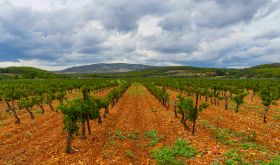
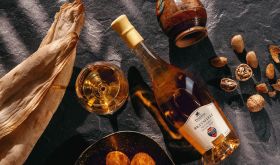
Knightor – whose first vintage was 2010 – is a newer thread in this story. The winery produces still, sparkling and aromatised wines (like Tam’s beloved vermouths) from grapes grown on four acres (1.6 ha) adjacent to The Eden Project. Knightor whites are made from Riesling, Bacchus, Madeleine Angevine and various other cool-climate varieties, the reds from Pinot Noir, Regent and Rondo. Most attention-grabbing, though, are its traditional-method sparkling wines, particularly the pure-Chardonnay vintage Blanc de Blancs. The sparkling wines complement the winery’s supporting role as romantic countryside wedding venue. Currently, though, the limelight is being stolen by the winery’s excellent vermouths. These are inspired by founder Adrian Derx’s Italian ancestry, and produced entirely from local ingredients. Tam’s recent tasting note describes Knightor Dry as ‘the most elegant, refined, complex, racy … vermouth that I have tasted’ (18 points). The label (below left) invokes history and tradition, but the vermouth itself confirms creativity and adaptability.
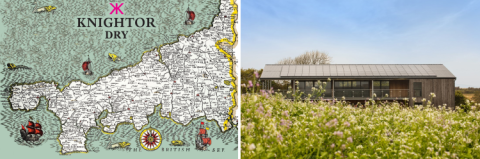
Also bringing fresh energy to the Cornish drinks scene is Trevibban Mill (above right), a small winery, cider orchard and wedding venue just outside Padstow. The approach here is progressive and natural, manifested through a fruity Pinot Noir Précoce, a skin-contact white named Orion, and a pet-nat based on Sauvignon Blanc and Bacchus. The stand-out among their ciders is the brilliant skin-fermented Tiger Milk – highly recommended. Natural creativity is clear at Trevibban Mill, which left me inspired for my final meeting, just down the hill in Padstow, revisiting the original inspiration behind this article.
Cornish spirit
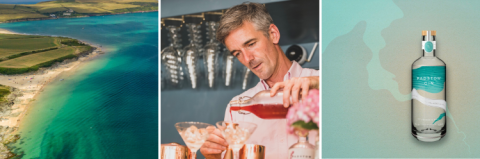
David McWilliam is a key ingredient in the modern Cornish drinks scene. He’s contributed to it in various ways for many years. In 2004, the BBC featured Camel Valley in Rick Stein’s Food Heroes series where David was visible in the background, sorting freshly harvested grapes. Soon after that, David became Nathan Outlaw’s ‘wine guy’, as supplier to The Black Pig. In the years since, he has established various successful drinks businesses, but the one which is really adding to Cornwall’s ‘cool’ is his newest project, Padstow Distilling Co. His rhubarb vodka is excellent, and a rose-petal gin is planned for 2021. It was my first sip of David’s flagship Padstow Gin that really inspired this article.
‘This wasn’t possible 20 years ago’, David says about his business. Small-batch distilling was illegal in Britain until 2008, when Sam Galsworthy and Fairfax Hall (the Cornishmen behind Sipsmith Gin) lobbied tirelessly for updates to centuries-old distilling laws. Without that, Britain’s craft gin boom couldn’t have happened. ‘Craft gins are ten-a-penny now, but I wanted to make a really special gin, that tastes of here.’ David can trace his products from grain to glass. The base spirit is from barley grown on a small headland (below left) immediately north of Padstow, and in springtime he hand-harvests Alexander plant stems from the hedgerows there.
Circling back to David and Padstow Distilling was a perfect final conversation. His story complements the others beautifully, and crystallises (distils, even?) what makes Cornwall so special.
The answer and the future
So now I have my answer. I know how Cornwall became so trendy while I was away. It always had most of the basic ingredients but needed just three more: a poke in the ribs from EU fishing quotas, a touch of vociferous adoration from a talented storyteller, and the persistent creativity of its farmers, fishermen, chefs, winemakers and distillers focusing on local, fresh, seasonal and diverse produce.
I quizzed everyone either in person or by Zoom, except for Dawn French whom I emailed. Her parting comment reveals one final secret ingredient: ‘the wonderful fresh fish and meat so abundant down here … and the cheer and cheek it’s sold with!’ That last bit is vital. Cornwall makes people relax and abandon pretension, and it attracts people who are like that naturally. Everyone I spoke with was very genuine, and very human. That kind of personality – devoted but relaxed, ingenious but informal – clearly creates amazing food and drink experiences.
I asked everyone for their forecast for the next 20 years. One word was repeated over and over: sustainability. We will (must!) learn from the past – look after our land and water, and protect our precious fish stocks. The EU can no longer make difficult decisions on our behalf, as it did in the 1990s, so this responsibility sits purely with us as post-Brexit Brits. ‘Diversity’ was also repeated: Cornwall will continue unlocking more and more things that it does brilliantly, most obviously top-end lamb, beef, fresh vegetables and fruit (watch the orchard section in episode one of Rick Stein’s new series). We see more fine food being made in more beautiful locations all around the county. And of course the wines will continue to develop and impress. More diversity will support sustainability, and will mean continued growth for Cornwall, and for Britain as a whole, I hope.
Other interesting people I’d like to have interviewed include Matt Chatfield of The Cornwall Project, Phillip Warren of Warren Butchers, Kate McBurnie of Cornish Wine Tours and star chefs Paul Ainsworth of No 6 in Padstow, Tom Adams of Coombeshead Farm, Dan Cox of Melilot Farm and Nigel Brown of Edie’s Kitchen. Each was mentioned and praised by someone I interviewed.
Another time…
But this article is arguably particularly well-timed anyway since the new 15-part BBC series Rick Stein’s Cornwall featuring several of the people described above was launched earlier this month.