When I saw your topic for the competition, I told Marco and Sebastián De Martino that I was going to write about their winery. They were very excited and I feel very guilty that I never got around to it, even though I did do some initial research. Too late now but here's what I wrote.
In 2005 the De Martino family convened for a dinner to celebrate the fact that one of their wines had been given the highest score they’d ever received from Chile’s most influential wine guide, Guía de Vinos de Chile.
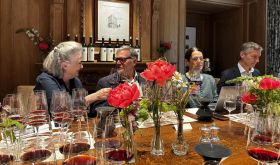
Three generations of the family sat in silence as the wine was poured. With great reverence, they looked at the colour, nosed the wine and drew it into the mouths. They tasted the wine and the silence grew. It became an uncomfortable hush. Eventually, Pietro the patriarch of the De Martino family asked, ‘Does anybody want to drink this?’
In the words of Sebastián, the fourth generation of this Chilean family, ‘the wine was shit’. From that very moment, they decided that everything at the winery had to change and they would go back to making a wine that they liked to drink. The De Martino family is not alone in making wine that they don’t like to drink. I’ve heard such confessions from more than one winemaker in California’s Napa Valley, but the De Martinos were early adopters of the movement that has been rejecting a concentrated, alcoholic style of wine often described as Parkerised. From 2011, their wines became delicious again.
Pietro De Martino was originally from the Avezzano region in the Italian Abruzzo where they were involved in both agriculture and construction. Pietro who was in the construction business became ill and doctors said that retiring to the countryside might help him recover. So in 1936 he bought the property in which the winery is now located in the town of Isla de Maipo, in the mid section of the Maipo Valley south of Santiago. The original property of around 10 ha (25 acres) is called La Quinta and was then planted mainly with Sémillon and Torontel with a mixed red-wine grape planting of Cabernet Sauvignon and Malbec. It also had a fruit orchard and other crops.
Pietro decided to transform the property into vineyards only and to build a winery. Unfortunately, in the process his condition got worse and he decided to travel back to Italy where he finally died just before the start of the war. He had no children and the property remained semi-abandoned throughout the war. ln 1947 Pietro's nephew Giorgio De Martino (the grandfather of Marco and Sebastián) arrived in Chile along with his mother (Armida, Pietro's sister) and he settled in La Quinta. He was a young man determined to make a living from wine and construction, looking for a better future than the one he thought possible back in Italy.
He started pulling the property back into shape, planting new vineyards, renting others and building the current De Martino winery. He is now retired at 95. For much of the mid twentieth century Chilean wine was sold in bulk. Only very few long-established producers bottled their own wines. The De Martino family sold most of their production in bulk or garrafas (a kind of Chilean demijohn). They bottled only a small part of their best wines for family consumption and a handful of clients. During the 1970's there are records of modest wine exports to Brazil but for political reasons most export markets were closed for Chilean wine.
Back in those days wines were made in a very simple, almost natural way. No additives were used. The wines were fermented in concrete and wooden vats made from raulí (the native Chilean oak), then aged in wood. Winemaking traditions followed mostly the Bordeaux paradigm imposed by French winemakers previously in the Maipo region. Equipment was very basic, yields high, and there was an aim towards drinkability rather than concentration or high alcohol. Grape varieties were mostly Cabernet Sauvignon with Merlot (or Carmenère) and Malbec. Whites were made in an oxidative way including a period of ageing in oak, mainly from Sémillon and Sauvignonasse (a relative of Sauvignon Blanc).
In the early 1970s Marco and Sebastián's grandfather managed to rent and later buy a second property in Isla de Maipo, Santa Inés Estate (280 ha/692 acres), by far their biggest property and the origin of all their Cabernet Sauvignon, Carmenère, Merlot and Malbec along with Sauvignon Blanc and Sémillon.
During the late 1970s Giorgio's sons Pietro, Marco and Remo joined the family business and they later, along with Marco's wife Paula Valdivieso, oversaw the expansion of export markets in the late 1980s and throughout the 1990s. They also oversaw the big change from bulk production to becoming a winery 100% focused on quality and estate-bottling all of its production. At the same time new technologies were being adopted such as temperature-controlled stainless-steel tanks, improved winemaking equipment and so on, adopting French barrels for ageing their best wines and replacing the old raulí vats and toneles.
The early 1990s saw a boom in Chilean wine exports that changed their business forever. The family had to travel to foreign markets to sell the wine, meet clients and so forth. They gained experience of and exposure to the global wine trade. Exports grew to 85% of their sales and remain so today. At the same time, the Santa Inés vineyards were providing excellent grape quality and overall the quality of their wines improved but changed in style.
Grapes unravelled
In 1994 it became clear that many of the vines previously considered to be Merlot were in fact the old, long-lost Bordeaux grape Carmenère. This shook the Chilean wine scene at a time when Merlot was a Big Thing on export markets. The De Martino family had planted a new ‘Merlot’ vineyard in 1992, in a particularly stony parcel on their Santa Inés estate called Alto de Piedras, which turned out to be 85% Carmenère, 10% Cabernet Franc and only 5% Merlot. Luckily for them, their Alto de Piedras vineyard has been providing them consistently with their best Carmenère for many years now.
Carmenère became something special for the family as they took the decision, not without pressure from other wineries, to start labelling their wines Carmenère instead of Merlot. They actually sold the first Chilean wine labelled Carmenère, vintage 1996, to the UK supermarket giant Tesco in 1997. This meant that they had to register this theoretically non-existent variety with the Chilean Ministry of Agriculture, a process led by Sebastián and Marco's mother, Paula Valdivieso. Since then, Carmenère has remained special to them.
By the end of the 1990s the Santa Inés estate was undergoing conversion to organic farming and was certified in time for the 2000 harvest. De Martino was one of very few Chilean estates to embrace organics so early [although see Antiyal, profiled twice in our sustainability writing competition – JR].
The current chief winemaker Marcelo Retamal was the winemaker in 1996. During that period Marcelo led a process which concentrated on matching grape variety to site with real precision and resulted in their single-vineyard range, probably the first terroir-specific range of wines in Chile.
This encouraged the family, always looking for the best quality possible, to expand into other wine regions. Thus they started making Sauvignon Blanc from cool-climate vineyards in Casablanca, Chardonnay from chalky soils in coastal Limarí, and Syrah from high-altitude vineyards in Elqui and Chopa in northern Chile. Later, they turned their attention to the old-vine, dry-farmed, field-blend vineyards in Cachapoal (Las Cruces vineyard) and Maule, as they came to understand the considerable value and potential of these vineyards. This process led them to launch their first vineyard-specific line of wines, the Single Vineyard series, at the beginning of the 2000s.
By the mid 2000s the fourth generation had joined the family business, first Sebastián De Martino leading their sales and marketing team and later Marco A De Martino on the production side, both sons of Marco De Martino and Paula Valdivieso. It was during this time that a change in the style of the De Martino wines was being envisioned by the winemaking team, led by Marcelo, and this fourth generation.
There was a strong feeling the De Martino needed to build a house style of its own, based on the wines the family really liked to drink. This meant taking a step back and taking time to define the style that the family really felt comfortable with. By the 2011 harvest, this reflection process was complete and the style of the wines changed dramatically. In a way, it was a step backwards with the knowledge gained from more than 80 years of winemaking, but backed by modern techniques. The goal was to produce more elegant and balanced wines, wines that really show their terroir, with great drinkability, fresh acidity and moderate alcohols.
The use of anything that could mask the wines’ personality was banned from the winery. This meant no more new French oak barrels, no more use of enzymes and no added yeast. Grapes were picked earlier and fermented exclusively with ambient yeast. It meant having a more hands-on approach to viticulture and a more natural approach to winemaking. The barrels used for ageing of the wines, although still mostly French, were now neutral, used ones. Austrian Stockinger foudres were brought in for ageing some of the wines.
Itata calling
During that same year, 2011, the De Martino boys set their eyes on another wine region, Itata in southern Chile. Itata is the oldest wine-producing region in Chile, with a winemaking tradition that spans back almost 500 years. The first records of vines being planted in Itata date back to 1551. The Spanish Conquistadors settled permanently in Concepción in the 1550s, making it the capital of Chile, and they brought with them País and Moscatel de Alejandria vines from the Canary Islands via Peru. The wines were made in tinajas (amphorae), made locally from the adobe clay which was also used to build most of the dwellings.
At the same time, in 2011, the De Martinos’ interest in rescuing the old tradition of making wine in tinajas grew and in 2012 they bottled their first vintage of a wine fermented and aged in tinajas. That was the Viejas Tinajas Cinsault (a 2013 wine of the week), which was followed in 2013 by the Viejas Tinajas Muscat (a 2014 wine of the week), their first orange (or prolonged skin contact) wine.
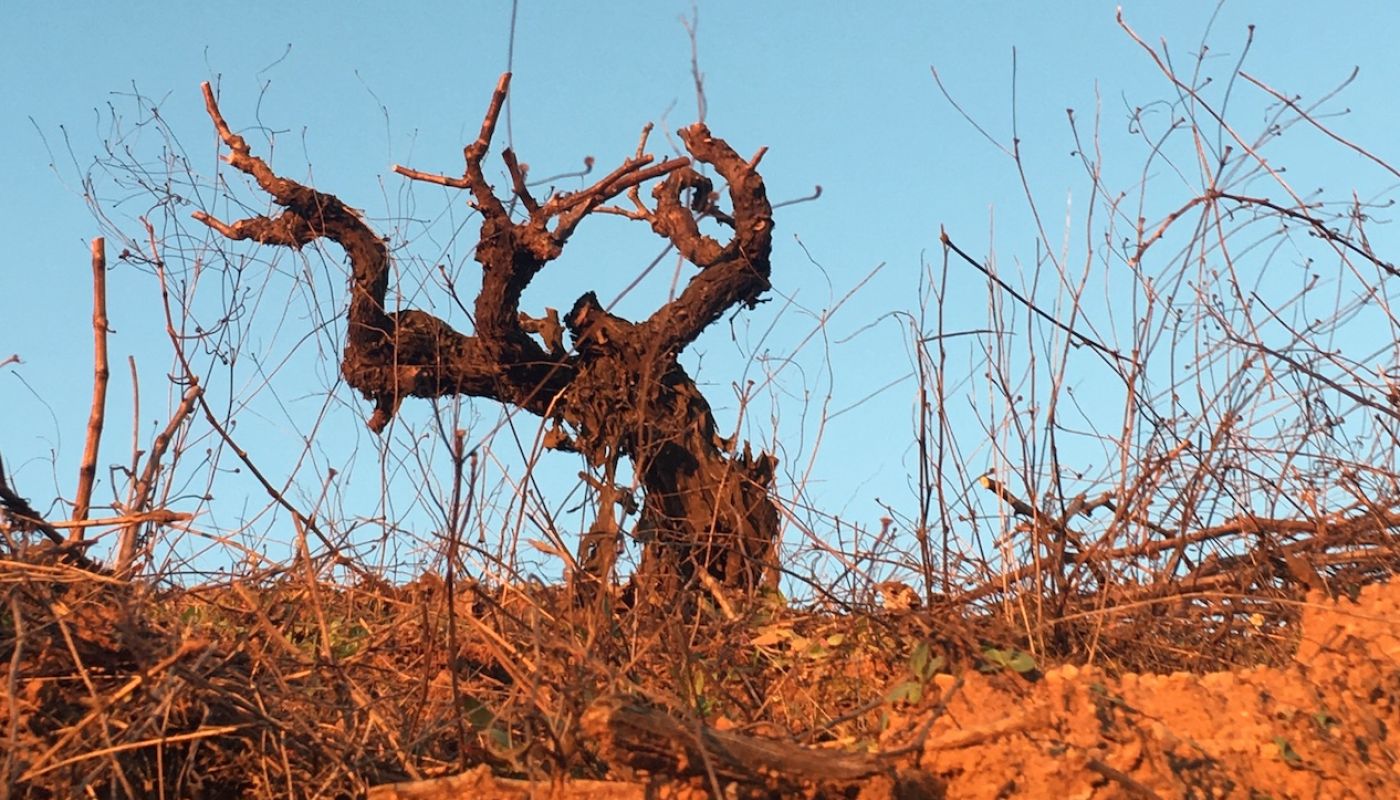
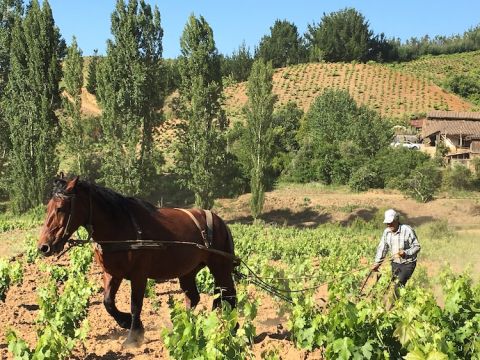
In 2014 they were able to buy a property in Itata which had very old vineyards (vines of unknown age but in excess of 100 years of age). These vineyards are the source of all their Itata wines, including their recently launched Las Olvidadas, their first País wine. The vineyards, totally organic, are worked by horse and have never been subject to any modern agricultural practices (see mainly Itata). The Itata region was long overlooked after many locals moved north following the arrival of the French who planted vines around Santiago and made that the capital city. Distance from the capital and poor transport saw them marginalised.
During the last few years De Martino have seen recognition of all this hard work. The De Martino family have been focusing on improving each vintage, both in viticulture and winemaking, always following their house style. Much research has been focused on their Santa Inés vineyard with the aim of continually improving the wines, which is how La Cancha Cabernet Sauvignon, a single-vineyard wine, was born in 2015. Most recently they have been working on improving both their bordeaux blends and Sémillon from Santa Inés.
The De Martinos’ Itata story is one of striving to make wines the way wines used to be made, a very comparable story to that of the resurgence of Swartland in South Africa (see the two regions compared in The new Chile). Old, abandoned vineyards being discovered by young and inspired winemakers. Both are now among the most exciting wine-producing regions of the world.
But this story in Chile, of natural winemaking from old, abandoned vines in Itata, finds its roots not from young winemakers looking for land they can afford, as in the Swartland, but from a family which was driven to search for authentic wine after being repelled by the direction of modern, over-manipulated, over-intense, over-alcoholic, over-concentrated and over-extracted formulaic wines of no regional distinction. Many other winemakers in Chile have become inspired to find their souls.
Jancis adds De Martino produce a raft of fascinating wines. This link will take you to all our tasting notes on 112 of them. But I happened recently to come across a relative bargain from them in a UK supermarket, presumably from that Santa Inés estate, that struck me as a little more mainstream than most of their wines. See De Martino, Limited Release Parcela 37 Cabernet Sauvignon 2018 Maipo (£10 M&S). In the UK, The Great Wine Company has taken over representation of De Martino from Berry Bros & Rudd, who have recently trimmed their portfolio substantially.