
Fashion is an important element in wine. Think of the Pinot Grigio craze, then Prosecco, Picpoul de Pinet, Pecorino… (Perhaps all that’s needed is a P?) There’s a whole entry on fashion in the Oxford Companion to Wine, though since it was written in 2014 it will doubtless be way out of date.
But fashions affect wine production as well as consumption. At the end of the last century there was a fashion for micro-oxygenation, bubbling tiny amounts of oxygen through wine to soften the tannins. At the moment putting whole berries, sometimes whole bunches, into the fermentation vat rather than crushing the grapes beforehand is à la mode.
A major barometer of fashion over the last 40 years has been the material in which wine is made and aged. The physical properties of oak are particularly suitable for wine. Small oak barrels, often called barriques, became hugely fashionable in the last two decades of the last century. Oak barrel maturation was seen as a sine qua non of making good, modern wine, Chardonnays as well as reds. The emerging wine exporters of South America, for example, would measure their sophistication in terms of how many new barrels they bought each year.
The US has a thriving cooperage industry but American oak is generally sweeter and more suitable for whiskey than for fine wine (Ridge Vineyards in California providing admirable exceptions to this generalisation). The most fashionable oak by far for wine has been French. France’s oak forests, a national treasure, are managed by a special government agency and have long provided French coopers with reliable raw material for what became a massively lucrative business supplying ambitious wine producers around the globe with barrels that cost hundreds of dollars each. Key elements in wine sales literature became the exact region where the oak was grown and how heavily it was toasted – even though insiders would probably claim that how carefully it was selected and seasoned is more important than either of these factors.
But this century has seen a new winemaking accessory du jour: a wooden fermentation vat that goes in towards the top made by an Austrian family in Waidhofen, a little town in pre-alpine countryside halfway between Salzburg and Vienna. Stockinger don’t have brochures or even a website, so unsophisticated is their sales effort. But so admired is the quality of Stockinger’s oak and workmanship that winemakers around the globe have been lining up to acquire their handiwork (which since the mid 1990s has included small barrels as well as fermentation vats).
As Robin Davis of UK importers Swig put it, ‘Stockinger seems to be the winemaker's Strad[ivarius] – a must-have to show the visitors, like a barrique in the early 1990s, a concrete egg in the 2000s, qveri in the teenies, and concrete tanks somewhere in there.’
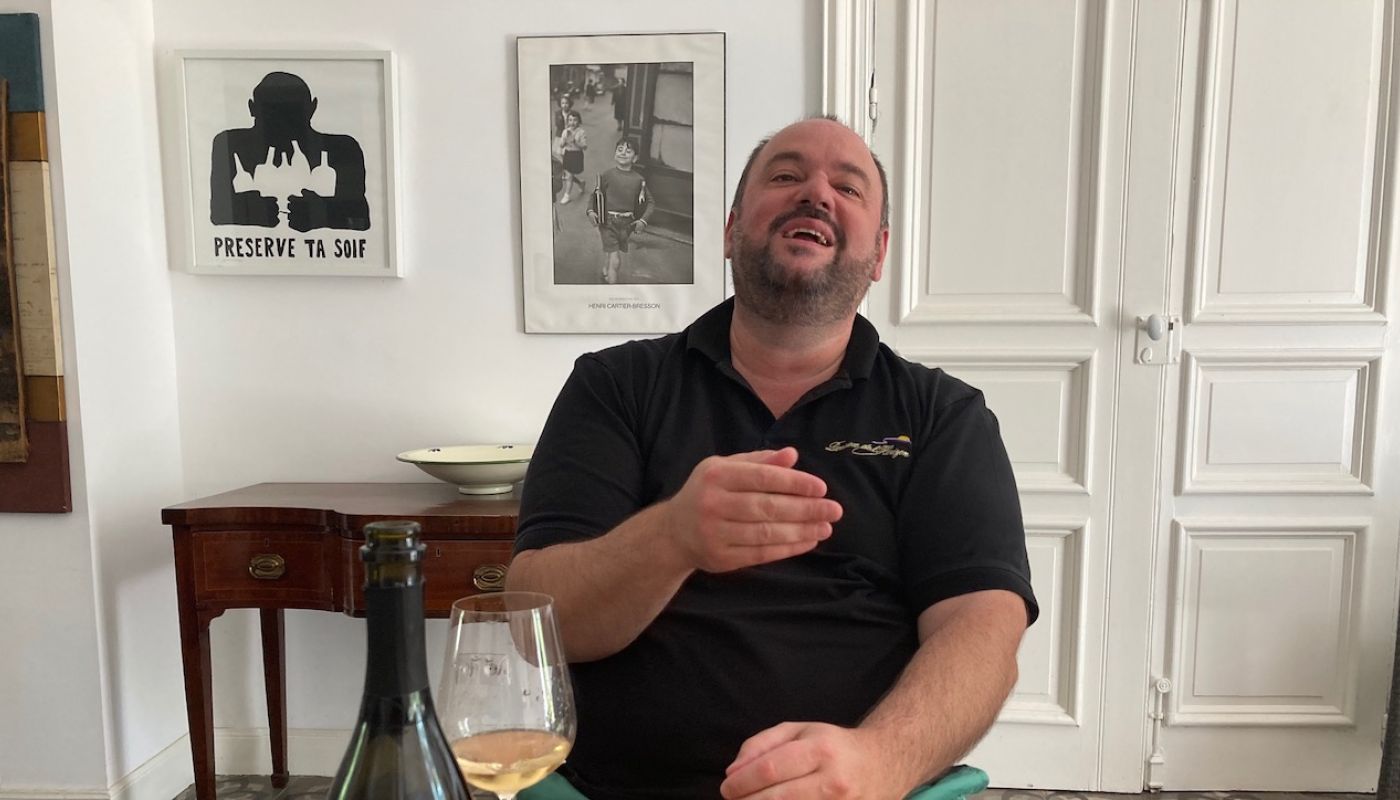
The public face of Stockinger is an ebullient German-born winemaker who runs his own small wine estate in Roussillon, south-west France. Thomas Teibert, pictured above, dropped off some wine samples at our house in the Languedoc at midday recently. We offered him coffee or water. Wine please, he said firmly, and proceeded to pour himself three glasses of Bollinger.
Teibert studied winemaking at Geisenheim (with Klaus Peter Keller in fact, who reports that he has never seen so many bottles on a table as when they dined together at Villa Mas). He worked in various wine regions including Austria, where, at Graf Hardegg winery, he was exposed to the handiwork of Stockinger in 1994 and started to represent them in Germany, working increasingly closely with Franz Stockinger. ‘He’s the wood man and I became the wine nose of the company. I developed the blends and toasts and we worked together. We didn’t like the taste of oak in the wine, so before everyone else we made an ultra-light toasting. In the beginning people said, “Why should I pay for an expensive barrel which has no barrique taste?” But little by little we established our clients and took on other markets.’
Stockinger was long admired within Austria and the first foreign wine producer to buy his famous fermentation vats, in the 1980s, had been Antinori, the important Florentine house who used them for their Tignanello and Solaia Supertuscan reds. Stockinger vats went on to be beloved by a wide range of top Italian producers such as Giacomo Conterno.
In 2003 Teibert, who had always wanted a wine domaine of his own, met Gérard Gauby of Roussillon at a particularly smart wine fair in Switzerland and liked his biodynamic wines so much that in 2004 he set up Domaine de l’Horizon in the same village, Calce, where he now has 15 ha (37 acres) of low-yielding vines up to 100 years old capable of producing some compelling wines.
A French base is useful for anyone selling barrels. Domaine de Chevalier, the Graves property making particularly subtle whites as well as reds, opened the door for Stockinger among the Bordeaux elite at a time when the tide was beginning to turn from overtly oaky wines to a subtler style. Teibert told me proudly that his favourite Languedoc producer, Rémy Pedreno of Roc d’Anglade, says there are two sorts of coopers: one of wood and one of wine.
In 2014 Teibert was introduced to California ex-sommelier and winemaker Raj Parr. A mutual friend in the wine business saw a similarity between these wine-obsessed characters and ensured they met up when both were in Beaune. The result was that Parr offered to help distribute an allocation of a few hundred Stockinger barrels in the US. Such is Parr’s social-media presence, and the reclame of Stockinger, that within two hours of a single Facebook post, the entire allocation was sold. ‘We didn’t realise we were so well known', Teibert told me proudly.
The Stockingers, father Franz and 30-year-old son Mathias, also a master cooper, do not frequent the wine circuit. Hardly drinkers, they’re much happier back home working with their 30 fellow artisans in what they claim is the oldest cooperage in the world, founded in 1516 in a town famous for its cooperages. Franz’s father bought the business in the 1950s from a family who had no successors. Ornate balconies were once a speciality but gradually wine vats and barrels took over.
French coopers, naturally enough, specialise in French oak but nowadays tend to buy some oak from eastern Europe too now that the forests there are better managed than in the communist era. Quite a few of them have come sniffing around Stockinger but it’s difficult to see why the Austrians would sell.
The Stockingers have experimented with many different oak provenances, including French, but for the moment tend to use about equal parts of Austrian (grown mainly around the capital – remember the Vienna Woods?), German, Hungarian and Romanian, Romania having some excellent forests even if not that many excellent coopers yet.
The result of over-oakiness becoming much less fashionable has been that the sort of wine producers I talk to have been buying far fewer new barrels than they used to, and also larger sizes, so that any oak flavour is less pronounced. I had imagined that this might have an effect on the bottom line of the French coopers but Teibert assured me I shouldn’t worry. There are always producers seeking barrels in new wine-producing countries such as China and anyway, ‘the US is a dream market for barrels – the best’.
France’s cooper aristocracy
All of these are bigger than Stockinger
The biggest:
François Frères group
Seguin Moreau, owned by Oeno, who also own the Diam technical cork business
Charlois group, including Berthomieu and Saury
Taransaud
Medium sized:
Damy
Vicard
Sylvain
Boutes
Dargaud & Jaegle (incorporating Vallaurine)













