Does size matter? It’s a favourite belief of wine professionals that the larger the wine bottle, the slower but more magnificent the evolution of the wine inside it. For that reason, large-format bottles generally carry a premium. The theory is that in larger bottle sizes the ratio of liquid to oxygen, assumed to govern the ageing process, is higher and therefore the reactions that comprise ageing will take place more slowly and somehow in a more stately fashion.
Part of the reason many wine producers excuse themselves from putting wine in half bottles is the argument that the wine will age inconveniently rapidly. But all these beliefs are predicated on the assumption that we live forever, which we don’t. As I get older, I become more impatient and would be delighted if all the wines in my cellar aged twice as rapidly as they are likely to. In fact, it’s rather tempting to seek out half bottles deliberately.
And one thing that rather worries me about the increasing tendency to bottle wines under screwcaps is my suspicion that they may age much more slowly than under natural corks, because there is less oxygen in the bottle – although, admittedly, quality-conscious producers are increasingly wise to this and are trying to control oxygen transmission rates, blessed OTRs, with the utmost precision.
Another reason I am a bit wary of really big bottles is closely related to the reason why so many wine producers prefer screwcaps to corks. If there’s a problem with the cork, then there’s a problem with a whole load of wine, not just 75 cl of it. And I must say that I see little evidence that the problem of cork taint is decreasing. This may be because I am lucky enough to drink a fair amount of wine that was bottled and stoppered many years ago, but that does not mean the problem doesn’t exist.
Only recently at Michael Broadbent’s ninetieth birthday dinner, fellow Master of Wine Michael Hill Smith had to halt the enthusiastic second pouring by a waiter at Brooks’s because of a badly TCA-affected bottle of the Cos d’Estournel 2001 that was so generously served to us all with our beef Wellington. One of the six bottles of a Zinfandel I presented at a tasting in Croatia a couple of months ago was mildly TCA-affected so that any taster would have been puzzled as to why I had chosen to showcase it. And those were simply the most recent examples I could remember at the time of writing. It has got to the stage where it is more remarkable to experience a multi-bottle dinner or tasting with all bottles in perfect condition than not.
I am thrilled that some cork producers can now offer, at a price, corks that are guaranteed uniformly TCA-free, but of course the sorts of wine whose producers are prepared to pay for this service are likely to be those with a long life. I may not even be around to enjoy the fruits of this new technique.
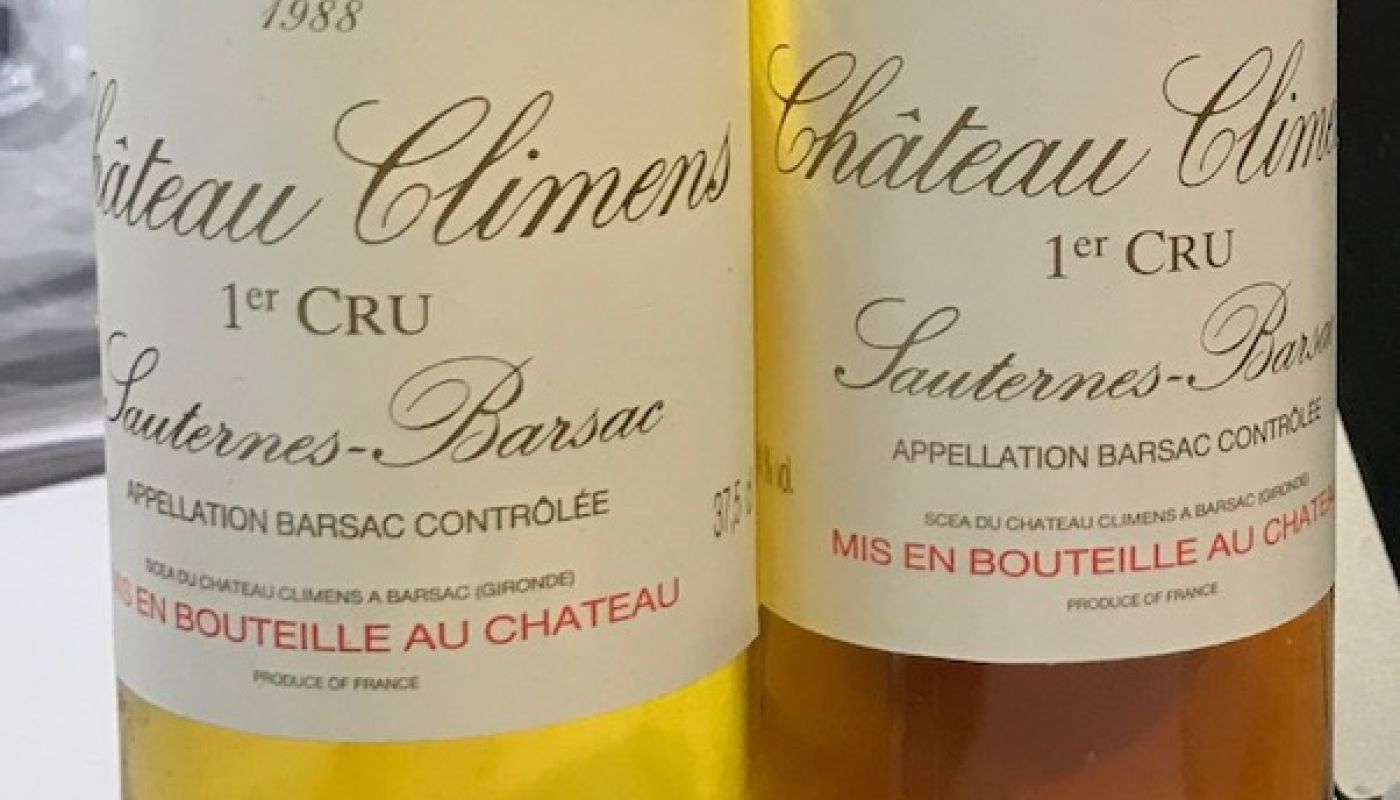
Sometimes members of our Purple Pages contact us to express their exasperation that we publish multiple tasting notes on the same wine in which the descriptions and scores may vary considerably. But that merely reflects the reality of wine. Anyone who has ever opened several bottles of the same wine to check them before an event will know just how common it is for small and sometimes big variations between individual bottles, even from the same case (see Bottle, and magnum, variation). We fairly recently moved house, which means we also, according to the removals company, moved four tons of wine. As I was unpacking cases of wine to rack in my lovely new cellar, I was particularly struck by the huge difference in colour between the 24 halves (ok, half bottles, as mentioned above) of Ch Climens 1988: from pale lemon yellow to almost tawny, as shown in the picture above.
In a clever attempt to capture the attention of London’s jaded wine media, the team behind the Pomerol estate Ch La Conseillante came over recently to treat us to a blind tasting of pairs of examples from five fine vintages – 1985, 1990, 2001, 2005 and 2009 – one from a standard bottle and one from a double magnum holding four times the volume. The idea was to explore the theory that wines last longer in a big bottle. And yes indeed they do. We were encouraged to taste the pairs from old to young and it rapidly became clear that in each case the 75-cl bottle was the first sample and the double magnum was the second. The first one in every case was lighter and more evolved, which meant that in the really old vintages – 1985 and 1990 – the better-preserved double magnum was the more enjoyable wine, but for the 2001, 2005 and 2009 vintages, it was the more mature example from the 75-cl bottle that was more fun to drink. The tannins in the double magnums made these younger examples just too surly and unevolved to enjoy as much.
And the two 2009s, the youngest vintage we examined, were still extremely similar. It seems as though the variation between bottle sizes increases with time in the bottle, which is probably what you would expect. But it did underline my suspicion that there is really only any point in paying extra for a big bottle if you are probably too young to afford one.
I took part in another blind comparison of pairs of wines from different bottle sizes fairly recently, with much less clear-cut results. Nick Baker runs a company devoted to top-quality champagne called The Finest Bubble here in London. (Actually I don’t think his customers are particularly interested in the finest bubble but what surrounds it…) He is such a champagne nut, I suspect he has formed the company merely as a tax-deductible excuse to taste as many great champagnes as possible. He had me lead a blind comparison of top bottlings, the likes of Cristal 1996 and Krug 1998, in both bottle and magnum. The results were all over the place, but then with champagne there are even more variables than with still wines, including the date of disgorgement (see Champagne – bottles v magnums).
Ho hum. Back to the drawing board. But at my age I’d say a magnum of anything is quite big enough for me.