It is undeniably true that we either do or do not live in an age of misinformation.
Your own opinion on this matter may well be determined by what appears in your social media feeds. Increasingly, algorithms prioritise those stories which are deemed most relevant to our online profiles, resulting in a so-called echo chamber effect in which a given set of beliefs are constantly validated, regardless of whether there is any truth behind them.
Furthermore, automated accounts (known as bots) can game that system by interacting with particular stories (for example, liking or re-tweeting them), thereby artificially increasing their prominence and relevance.

Twitter has come to epitomise the phenomenon. If I may dip my toe into the shark-infested waters of politics for a moment, a chastening example can be found concerning the recent American presidential election.

This quote is totally fabricated, but that didn't stop it from being shared countless times – doubtless most enthusiastically between people who were already inclined to believe it. There are of course hundreds of other examples, none of which do credit to either end of the political spectrum, Pizzagate being the most recently visible, and most bizarre.
Search Twitter for #winefact and you find a string of similarly spurious truths. They range from unsubstantiated propaganda ...

... to dubious clickbait ...

... to the inevitable prurient sniggering.

Misinformation in wine is nothing new, however.
For hundreds of years, wine was routinely adulterated. Ostensibly this was done to improve any shortcomings a wine might have – for instance, underripe Bordeaux might be beefed up by blending in a generous dose of full-bodied red from the south of France. But such practice is wide open to connivance, and it became inevitable that more sought-after wines would be cut with plonk to stretch their volume and therefore make more money.
The establishment of the appellation system and château bottling in the first half of the twentieth century was supposed to quash any such nefarious practice. Yet Georges Duboeuf of Beaujolais was convicted of fraudulent blending as recently as 2006, while South African behemoth KWV were busted in 2004 for illegally adding pyrazine flavouring to their Laborie Sauvignon Blanc.
Almost everyone who has worked in a winery is apparently familiar with such goings-on – though nobody wants to be quoted on the record, unsurprisingly. When I worked a vintage in McLaren Vale it was de rigueur to add water to a ferment to reduce its alcohol level. Once, visiting a winery in Spain, I was shown verboten oak staves discreetly attached to the inside of stainless-steel tanks containing ‘oak-aged’ white wine.
Then there are the examples of one grape variety being confused with another. Until the mid 1990s, most Chilean ‘Merlot’ was in fact made of Carmenère, while in Australia the variety sold as Albariño was identified as Savagnin in 2009. These are at least genuine mistakes – though of course in both cases a less valuable variety is misidentified as a more valuable one, which does seem rather convenient wouldn't you say, Dr Watson?
The Gallo company in California were deliberately sold Merlot and Syrah from the Languedoc, but were told it was fashionable Pinot Noir. Gallo labelled it as such for their Red Bicyclette brand. Twelve defendants were convicted of fraud in 2010 – but perhaps the real crime is that nobody who tasted the wine apparently noticed anything amiss; the discovery was not made until a routine audit. Then there was Brunellogate, when several Italian producers were indicted for fraudulently blending varieties other than Sangiovese into their Brunello di Montalcino, strictly against the appellation regulations.
Misinformation not only concerns what’s in the bottle, though – it can also be on the bottle. French brand J P Chenet was notorious for adding a layer of fake dust to its red wines in an attempt to hoodwink people into thinking it was a valuable older vintage. And labels themselves can be notoriously misleading.
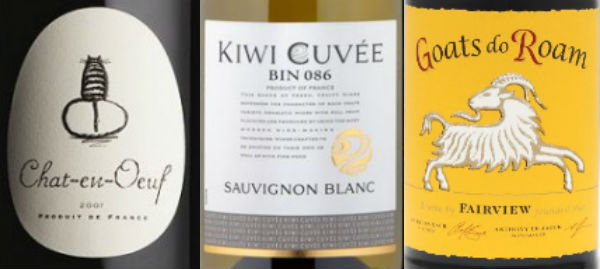
South African brand Fairview has baited the Rhône authorities for years with its soundalike Goats Do Roam brand. Another Rhône rip-off is Chat-en-Oeuf – though at least this wine originates from French grapes. But surely the ultimate example of such ‘homages’ is Kiwi Cuvée, a Loire Sauvignon Blanc designed to imitate the New Zealand versions that have been so successful.
As the saying goes: In Vino Falsitas.