Twenty five years ago, immediately after my restaurant’s book-keeper had reported that we were not trading as profitably as hoped and that we needed to make savings, I sat down with the chef Martin Lam to discuss what we could do. I still remember his response. “I’ll obviously look at everything”, he said, “except what I spend on herbs. For me herbs have the biggest impact on whatever I’m cooking and they are the one ingredient I couldn’t do without.”
At a time when many restaurateurs around the world are facing an even bigger financial challenge than the one I faced in that bygone era, I thought it would be interesting to speak to several top chefs and find out which is the one ingredient that they consider absolutely crucial to their cooking. Money was no object but, to avoid duplication, as several responses came in I did explain to those who had not yet responded which ingredients had already been taken. In the end there was only one instance of duplication, and in the face of a recession I thought it was illuminating to let two different New York chefs explain why they could not cook without black truffles.
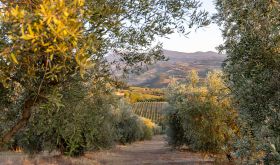
My first response came overnight from Luke Mangan, who oversees restaurants in Sydney, Tokyo and San Francisco. He chose a very particular local extra virgin olive oil, Frantoio, produced in the little village of Stuart Mill, Victoria.“I want olive oil not just because it can be used for every course including dessert – we have even poached fruits in it and made an olive oil sorbet – but also because just a little drizzle of the right stuff brings any ingredient to life.”
Over at The Walnut Tree in Abergavenny, Wales, Shaun Hill had a different take. “I think olive oil’s place is fairly secure as it figures in the descriptions of numerous dishes on the menu. I would want to safeguard quality background ingredients and as I am most careful about the stocks we make I would keep on buying veal bones. They are far more expensive than most customers realise but they make vastly superior jus and demi-glace sauces than the beef bones which the butcher will usually supply free of charge. So, veal bones please – with good unsalted butter as first reserve.”
While I had to chase several of the male chefs I had initially contacted, the responses from Myrtle Allen at Ballymaloe House outside Cork, southern Ireland, and Rose Gray at The River Café, in west London, were immediate.
Allen’s voice on the phone was as clear as her precise request. “I would choose potatoes but very specific varieties please because what many forget is that potatoes are as seasonal as any other vegetable. So what I prize most of all are Golden Wonder potatoes from autumn through the spring and then British Queen, early potatoes, from June through the summer.” I thought this a fitting tribute from Ireland’s most respected chef to the end of what has been the United Nations International Year of the Potato.
Gray said that she could never do without salted anchovies, preferably the large Cantabrian ones packed in 10 kg tins by the Spanish company Ortiz. “The flavours which anchovies give are vital for many pasta and meat sauces such as bollito misto and fish sauces such as salsa verde. And I like them on toast for breakfast with black pepper and butter. But these particular anchovies have been over-fished sadly and are becoming increasingly rare and, consequently, very expensive.”
Expensive was certainly the adjective which would unite the ingredients the three chefs I contacted in America said that they could not live without.
Jasper White at his Summer Shack restaurant in Boston said that my question was a little like deciding which of your children you would never do without, before adding that he could never run a restaurant that doesn’t sell oysters. “For me they are the ultimate first course. They stimulate the palate (and other things as well!) and they make you more hungry than you were before you ate them. And they evoke primal pleasure”, he added, just for good measure.
Separated by only 27 blocks in central Manhattan, neither Eric Ripert at Le Bernardin nor Daniel Humm at Eleven Madison Park would give up black truffles. Humm explained his choice by saying that although in the present climate it was only appropriate to be more careful with every ingredient, he would not allow it to change fundamentally his style of cooking. Ripert too openly acknowledged the economic climate but simply felt that black truffles have a mystical element about them, before adding, “I suppose you could say I’m obsessed with them.” While Ripert would carry on using them on salads and in meat stews, Humm’s repertoire will still include chicken poached with black truffles under the skin and scallops, celery and truffles.
It took two European chefs to rectify the balance towards more basic and less expensive ingredients and, ironically, it was the globally celebrated Heston Blumenthal at The Fat Duck in Bray who chose the most basic and least expensive.
“I know it is not particularly politically correct to choose table salt”, he explained through a crackly line on his mobile, “but as far as I am concerned, nothing else acts as quite such an effective flavour transformer, whatever it is used on. I am not talking about the increasing number of unusual varieties of salt that are available but the plain, simple, straightforward variety. From marinades to seasoning, salt has so many diverse uses, and I do think nutritionists give chefs an unnecessarily hard time about the relatively small amounts of salt most chefs use to enhance flavour.”
From Trussardi in Milan, Andrea Berton was equally specific and frugal.“I would never do without rice. It’s cheap, very useful in the kitchen and I love it. Obviously we use it most frequently in our risotto but we also make rice crisps, which we serve with the aperitifs. We boil the rice and then mix it with either saffron, cod, paprika or curry as a flavouring and this we freeze. Then we make small, thin discs which we fry and serve as soon as they have dried. They’re delicious.”
But is was left to Martin Lam, now the chef/proprietor of Ransome’s Dock in Battersea, which won the AA Wine List of 2008 award, and Paul Merrony at The Giaconda Dining Room in Soho to reveal two very different aspects of the restaurant as a small business.
In Lam’s case, it was that nothing had changed in his time at the stoves. “Herbs still, please. They bring a freshness and vitality to dishes, from Thai basil in a stir-fry, to coriander on Moroccan chicken, to chives in a beurre blanc, béarnaise sauce and chips. And closer to home there is not much that is not improved by liberal amounts of very fresh parsley as a dish is being served.”
Merrony asked for two ingredients, although neither is to be found in any kitchen’s cold store. The first, he explained, is what the French call ‘conscience professionnelle’ or professional integrity. “It’s all too easy to get slack when bookings are slow but that’s just the time, more than any other, when you need to keep your standards up. Then, in a general sense, every chef running their own business is just like any other business operator and we can’t operate without cash. So, I suppose, cash is my essential ingredient.”
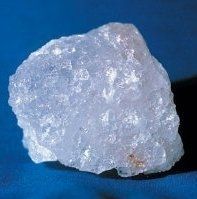
Our illustration is a rather beautiful crystal of rock salt. Which one ingrdient could you not do without? Comments below most welcome.