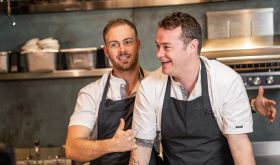
After the first of the three meals during which 80 top chefs from around the world, led by Alain Ducasse, had gathered in Monte-Carlo to pay tribute to, and celebrate the 81st birthday of, Paul Bocuse last weekend, the leading French chef over the past 40 years, Tetsuya Wakuda from Sydney Australia, climbed wearily on to the coach taking us back to our hotel.
He had every reason to feel exhausted. He had flown in that morning and the following day was to prepare what was to be one of the highlights of the lunch for over 300, fillets of red mullet slowly roasted with a light vinaigrette. Two days later he would be heading back to Sydney but nothing, he added, would have kept him away from this celebration whose precise planning had preoccupied 10 PR women for more than a year.
“I will always be grateful to Bocuse,” Tetsuya explained, “because when I was growing up in Tokyo and being taken out to eat in restaurants by my parents that was the time when his influence had become critical in imbuing Japanese chefs with the very finest French techniques and professionalism. His influence had an enormous impact on chefs in my native country and then on what I took to Australia and I think the repercussions from his first visit to Japan in 1965 have had a profound effect on chefs and restaurant goers everywhere.”
In the press conference just before the photo of all the chefs on the steps of the Casino Bocuse himself made reference to the obviously critical year of 1965 when he became then the 11th chef in France to win his third Michelin star and he had made that seminal visit to Japan. And, in an expression of the modesty which seemed to pervade his acceptance of all the expressions of gratitude that were bestowed upon him during the weekend, it was noticeable that no sooner had the first photo of all the chefs been taken than Bocuse went over to the crowd and brought out Yoshiki Tsuji, the President of the Tsuji Culinary Institute, with whose father Bocuse had made that initial, formative journey to face the cameras.
“My late father, Shizuo Tsuji, had started the school and was a regular visitor to France in the early 1960’s, “Tsuji explained over an espresso in the Hotel de Paris. “He was told by Madame Point of La Pyramide in Vienne that there was this great, new talent emerging at near Lyons and they should meet. I remember my Dad saying how he was struck by Bocuse’s strength of character and passion for French cooking but what impressed him most when he first came to Japan was how Bocuse could so intuitively recognise how Japanese cooking could shape what he was then cooking in France. It wasn’t by using our ingredients or techniques but rather by bringing out the simplicity and lightness of our food and appreciating the speed with which our chefs work. Bocuse was also the first chef to appreciate that Japanese food was very distinct from that of the rest of Asian cuisine, something that wasn’t really understood in Europe at that time.”
This working relationship continued when Tsuji decided to take over a French château as a ‘finishing school’ for his second year students. “When my Dad mentioned this to Bocuse he went of in his car to look at around 30 possible châteaux for us until he phoned to say he though he had found the most suitable one.” Tsuji’s two French chateaux (the second was named after Escoffier) are now temporary homes to 200 Japanese hardworking students and one reason why the quality of French viennoiserie and patisserie in Japan is so high.
At the same time through a strength of personality that barely seems to have diminished over the past 40 years Bocuse was emerging as the leader of the French chefs that were to dominate the last quarter of the 20th century. In his book ‘The Great Chefs of France’ published in 1978 the late Quentin Crewe describes how Bocuse had by then
And what he had also demonstrated by then was not so much how easy it is to build an international reputation as a top chef, because not that many have succeeded, but that when it can be achieved it is really only the most fitting conclusion for those able to reach the top of this creatively, and physically demanding profession. Certainly, during the first buffet dinner as many of these chefs met up with one another, there was an extraordinary air of confidence that seemed to pervade the room and the balcony overlooking the harbour where many had gone for a cigarette. There was a definite consensus that many there were at the top of a profession for which universal recognition, approval, fame and consequent financial reward had finally arrived.
It was to thank Bocuse for this breakthrough that so many chefs had travelled so far. Daniel Boulud from restaurant Daniel and Eric Ranger from the Ritz-Carlton in New York; a large Spanish contingent that included Ferran Adria and Juli Soler from El Bulli, Juan Mari Arzak, Santi Santamaria and Juan Roca; Gualtiero Marchesi and Nadia Santini from Italy and England’s Raymond Blanc. And Lea Linster from her restaurant in Frisange, Luxemburg, who for the Saturday lunch prepared the dish of lamb skilfully wrapped in a thin, crisp coat of potatoes which won the Bocuse D’Or (an annual culinary competition Bocuse created in 198 that has launched the careers of many young chefs) in 1989 and became, she confessed, the making of her restaurant. A dish, she continued, that has become so popular that she can now simply not take off her menu.
On the way to the photo shoot I was asked by a fellow writer whether I knew why amidst all these chefs who had travelled so far there were relatively few French chefs. At the lunch that followed I learnt from an astute observer of the French restaurant scene that the answer lay in the age of those French chefs present. There were a number there who were either over 60 or under 40 and that the reason for the absence of those in between was that, not surprisingly perhaps, en route to the top, a number of chefs had either fallen out with Bocuse or not got the recognition they felt they deserved. In those days, my informant continued, there was no doubt that Bocuse could be seen as Il Capo at the head of ‘the mafia’ of top chefs or even as ‘the Pope’, and that those who pleased him prospered while others didn’t. Certainly, the presentation to Bocuse after the Saturday lunch of a tall chef’s hat entirely made of gold material from the Belgian delegation which he put on with alacrity before waving to the applauding audience certainly reinforced this metaphor.
And at 81, Bocuse certainly seems to be enjoying life and restaurants, having just opened his latest outpost in Tokyo last month with Hiroyuki Hiramatsu. Sitting two places away from him over the final dinner it is possible to report with accuracy and some envy that he ate everything that was served to him during an excellent five course meal (only passing on the petits fours). And that, as most chefs do, he still eats remarkably quickly and that he was polishing off the sauce with his lamb with a piece of bread long before the rest of the table were half way through. And judging by the force with which he squeezed the bare arm of the very attractive woman almost 50 years younger than him sitting in between us lost none of his (his life over the past 30 years with simultaneously what is referred to in France as ‘his three wives’ is well chronicled in France but never discussed).
Nor does Bocuse seem to have lost sight of just what has made his exceptional career possible. At the end of the first meal he thanked and shook hands with all the young chefs. After the second, when the compere had thanked all the chefs, Bocuse interjected to pass on his thanks too to all the sommeliers and waiting staff. But even he did not witness what may be the most long standing consequence of this weekend that was a fascinating combination of French finesse and Monagesque extravagance. Just before midnight Bocuse was led out on to the balcony by eight young, scantily dressed dancers to watch the fireworks that were to go off in his honour and admire the two metre tall ‘piece montee’ that revealed a globe covered by his name, all the cities in which he was now famous and various tools of the chef’s profession. After the fireworks all the young chefs who had worked so hard over the weekend in the execution of la cuisine Francaise came forward to have their pictures taken in front of this culinary universe. And, one day, to imagine themselves as heirs to his crown.