The unlikely combination of an email from a reader in Hong Kong announcing her return to her native Singapore and the onset of temperatures close to 30 °C in London prompted a recent visit to Sedap, a small family-run restaurant whose name means 'delicious' in Malay Chinese, situated opposite an 18th-century Hawksmoor church.
Having announced that she was about to go and work for a new bank in what she calls 'chicken rice land', she signed off her email with the exhortation that on my next visit I must try Peranakan food. As my enthusiasm for this style of food had already been whetted by my last visit to Singapore, I took the Northern Line tube instead, because Peranakan or Nyonya cooking, as practised at Sedap, is one of the most fascinating styles of cooking I have ever come across.
The name refers to the descendants of Chinese traders who intermarried with women living along the British-controlled straits of Malaya or the Dutch-controlled island of Java from the late 15th and 16th centuries. The name Nyonya refers to the women who undertook the cooking and over the years absorbed so many different culinary influences: Indian dry spices, Malay curries, Thai herbs, as well as the differing styles of the many Chinese regions. Then there is the buah keluak, the nut from the kepayang tree that grows wild across Indonesia and Malaysia, and is the distinctive ingredient of Nyonya cooking.
Now over 500 years old, Nyonya cooking is far more than fusion. It is a manifestation of a very distinctive culture, and its renaissance today among young Singaporeans is due to the fact that, like many others around the world who now are finally beginning to appreciate the importance of their forebears' cooking, they see it as a nostalgic vision of the past that could, even quite recently, have so easily disappeared.
The food bears the hallmarks of the best of home cooking. Many of the time-darkened dishes are slow cooked and so take on a rich, unctuous texture. The dishes are hot, so fitting for a steamy climate, but while less spicy than Indian or Thai food, the flavours are more intense than most Chinese food. Nyonya cooking is also particularly labour intensive, and creating it is a labour of love.
True Blue, which opened in Singapore in 2003, and Candlenut Kitchen, which opened six months ago, represent very different manifestations of Nyonya cooking although both are housed in the two-storey 'shophouses' widely built during the late 19th century.
The former is located right next to the Peranakan Museum and is one of the most effective combinations of restaurant and museum I have ever come across. Old black-and-white wedding pictures adorn the walls; numerous cabinets are full of blue and white china; intricately embroidered costumes are on show alongside innumerable pairs of beaded shoes. Enlivened by a small courtyard, the room exudes Nyonya style.
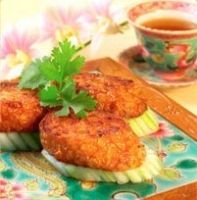
In every other respect bar one, True Blue lives up to its reputation for being 'the real thing'. It is family owned, a Nyonya tradition, created by Benjamin Seck. His mother, Daisy Seah, is the chef and his sister, Irene Ong, is the pastry chef, when she is not acting. Its elegant crockery adds extra lustre to dishes such as the banana blossom salad with cucumber; minced chicken and prawn rolls; duck with sweet coriander powder; their rendition of the classic Malaysian beef rendang, beef simmered in coconut milk; and steamed tapioca balls topped with durian, the fruit that smells so strong that my Peranakan friend ordered it specifically because his fastidious wife was not eating with us. True Blue only wavers from complete authenticity in its owners' decision not to serve the pork that is integral to Nyonyan cooking at all, out of deference to its Muslim customers.
The slight, rather nervous Malcolm Lee, who opened Candlenut Kitchen nine months ago, is at 26 young enough not to share such inhibitions. Having graduated top of the class from the main Singapore culinary academy, he could have chosen any top professional kitchen to work in but he has decided instead to cook the dishes his grandmother once prepared for him. Although she is now too infirm to visit the restaurant, she ensures that standards are maintained by sending Lee's uncle along with dishes she has cooked for her grandson to taste.
The simple, modern layout of the restaurant provides a marked contrast to a menu that includes such dishes as Mum's curry and Yeye's curry, described as a fourth-generation recipe. But as well as a definite sense of history, Lee's menu also provides a strong connection to the wild ingredients that are the building blocks of Nyonya cooking.
The candlenut, after which the restaurant is named, comes from a tree found widely across Indonesia and Malaysia, and is used as a thickening agent in curries and sambals, the popular chili-based sauce. But Lee's dish of ayam buah keluak epitomises Nyona cooking. These nuts, poisonous when first picked, have to be thoroughly soaked overnight, then cracked open to release their contents, which are combined with minced prawn, sugar and salt then pounded in a mortar before being pushed back into the shell and served with slow cooked chicken and pork ribs. They add a distinctive flavour, which some find too strong, as well as a particular aroma. The restaurant charges Sin $2 for each additional nut, a price well worth paying in my opinion.
Buah keluak nuts are rarely found outside Asia even in the few restaurants that do specialise in this particular style of cooking. Until 2009 a restaurant called Nyonya existed on a V-shaped site in Notting Hill Gate, west London, which with windows on either side seemed to replicate in some small part the heat of Singapore. But then the family members who were working there decided to set up on their own and moved to the City to open Sedap.
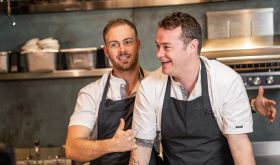
It is a family affair. Father Dheng Chye Yeoh and daughters, Julie and Purdy, run the restaurant while their mother, known to one and all as Mary Chong, is the chef. A photo of her mother hangs above the restaurant because, as Julie explained, 'Mum cooks but all the recipes are my grandmother's'. Sedap's food and friendly service attract a diverse clientele from Singaporeans living in London to the men who served in the British army in Malaysia many years ago.
Nyonya cooking occupies a distinctive place in the world today. It is part of a universal craving for what we perceive as the comforting dishes of the past. But unlike so many other cooking styles that have travelled seemingly so easily, Nyonya food is at its most authentic in that particular region of Asia where it evolved centuries ago.
Sedap www.sedap.co.uk
True Blue www.truebluecuisine.com
Candlenut Kitchen www.candlenutkitchen.com