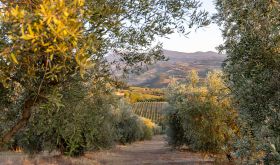
Tasmania may be treated as an anachronistic joke by some Australians but not, I would wager, by Australian wine lovers. As vine growers on the mainland struggle to cope with increasingly severe droughts, heatwaves and saline irrigation water, their counterparts in Tasmania live on a green and pleasant island cooled by Antarctic currents and westerlies off the Southern Ocean.
The wines reflect the pristine atmosphere of the Island State and Australia’s coolest climate with crisp, fresh acidity and well defined fruit flavours. In a series of tastings of such Australian varietals as Pinot Noir, Pinot Gris/Grigio and Riesling which I undertook last August, Tasmania did consistently well.
Tasmania’s most obvious attraction for Australian winemakers is as a possible source of good quality, still base wines destined to be made sparkling. Most of the rest of Australia is far too hot to produce the sort of high-acid musts needed to yield complex fizz. Tasmanian growers boast furthermore of the fact that their average yields are less than half those in Champagne, resulting in more concentrated, complex juice. Moët & Chandon were tempted to establish their base for Australian sparkling wine production here but in the end were swayed by the vastly greater potential tourist numbers in the Yarra Valley on Melbourne’s doorstep. Champagne producers Louis Roederer and Deutz both invested here at the end of the last century, only to pull out eventually. Today a significant proportion of Australia’s most admired fizz is made from Tasmanian grapes, even if the likes of Ed Carr, Hardys’ king of carbon dioxide responsible for a fizzy stable headed by the all-Tasmanian Arras, prefers to ship the ingredients back to his base in South Australia before starting the champenisation process.
Hardys bought the Tasmanian winery once occupied by Pipers Brook, and renamed it Bay of Fires, a name they give a midmarket all-Tasmanian range of sparkling wines. Other mainstream Australian wine producers who go foraging in Tasmania for suitable ingredients for their sparkling wines include Yalumba who now own the Jansz brand launched by Roederer and Taltarni whose Clover Hill fizz is made from Tasmanian fruit.
The Tasmanian sparkling wine that has impressed me most however is made on the island itself, by fifth generation Australian winemaker Stefano Lubiana who selected a hillside overlooking the Derwent estuary on the east coast of Tasmania as his perfect spot for viticulture.
Another super-talented Tasmanian winemaker who played a pivotal role in the wine history of the island is Andrew Pirie, who was for long in charge of Pipers Brook and their cheaper Ninth Island label but now oversees production at the only other winery of any real size on the island, the relatively new Tamar Ridge. He also has his own small winemaking operation at Rosevears Estate and his eponymous sparkling wine should be worth waiting for to judge by the quality of the 1999 he made while still at Pipers Brook which has been released under the name of the new Flemish owners of Pipers Brook, Kreglinger.
Today there are about 170 wineries in Tasmania but most of them are tiny. The variation in climate between Tasmania’s various wine subregions is surprising for an island the area of Ireland, which still uses the single appellation Tasmania for all its wines. The most important subregion, the Tamar Valley in the north is so much warmer than Pipers River just 35 km to the east of it that Tamar Valley grapes are regularly picked a good two weeks earlier than Pipers River ones. Grape ripening in Pipers River is slowed by winds off the Bass Strait, making it a good area for sparkling wine ingredients and such cool climate varieties as Riesling and Pinot Noir, both of which bewitching varieties thrive in Tasmania when most of mainland Australia is too hot for them. Tasmania has also managed to produce some stunning sweet botrytised Riesling.
The vineyards on the east coast of the islanc around Bicheno can also yield Pinot and Riesling that is much more refined than the Australian norm, and the fact that the east of the island is in the rain shadow of the mountains to the west helps ward off vine diseases and rot – and means that irrigation is needed here. Stefano Lubiana, Freycinet and Apsley Gorge have all built up excellent reputations here on the east coast, even if Freycinet has to sell under the name Wineglass Bay in Europe at the behest of the Spanish sparkling wine giant Freixenet. Lubiana meanwhile fell foul of Veuve Clicquot who argued that the orange on his labels was too similar to the orange used for their champagne branding. Is it assumed by international lawyers that small islanders are fair game?
Chardonnay, much of it used for sparkling wine, is the island’s most planted grape variety which does little to distinguish Tasmania from Austraslia’s other wine states. Riesling is also widely planted however and can be very refined, while Pinot Gris/Grigio is gaining ground here just as it seems to be practically everywhere else. There are strong climatic similarities between Tasmania and New Zealand which is also planting Pinot Gris at a great rate.
But where there are similarities with New Zealand, it is likely there will be some Sauvignon Blanc in the vineyards and indeed Tasmanian Sauvignon Blanc can be very impressive. For my money it is the most successful varietal in the wide range offered by Tamar Ridge, who have hired the services not just of Andrew Pirie but of internationally renowned viticulturist Dr Richard Smart. The Sauvignon clone is apparently the same as that most commonly grown in New Zealand’s Marlborough and it tastes like it, although the Tamar Ridge 2006 seems to have more concentration than many examples from Marlborough.
Perhaps the single most distinctive Tasmanian wine however is an oaked Sauvignon Blanc made at Domaine A, Swiss-born Peter Althus’s obsessively run estate in the Coal Valley in the south of the island which is, counter-intuitively, Tasmania’s warmest area. The mountains presumably shelter this subregion from the prevailing winds. It is even warm enough here to ripen the late ripening Cabernet Sauvignon pretty consistently, even if in vintages as cool as 2004 it has to be picked as late as June.
See also Roger Jones's account of his recent travels in Tassy. See winesearcher.com for international stockists.
SOME TOP TASMANIANS
Apsley Gorge Vineyard Pinot Noir 2003
Domaine A, Lady A Fumé Blanc 2004
Domaine A Cabernet Sauvignon 1999
Kreglinger Sparking 1999
Kreglinger Sparking 1999
Spring Vale Pinot Noir 2005
Stefano Lubiana Sparkling NV
Tamar Ridge Sauvignon Blanc 2006
Tamar Ridge Botrytised Riesling 2005