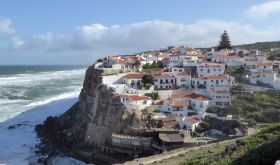
Arrived in Adelaide yesterday at 06.40 and spent the rest of the day in the city trying desperately to stay awake: by tram to the sea in the suburb of Glenelg; a brief foray into the art gallery and the museum and a wander along the river right behind our hotel. I passed up the once-in-a year opportunity to see inside Government House, the Governor’s residence just down the road from our hotel, because the queue was so long and because an elderly lady in the queue said it was ‘very English’.
In the evening the 12 participants on the tutorial, from all corners of the world, were treated to a welcome dinner at the excellent Sparrow Kitchen and Bar in north Adelaide, with a few well-chosen bottles, including Crawford River Riesling 2006 from Henty in Victoria, one of Jancis’s favourites. A good match with the kingfish and cockles.
Today, Monday, began early, setting the tone for an intensive week of hard labour. Our minibus crawled through Adelaide’s rush hour traffic to the Australian Wine Research Institute (AWRI) for an overview of their work and an introduction to their Advanced Wine Assessment Course (AWAC).
The Institute is funded by the compulsory levy on growers and winemakers and by the government, which matches the money raised by the levy. There are also contributions from related industries such as coopers and bottle manufacturers.
Their work is impressive in scope and depth and falls under four headings: research (about 70% of what they do), development (new techniques such as non-intrusive tests using NRI spectroscopy), extension (dissemination of research to grape growers and winemakers), and commercial (sale of analytical services). I’ll be spending a day at the AWRI next week so may have more to report later.
There’s talk of ‘management processes’ and ‘modulation of flavour’ and it all sounds a long way from the romantic view of the artisan winemaker, but the point is to be able to understand what happens in the vineyards and winery so that you have the choice to exercise more or less control. One recent project was the identification of the compound in Shiraz (rotundone) that gives a spicy flavour, so a producer can fine-tune his or her viticulture and vinification to have more or less of this particular character. I guess it’s something you might work out by trial and error over many years but there are so many variables that it could take decades. It’s not as if the artisan winemaker doesn’t make choices, just that they may not know the consequences of their choices.
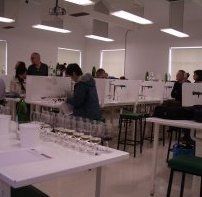
The Advanced Wine Assessment Course normally takes four days but we had two hours to go through two flights of wines (as pictured): 10 Shiraz and 10 Riesling. There were repeats in the line up, not to intimidate us, they protested, but to train us to put aside the factors that can influence objective judgement: emotion (what happened on the way to the forum), physiology (especially tiredness, eg jet lag or palate fatigue), preceding wines, environment. I found the third of these the most intrusive, though tiredness also played a part after a jet-lag affected night. It’s all considered good training, particularly for the Australian show judging system, where the emphasis is less on medal stickers on bottles for the benefit of the consumer and more on ‘improving the breed’ for the benefit of producers and the industry as a whole.
Our taste of the training seemed to be designed mainly as a bonding activity for the 12 tutorial participants – encouraging people to speak up and stand up for wines they scored highly (as in any group, some members needed no encouragement to speak up). My own consistency was reasonable but less than I would have liked [ie only 99%? JR] and I found that the preceding wine or wines was the most intrusive factor. For example, I judged a full-flavoured, lime and toast, crisp 2003 Riesling more highly after another similar (but not such good) wine than when I tasted it after a run of four more delicate, floral and citrus styles. Another factor was knowing that there were repeat wines, making it all too tempting to try to identify the repeats to avoid embarrassment later rather than concentrating on each wine, one at a time, and its intrinsic quality.
Suitably armed, and sobered by the demands of judging consistently and objectively, we boarded the bus and headed for the Barossa and the luxurious Louise hotel for a very quick sandwich lunch and our first session in the tutorial: Australia’s regional classics, presented by tutors Michael Hill Smith AM, MW, Andrew Caillard MW and Dr Tony Jordan.
This was pretty similar to the London Landmark tasting I went to in London just over a year ago. The aim was to present a small selection of benchmark wines that demonstrated optimal partnerships of grape variety and region. I’ll be posting my tasting notes when I get back but here’s a list of the wines:
2008 Grosset Wines Polish Hill Riesling, Clare Valley
2002 Pewsey Vale, The Contours Riesling, Eden Valley
1998 Tyrrell's Wines Vat 1 Semillon, Hunter
2005 Leeuwin Estate Art Series Chardonnay, Margaret River
2006 Petaluma Piccadilly Valley Chardonnay, Adelaide Hills
2006 By Farr Sangreal Pinot Noir, Geelong
2001 Cullen Wines Diana Madeline Cabernet Sauvignon/Merlot, Margaret River
2004 Wynns Coonawarra Estate John Riddoch, Cabernet Sauvignon, Coonawarra
1998 Brokenwood Graveyard Vineyard Shiraz, Hunter
2004 Mt Langi Ghiran Langi Shiraz, Grampians
2006 Henshke Mt Eldestone Shiraz, Eden Valley
2004 Penfolds RWT Shiraz, Barossa Valley
2006 Glaetzer Anaperenna Shiraz/Cabernet Sauvignon, Barossa Valley
2006 De Bortoli Noble One Botrytis Semillon, Riverina
The quality of the range was consistently high though the selection was, inevitably, fairly predictable. But this was setting the scene for the sessions to follow, where we will look at all the major varieties from a wider range of regions and styles.
Aside from the wines and the first stunning view of the sun on the Barossa Ranges (sorry, moving too fast to get a pic), the highlight of my day was free wifi access in my room [a woman after my own heart – JR] in the very beautiful Louise hotel, after the rapacious 55 cents a minute and the tether of an ethernet cable at the Hyatt in Adelaide.
Now a dash to the themed dinner: Australia’s fine wines, including, apparently, a vertical tasting of McWilliams Lovedale Semillon from the Hunter Valley.
Tomorrow: Riesling with Jeffrey Grosset; Shiraz and blends with Stephen Pannell; ‘a historic perspective’ set at Barossa Valley Estates; and, for those with stamina, a tour of the Seppeltsfield winery.
For all related articles and tasting notes, see Landmark Australia – a guide.