See also my tasting notes on the competition wines, listed at the end of the article.
Blind tasting is a very odd activity. Contrary to what many presuppose, it has nothing to do with blindfolds. It involves tasting a wine without seeing the label and it can deliver shocking surprises. I tasted seven non-vintage champagnes blind with a group of professionals recently. The group was horrified to find that the wine most of them preferred carried a label they regarded as their least favourite. That sort of result is especially common with champagne, arguably the most image-driven, rather than quality-driven, wine of all. But it happens all the time when wine is tasted blind.
Because I'm interested in how wines really taste as opposed to how I think they should, I taste wine blind as often as I can, especially when assessing similar young wines. But blind tasting when you know absolutely nothing about the wine in front of you is something completely different. The notoriously difficult Master of Wine exams include three sessions during each of which you have a dozen glasses in front of you and nothing more helpful than a printed exam paper asking you to identify each wine as closely as possible, and assess its quality.
Now that the MW is behind me, I taste wine completely blind only very rarely, and never in public. (When I started out in wine everyone expected me to get it wrong and noticed only when I got it right – today the reverse is true.) So my blind tastings today are either round the dinner table with good friends and once a year when I act as a judge, with Hugh Johnson, in the Oxford v Cambridge wine-tasting competition.
This is the most extraordinary Varsity match, always held well before the Boat Race but taken just as seriously nowadays. This year's taste-off took place at the end of last month, as usual in the Oxford and Cambridge Club on Pall Mall in London. The teams of six plus a reserve had been training since the beginning of the academic year. The Cambridge coach, a past competitor who has served in the US Army in Iraq and signs himself Major Dave, puts them through five blind tastings a week in the month leading up to the match.
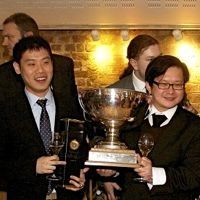
The Oxford coach, historian Hanneke Wilson (third from the right in the photo below), inflicts a similar routine, including a 12-bottle tasting under match conditions every Saturday afternoon. Captain of her team was Brunei-born biophysicist Ren Lim (holding the cup), whom I had met at last year's competition where he was crowned top taster. Another alumnus of the Oxford team, Alex Hunt, now a Master of Wine and professional wine buyer, told me how he'd been drafted in to organise some practice tasting this year and Ren had nailed a 2011 Pinot Grigio from Collio precisely. Such precision, I should report, is rare.

When I attended my first Oxbridge wine-tasting competition brothers from Hong Kong were competing and this was thought hugely novel. In this year's teams, six out of the 14 had Asian surnames, and the Cambridge team included an American, a Pole and a Lithuanian doing a PhD in 'automatic emotion prediction in music'. I do hope none of them is neglecting their studies for wine. The top Cambridge taster Stefan Kuppen was a Dutch ex investment banker and the top Oxford taster with exactly the same score (140 points out of a possible 240) was a first timer, Balliol chemistry PhD student Tom Arnold.
In the end Oxford won by a dribble, 689 to 677 marks, and the Cambridge captain Ellie Kim, a second-time competitor who grew up in Korea and Canada, was distraught. 'I can't believe it', she kept repeating when the results were announced in Berry Bros' cellars across the road, making me as co-marker feel decidedly guilty. Hugh and I always taste blind ourselves first so that we can judge what incorrect guesses we feel are admissible. And then, on the anonymous but numbered papers submitted, we allot up to five marks for the dominant grape variety, up to eight for geographical origin, up to two for vintage and up to five for the, generally almost illegible, written comments on each wine.
Usually the wines are fairly run of the mill but this year Pol Roger champagne, who have sponsored the event since 1992, decided to celebrate the sixtieth anniversary of the competition (started by Harry Waugh of Harveys of Bristol when Sir Winston Churchill was prime minister, we were reminded) by persuading some of the world's finest wine producers to donate some of their finest wines. So it was that we were treated to the likes of Le Montrachet and first growth Château Haut-Brion, not to mention a 1953 to celebrate the anniversary. (See below for the complete list.)
I was reminded of how, when asked to give tips to Master of Wine students on the tasting papers, I assured them that they would never be served a first growth since the Institute couldn't possibly afford one. The next year the red wines set before the candidates included three vintages of Château Lafite. (This was long before Chinese inflation of that particular first growth's prices.)
None of the tasters this year seemed to realise that the wines were quite so smart, but that's not surprising since blind tasting is the least flattering way to show off a wine. And very probably many of the student competitors had never tasted a first growth, much less a wine from the 1950s.
The same could not be said for two other teams – wine writers v wine trade – who, exceptionally to celebrate the anniversary, were given exactly the same wines to identify in a separate room, their papers marked by senior Masters of Wine Anthony Hanson and Sebastian Payne. (In the action photo below, Alex Hunt MW can be seen, head down, concentrating hard at the far end of the table.) The atmosphere in their room was so competitively tense that at one point Cassidy Dart, Pol Roger's selector of the blind wines, refused to enter.

In the event the scores of wine writers Oz Clarke, Matthew Jukes, Will Lyons, Peter Richards MW, Anthony Rose, Michael Schuster and Joe Wadsack were even closer to those of the trade team of five Masters of Wine and two Master Sommeliers and the trade won by just six points. But the top individual taster with a score of 176 was, much to his surprise, Anthony Rose of The Independent. Judge Sebastian Payne MW grudgingly admitted, 'I must say I have new respect for you hacks. You're actually quite good at your job.'
WHITES
Huet, Clos du Bourg Sec 2011 Vouvray, Loire
Ch de Beaucastel, Vieilles Vignes 2011 Châteauneuf-du-Pape, Rhône
Marquis de Laguiche 2008 Le Montrachet, Burgundy
Egon Müller, Scharzhofberger Auslese 1987 Mosel, Germany
Georges Vernay, Coteau de Vernon 2010 Condrieu, Rhône
Ch Climens 2004 Barsac, Bordeaux
REDS
Clos Rougeard, Les Poyeaux 2006 Saumur-Champigny, Loire
Dom Dujac, Aux Malconsorts Premier Cru 2006 Vosne-Romanée
Biondi-Santi, Riserva 2006 Brunello di Montalcino, Tuscany
Ch Haut-Brion 1995 Pessac-Léognan, Bordeaux
Vega Sicilia, Unico 1953 Ribera del Duero, Spain
Kongsgaard Syrah 2009 Carneros, California
See also my tasting notes on these wines.