See my tasting notes on Domaine de l'Amandyère's wines and use the tasting notes search to find those on Thousand Candles.
I'm becoming increasingly concerned about launch prices for unknown wines. You can, for example, buy a bottle of Stéphane Serre's L'Indivisible Languedoc red for 235 euros, that's about £200 or $300. His L'Anoblie is 630 euros – a bottle.
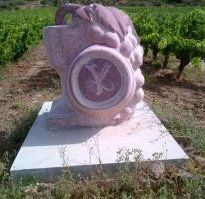
His wines do not carry a specific appellation, supposedly the top rank of France's wine, because he wants to distinguish them from those of his neighbours in the tiny Corbières village of Montlaur. So he sells his range of colour-coded bottlings as mere Vin de France. Referring to Appellation d'Origine Contrôlée regulations, he says, 'our research is too important to be curbed by bureaucracy'. You probably won't have heard of his Domaine de l'Amandyère (a fancy way of spelling the French for almond tree) because he hasn't actually managed to sell very much yet. As he puts it, 'I need to develop my commercial network'. He has, on the other hand, found time to install the marble sculpture engraved with his Y logo in one of his two isolated vineyards.
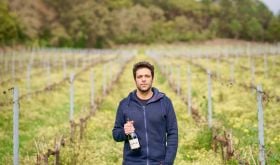
Intense, shaven-headed and in his early forties, this 'artisan wine jeweller', as he calls himself, only recently returned to his family's vine-growing roots and has certainly put his all into production, even if, for someone whose previous experience was in marketing, he has been surprisingly slow on the sales side. He has yet to sell his first vintage, 2009, and the next three vintages sit in various small tanks and casks in a barn that was decidedly warm when I visited. But he and his accomplice Serge Mazet (on the left in the photograph) could not be faulted for ingenuity.
From his four hectares of vines they apparently reject so many grapes as substandard that they are proud of counting production in litres rather than hectolitres, and yet they have managed to make no fewer than seven different wines from the 2009 vintage, called things like L'Extravagante and L'Elliptique, and plan even more for successive vintages. As Stéphane put it defiantly to me, 'I make wine for me, not for others.' Serge quickly corrected this commercially bold statement by adding, 'but to share'.
Part of the reason for their lack of interest in sales effort is clearly because the two of them have so enjoyed the viticulture and vinification, experimenting with techniques far more intricate than their neighbours. The results are undoubtedly different from and much richer and later-picked than the average Corbières. But would I think of buying one of their mixed cases of a dozen bottles at 2,000 euros, however beautifully presented? Not for one minute.
Most of Serres' wines, I should point out, are a mere 164 euros a bottle and can be found at Vins et Vinos, 38 rue Barbès, 11000 Carcassonne, France.
But this is just one example of the many brand-new wine enterprises today that seem powered by the belief that more is more, particularly with regard to launch prices per bottle. My jaw dropped recently when researching the background to a new wine from Australia, Thousand Candles. This is an unusual Shiraz-dominated blend from a single vineyard in the Yarra Valley outside Melbourne. It is made by William Downie, an early and gifted member of the admirable new wave of young winemakers determined to produce wines very different from the high-octane Shirazes that used to represent the Australian mainstream.
Also involved is Paul Henry, a skilled marketeer who was at one stage in charge of presenting Australian wine generically to the outside world. Perhaps it was he who advised an attention-grabbing release price of AU$100 – about £65 or $90 – a bottle for the first, 2011, vintage, which was admittedly one of Australia's wettest ever. Downie, a Pinot Noir enthusiast, is a fan of whole-bunch fermentation, a controversial Burgundian technique which involves including all the stems in the fermentation vat. The 2012 is much better but Thousand Candles 2011 tastes like a pastiche of this style, threaded through with the green stemmy character of an underripe vintage and real tartness. Henry quite rightly describes it as 'a Marmite wine that people will either love or hate' (presumably it is assumed in Australia that everyone loves Vegemite). This is certainly a wine that will be talked about, and there is a certain faction in the Australian wine business that presents ambitious pricing as a virtue, bravely establishing the fact that Australia can produce wines with sky-high prices too.
But, while I would be the last to condone the stratosphere-high prices of France's most expensive wines, Bordeaux's first growths being the most obvious examples, they at least have a track record proven over nearly two centuries. It has also been demonstrated that these wines can mature for decades, and there is a well-established secondary market for them.
A decade or so ago, outfits such as Heritage Fine Wines and Orb Wines opportunistically tried to convince investors that a portfolio of unknown Australian wines was a good bet. It all went horribly wrong. But with Thousand Candles, everything fell into place when I discovered it is primarily aimed at the Asian market, and that total production is apparently only 650 dozen-bottle cases. Rarity of course can be used to justify high prices, up to a point, but there is huge variation in different markets' reaction to high prices.
Although the Chinese economy may not sustain this, there have until now been enough well-heeled Chinese wine buyers to encourage producers to aim for the sky with their prices, for both Chinese and imported wines. In a wine market as relatively inexperienced as most Asian ones there is widespread, if misplaced, belief in a direct correlation between price and quality.
The same has been true for many of those in the massive wave of new American wine enthusiasts. The recovering US economy has sustained Napa Valley Cabernets in their position as some of the most expensive wines on the planet. And only last week I was emailed by the admirable sommelier-turned-wine-producer Rajat Parr about his brand new Central Coast venture Domaine de la Côte ($90 for the top bottling). 'I will be in touch soon to let you know your specific allocation', he cheerily assured me, and presumably everyone else on his mailing list. European wine producers selling to hardened, price-sensitive wine buyers on their side of the Atlantic would kill to be able to use this technique.
The joke is that wine is not really very expensive to make. Production costs of even the grandest red bordeaux are rarely more than 10 euros a bottle, 30 euros at most if the Château is run on bank borrowings.
And as for the specially fashioned 'icon' bottlings pulled out of a hat by so many New World producers nowadays, don't get me started – except to repeat the comment, 'icon: is that one word or two?'
MORE BACKGROUND
First find your grapes, then your name, and then your website. Customers come much later.
There is much to enjoy on these beauties:
www.domainedelamandyere.com
www.thousandcandles.com.au
www.domainedelacote.com
See my tasting notes on Domaine de l'Amandyère's wines and use the tasting notes search to find those on Thousand Candles.