Even after a delicious bowl of pumpkin soup with girolles and hazelnuts at Magdalen, which opened no more than a five minute walk from London Bridge station in early January, there was still a knot in the pit of my stomach.
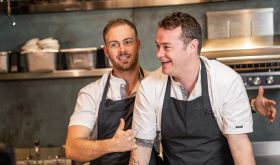
But the fact that it was there was entirely my fault and nothing to do with the good food being cooked here by husband and wife team James and Emma Faulks and their obviously understanding sous chef David Abbott. I was feeling that way because en route to our table on the first floor I had walked past the bar behind which it was plain to see the two electric lifts which are there to bring the food up from the basement kitchen.
These lifts are very common in restaurants as so often the kitchen is in the least expensive, and invariably windowless, subterranean depths. But as someone who worked with them for the best part of a decade in a tall, thin building on four floors where four lifts carried the food from the kitchen to as many as 180 customers above ground, I still find they generate more than a frisson of fear.
That feeling is based not only on the fact that certainly 20 years ago their engineering was temperamental. They tended to break down just before the restaurant was busy or at the weekend and getting them repaired quickly invariably proved expensive. Lifts also limit the menu. Any dish which does not travel easily, such as a soufflé, is obviously not possible, nor are more prosaic dishes like pasta very easy as the sauces can congeal between the chef and the customer. Chefs have to be careful with the richer sauces based on veal stock too because these tend to develop a skin (Magdalen sensibly eschews these completely) and there is the extra challenge during any cold period of ensuring that the food does not become too cold on its travels (although the plates cannot be too hot for the waiters’ or the customers’ sake).
To discover how this young, talented trio were coping with their lifts I spent some time observing them in their basement kitchen in which they had worked every lunch and dinner since they opened living a life, as James explained, where ‘we only see daylight on Sundays’.
Before descending the narrow staircase that leads from the ground floor restaurant to the kitchen, I spent some time with Magdalen’s fairygodfather and James’s real father, Roger. An engineer by training, he has found that the sale of his business a couple of years had serendipitously provided the £750,000 necessary to gut what was formerly a Peruvian restaurant and to build a completely a new and comfortable interior. “It was fortunate that we were forced to do it this way by the state of the interior because it meant that once we realised we had to use lifts we could install them first and then construct the rest of the restaurant around them.” And as Magdalen has got off to a flying start without using any PR but just by offering a 50% discount on its food for the first week he has come to realise quite how shrewd his investment may prove. “I knew James was a good chef but not this good,” he said proudly. “Nepotism only goes so far.”
Magdalen’s set of double lifts – one to take the food up in and the other to bring the dirty crockery down in – are certainly sparkling new and have cleverly been installed on separate circuits in case one breaks down. The kitchen is also supplemented by more advanced technology. As in many kitchens today there is a TV screen which allows the chefs to keep an eye on what is going on in four different parts of their restaurant and where James stands there is a ServAlert machine which buzzes to the waiting staff on the first floor that the food lift is on its way. James reported it emits an increasingly annoying buzz should they fail to empty the lift immediately.
The kitchen may be windowless and barely high enough to accommodate Abbott but it is clearly delineated, at least initially. Emma, the pastry chef, works in the coolest part away from the main ovens and during my visit was baking pastry shells that were the base of a chocolate tart for two that she knew would be a big seller on their Valentine’s dinner menu that night. James works by the Micros printer which sends the orders down from two floors above, calls the orders and prepares the cold first courses while David patrols the range concentrating on any hot starters, such as the foie gras with glazed chicory or the lentil soup with a warm egg yolk and bacon, and getting the main courses under way.
But in a small kitchen such neat divisions of labour do not last long. Once the orders started coming in, Emma had come across from her section to cut the apple into the celeriac remoulade that accompanies the smoked eel starter and then was helping James load the cold starters into the lift as soon as they were ready. Even though they may be part of a table’s order that includes hot starters another challenge of a basement kitchen linked by lifts is not just ensuring that the hot food stays hot but also that once the cold food is ready it does not become too warm from staying too close to the stoves. Putting these dishes straight into the lift prevents this. A few minutes later, Emma was taking the skin off the smoked haddock they serve with choucroute, Morteau sausage and a butter sauce while David was slicing a roast rib of Hereford beef, another dish for two to share that has proved extremely popular.
In many ways Magdalen’s robust, straightforward style of cooking is not too affected by the kitchen’s location or reliance on lifts. They extract the maximum flavour from the terrines they produce and a particularly wholesome jellied rabbit with grain mustard. The main courses come fully garnished with vegetables and potatoes so there is no waiting for any extra side dishes and certainly nothing extra was needed for a fillet of brill on the bone with diced fennel and brown shrimps or a braised hare leg with polenta. Only one dish of the three meals I have enjoyed at Magdalen suffered and that was because the ox tongue had been cut too thin so that it toughened up during its journey. Emma’s desserts are a delight, particularly her lemon pot with cassis.
But what is most impressive about Magdalen, part of an up and coming area close to the More London redevelopment, is that nothing jars. Its menu is in keeping with its low-key interior where the focus of the investment has obviously been on the food. There are no flowers on the tables. Paper tablecloths minimise the cost of replacing the linen underneath too regularly and there is no expensive art on the wall. The menu prices reflect this with my most expensive meal there for five costing £40 per person with wine but not service. This will leave enough, I hope, for the Faulks to have something to spend on their Sundays off during the rest of their 25 year lease.
Magadalen, 152 Tooley Street, London SE1 2TU. 020-7403 1342. Closed Sunday and Monday lunch.
Even after a delicious bowl of pumpkin soup with girolles and hazelnuts at Magdalen, which opened no more than a five minute walk from London Bridge station in early January, there was still a knot in the pit of my stomach.
But the fact that it was there was entirely my fault and nothing to do with the good food being cooked here by husband and wife team James and Emma Faulks and their obviously understanding sous chef David Abbott. I was feeling that way because en route to our table on the first floor I had walked past the bar behind which it was plain to see the two electric lifts which are there to bring the food up from the basement kitchen.
These lifts are very common in restaurants as so often the kitchen is in the least expensive, and invariably windowless, subterranean depths. But as someone who worked with them for the best part of a decade in a tall, thin building on four floors where four lifts carried the food from the kitchen to as many as 180 customers above ground, I still find they generate more than a frisson of fear.
That feeling is based not only on the fact that certainly 20 years ago their engineering was temperamental. They tended to break down just before the restaurant was busy or at the weekend and getting them repaired quickly invariably proved expensive. Lifts also limit the menu. Any dish which does not travel easily, such as a soufflé, is obviously not possible, nor are more prosaic dishes like pasta very easy as the sauces can congeal between the chef and the customer. Chefs have to be careful with the richer sauces based on veal stock too because these tend to develop a skin (Magdalen sensibly eschews these completely) and there is the extra challenge during any cold period of ensuring that the food does not become too cold on its travels (although the plates cannot be too hot for the waiters’ or the customers’ sake).
To discover how this young, talented trio were coping with their lifts I spent some time observing them in their basement kitchen in which they had worked every lunch and dinner since they opened living a life, as James explained, where ‘we only see daylight on Sundays’.
Before descending the narrow staircase that leads from the ground floor restaurant to the kitchen, I spent some time with Magdalen’s fairygodfather and James’s real father, Roger. An engineer by training, he has found that the sale of his business a couple of years had serendipitously provided the £750,000 necessary to gut what was formerly a Peruvian restaurant and to build a completely a new and comfortable interior. “It was fortunate that we were forced to do it this way by the state of the interior because it meant that once we realised we had to use lifts we could install them first and then construct the rest of the restaurant around them.” And as Magdalen has got off to a flying start without using any PR but just by offering a 50% discount on its food for the first week he has come to realise quite how shrewd his investment may prove. “I knew James was a good chef but not this good,” he said proudly. “Nepotism only goes so far.”
Magdalen’s set of double lifts – one to take the food up in and the other to bring the dirty crockery down in – are certainly sparkling new and have cleverly been installed on separate circuits in case one breaks down. The kitchen is also supplemented by more advanced technology. As in many kitchens today there is a TV screen which allows the chefs to keep an eye on what is going on in four different parts of their restaurant and where James stands there is a ServAlert machine which buzzes to the waiting staff on the first floor that the food lift is on its way. James reported it emits an increasingly annoying buzz should they fail to empty the lift immediately.
The kitchen may be windowless and barely high enough to accommodate Abbott but it is clearly delineated, at least initially. Emma, the pastry chef, works in the coolest part away from the main ovens and during my visit was baking pastry shells that were the base of a chocolate tart for two that she knew would be a big seller on their Valentine’s dinner menu that night. James works by the Micros printer which sends the orders down from two floors above, calls the orders and prepares the cold first courses while David patrols the range concentrating on any hot starters, such as the foie gras with glazed chicory or the lentil soup with a warm egg yolk and bacon, and getting the main courses under way.
But in a small kitchen such neat divisions of labour do not last long. Once the orders started coming in, Emma had come across from her section to cut the apple into the celeriac remoulade that accompanies the smoked eel starter and then was helping James load the cold starters into the lift as soon as they were ready. Even though they may be part of a table’s order that includes hot starters another challenge of a basement kitchen linked by lifts is not just ensuring that the hot food stays hot but also that once the cold food is ready it does not become too warm from staying too close to the stoves. Putting these dishes straight into the lift prevents this. A few minutes later, Emma was taking the skin off the smoked haddock they serve with choucroute, Morteau sausage and a butter sauce while David was slicing a roast rib of Hereford beef, another dish for two to share that has proved extremely popular.
In many ways Magdalen’s robust, straightforward style of cooking is not too affected by the kitchen’s location or reliance on lifts. They extract the maximum flavour from the terrines they produce and a particularly wholesome jellied rabbit with grain mustard. The main courses come fully garnished with vegetables and potatoes so there is no waiting for any extra side dishes and certainly nothing extra was needed for a fillet of brill on the bone with diced fennel and brown shrimps or a braised hare leg with polenta. Only one dish of the three meals I have enjoyed at Magdalen suffered and that was because the ox tongue had been cut too thin so that it toughened up during its journey. Emma’s desserts are a delight, particularly her lemon pot with cassis.
But what is most impressive about Magdalen, part of an up and coming area close to the More London redevelopment, is that nothing jars. Its menu is in keeping with its low-key interior where the focus of the investment has obviously been on the food. There are no flowers on the tables. Paper tablecloths minimise the cost of replacing the linen underneath too regularly and there is no expensive art on the wall. The menu prices reflect this with my most expensive meal there for five costing £40 per person with wine but not service. This will leave enough, I hope, for the Faulks to have something to spend on their Sundays off during the rest of their 25 year lease.
Magadalen, 152 Tooley Street, London SE1 2TU. 020-7403 1342. Closed Sunday and Monday lunch.