
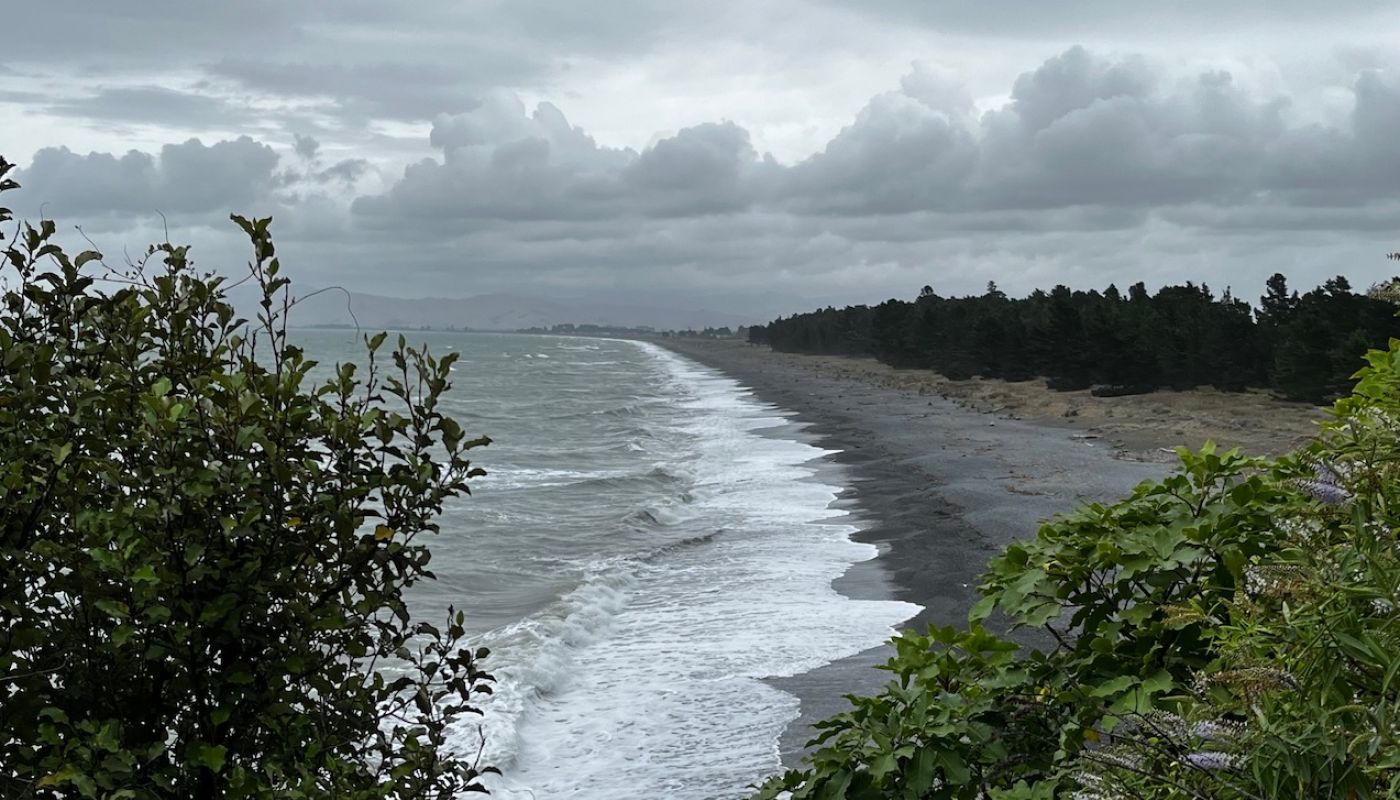
Fifty years ago Marlborough in the far north of New Zealand’s South Island was a region with one small country town, called Blenheim for reasons historians will understand, and a few hundred subsistence farmers with sheep, tobacco, garlic and orchard fruit. But in 1973 a new crop was essayed in this wide, flat valley when the first grapevines went into the ground.
At first they failed to thrive. But two years later Montana Wines (today rebranded as Brancott Estate) trialled the Sauvignon Blanc grape, releasing its first commercial vintage in 1979. David Hohnen of Cape Mentelle winery in Western Australia was so impressed by Marlborough Sauvignon Blanc that he and his young winemaker Kevin Judd launched their own brand of it, Cloudy Bay. (See Hohnen’s account of this in our BBC2 series in 1995.) The main image above is of Cloudy Bay itself, under cyclonic clouds last month.
This was at a time when cool climates were metaphorically cool in wine circles. The moody clouds on Cloudy Bay’s label, together with the extraordinarily pungent reek of a stereotypical Marlborough Sauvignon and backed up by New Zealand’s trademark crisp acidity, provided a distinctive counterpoint to the big, oaky, sun-soaked Chardonnays that Australia was producing. It all came together at just the right time to start an international craze. Cloudy Bay was soon sold around the world, and strictly on allocation. It was only a matter of time before a multinational acquired the company (by then with its own young team and stereophonically equipped winery). In 2003 it was bought by Veuve Clicquot, which was later subsumed into the luxury goods group LVMH.
Thanks largely to the success of the label, pastures and orchards were rapidly converted into vineyards and competitor brands mushroomed, the most successful of them becoming international household names such as Oyster Bay and Kim Crawford. Marlborough Sauvignon Blanc soon became as firm a staple of any wine selection as Chablis – and usefully more affordable.
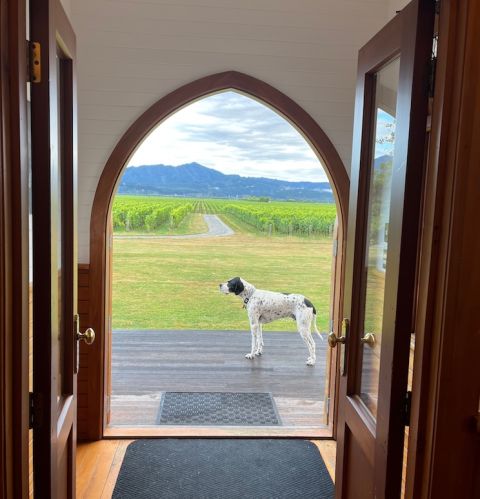
In 2000 the Bourgeois family of Sancerre, the Loire homeland of the Sauvignon Blanc grape, decided to venture outside France and bought 98 hectares (242 acres) of land in the Wairau Valley. The locals thought they were mad because they chose a spot way upriver of what was then the westernmost winery in Marlborough, Grove Mill, and one that, unusually, was well above the valley floor. But such has been the explosion of interest in Marlborough Sauvignon since then that the whole region is now one big, green monoculture that extends a 45-minute drive west of the Bourgeois’ Clos Henri site. (Purple Pagers can examine this map of the Wairau Valley from the latest edition of The World Atlas of Wine and see just how out of date it already is.)
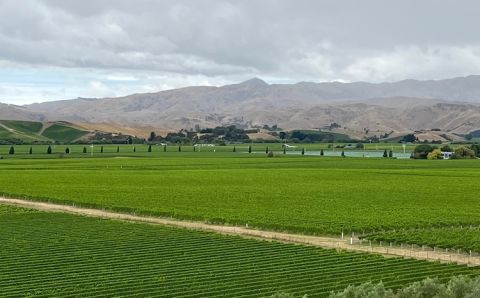
Marlborough Sauvignon Blanc may have been a staple in the UK since the late 1980s, but it is now outdone by the US. In 2021 New Zealand was the third most successful wine exporter to the US after France and Italy, each of which produces well over 10 times more wine than New Zealand. Total shipments of Marlborough Sauvignon (which makes up virtually all of the New Zealand wine that Americans buy) were worth considerably more than total imports from Spain, Australia or Argentina. Other wine-producing countries outside Europe envy its success, often asking visitors such as myself which grape varieties they should promote in order to conquer export markets.
But quality-minded, experimental Marlborough wine producers such as the Bourgeois are coming to realise that international sales success is a two-edged sword. Because it’s so profitable to make Marlborough ‘Savvy’ on an industrial scale – thanks to the region’s generous quotas of aquifers and ultraviolet light, the vine variety’s naturally copious yields and the wine’s conveniently short ageing that needs no expensive oak – the region is now dominated by big companies that are getting bigger and are generally uninterested in exploring much nuance.
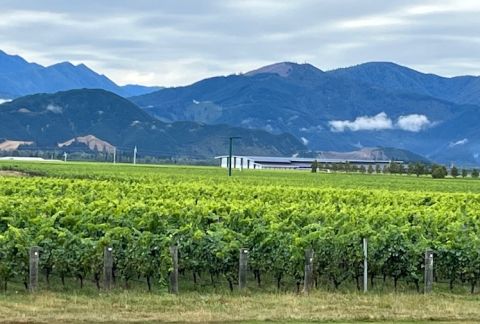
The New Zealand Fine Wine Producers Group was formed recently to spread the message that the country produces far more interesting wines than the homogeneous swell of Marlborough Sauvignon. There are 662 small wine producers in New Zealand, 66 medium-sized wineries and 16 big ones, all of the latter dependent more or less on Marlborough Sauvignon Blanc.
The current situation, in which consumers associate New Zealand wine exclusively with mass-market examples of one combination of grape and place, is particularly galling for Marlborough’s better producers. They make some especially stunning Chardonnay, Chenin Blanc, Riesling, aged Sauvignon Blanc and sparkling wine, with their Pinot Noir improving by the year, even if none of these is as profitable as young, unoaked Sauvignon Blanc.
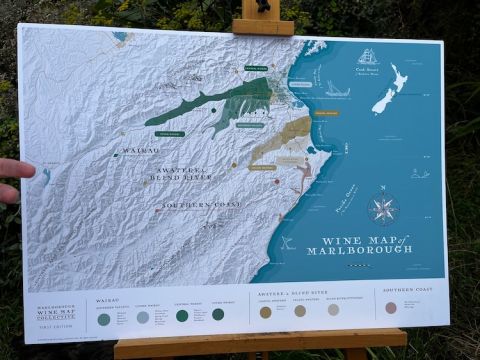
A new map of Marlborough wine country has been designed to remind producers and consumers that the region does actually have terroirs, and that they deserve to be recognised and exploited. In a manifesto drawn up to accompany it, the relatively artisanal producers Astrolabe, Blank Canvas, Dog Point, Mahi and Rapaura Springs identify what they call ‘a dangerous tipping point where the dilution of the brand value of Marlborough is occurring because of the dilution of the product itself’. Fighting words indeed.
The map follows the formation of Appellation Marlborough Wine by a similar but larger group of the region’s most ambitious producers. A blind tasting panel determines whether wines submitted are allowed to carry the organisation’s logo. The most common reason for refusal? Dilution.
These campaigns may not impinge much on the casual wine drinker, but they should be of interest to more engaged wine lovers seeking a bargain. For none of Marlborough’s finer wines is overpriced and, contrary to popular opinion, they improve with age.
The calls to action among the smaller producers are also understandable. Indevin, whose website boasts that its giant Marlborough tank farm alone (it also has giant wineries in Gisborne and Hawke’s Bay) processes 30,000 tonnes of grapes annually, actually processed 104,000 tonnes by 2022 according to a recent presentation by founder Duncan McFarlane. The operation, which specialises in shipping supermarkets’ own-label wines in bulk, has become astonishingly powerful. In 2021, when it took over the country’s biggest family-owned company Villa Maria, it could boast that it controlled 17.3% of New Zealand’s grape supply.
Indevin also controls one of the country’s biggest vineyard-management companies and is said to have forward-bought thousands of Sauvignon Blanc plants from the country’s leading vine nursery Riversun in Gisborne. Though the extent to which these tender little cuttings withstood the awful might of Cyclone Gabrielle earlier this month is anyone’s guess. At the time of writing, it’s virtually impossible to access the vineyards of Gisborne on the North Island’s Cyclone Gabrielle-ravaged east coast.
The second biggest force in Marlborough is probably the American-owned multinational Constellation Brands while the French drinks company Pernod Ricard and Treasury Wine Estates of Australia also have a significant presence. It’s a far cry from sheep-farming – though some of the more sustainably minded vine growers do use sheep in winter to munch their way through the cover crops between Marlborough’s neatly machine-hedged vine rows.
Superior Marlborough Sauvignon Blancs
There are many others. See Marlborough for connoisseurs.
Astrolabe, Taihoa Vineyard 2021 13.9%
The 2020 is £28 Hic! Wine Merchants, £34.95 South Downs Cellars and $39.99 Share a Splash Wine Co, CA
Blank Canvas, Abstract | Three Rows 2019 13.5%
£22.70 VINVM
Clos Henri, Estate 2022 13.8%
This bottling used to be called Petit Clos, whose 2021 is £17.07 Vinatis and is widely available in the US from $15.97
Clos Henri, Otira Glacial Stones Single Vineyard 2021 14.4%
A new wine that will be available retail from May
Cloudy Bay 2022 13.2%
Widely available from £23.68 and, in the US, $24.99
Cloudy Bay, Te Koko 2020 13.8%
£42.49 GP Brands and widely available in the US from $41.98
Dog Point 2022 13%
Widely available from £16.95 and, in the US, $16.99
Dog Point, Section 94 2017 13%
£19.95 Roving Sommelier Wines, £21.99 Thorne Wines
Framingham 2022 12.5%
£15.75 London End Wines, £16 VINVM, £18.50 NY Wines and others
Greywacke, Wild Sauvignon 2016 14%
$35.99 Marty’s Fine Wines, MA
For tasting notes, scores and suggested drink dates see also Marlborough for connoisseurs. For some international stockists see Wine-Searcher.com. There are more than 900 tasting notes on Marlborough Sauvignons in our database.













