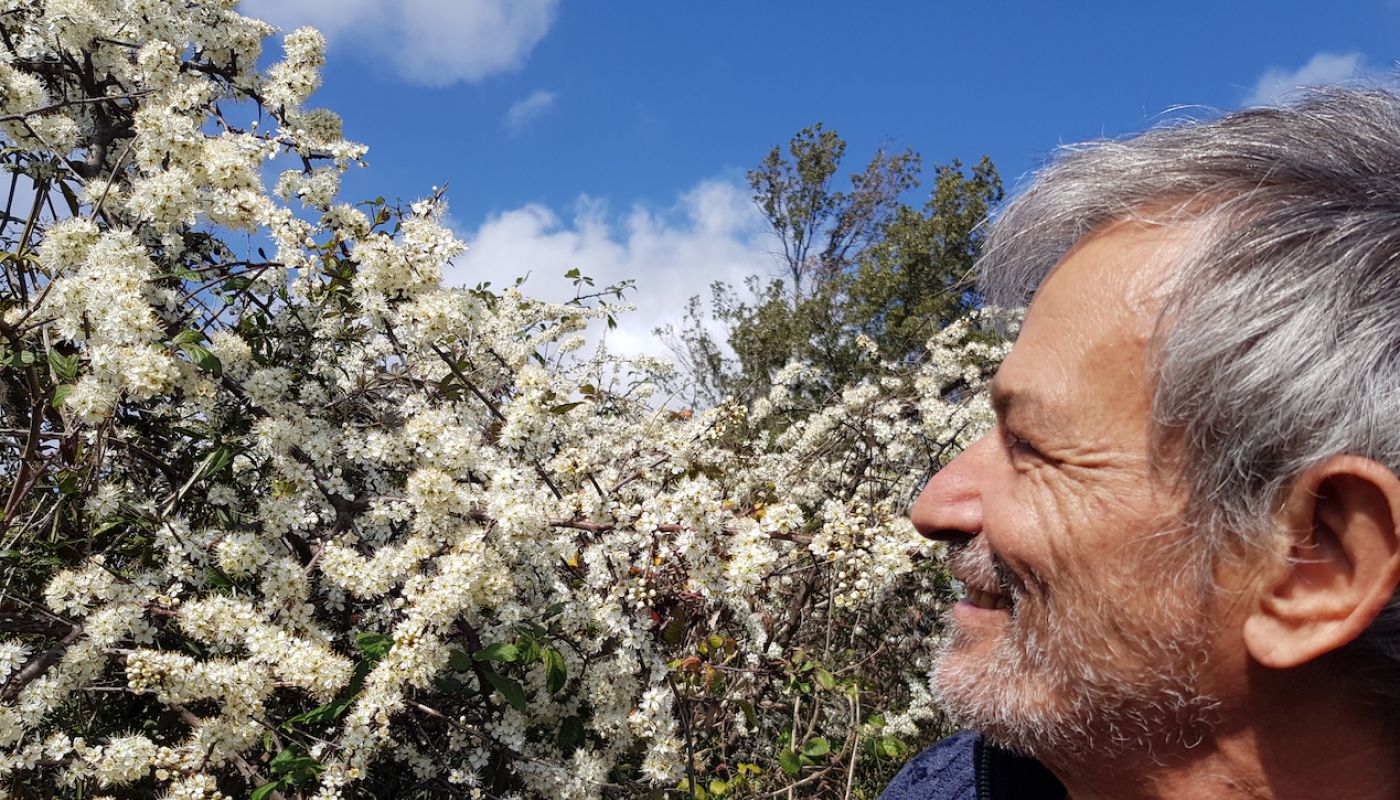
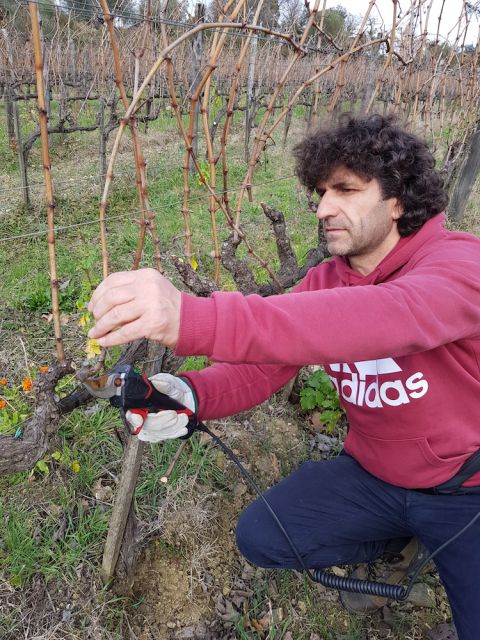
17 March 2021 Katia Nussbaum of San Polino reprises the coronavirus diary she shared with us almost exactly a year ago. Her husband Gigi is pictured above admiring this year's blackthorn blossom.
Coronadiary day 365
I am writing this on the evening of a beautiful spring day, the magical time of year when every living thing around us at San Polino seems to be waking up in a rush of cheeping birds, buzzing bees, fluttering butterflies and budding vines.
In the province of Siena we are back in total lockdown. Red zone and distancing. Almost a full circle one year on.
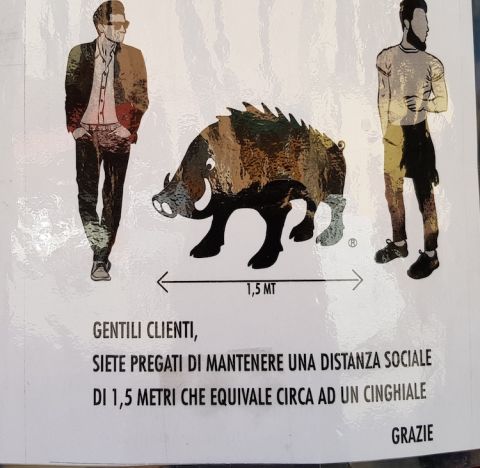
The Italian government has changed: the Best of the Best they call themselves. Let’s truly hope they are and that Draghi manages to balance that delicate equation of closures/ livelihoods/hope.
We will see.
For the present we must be optimistic for the future, which could still be wonderful with some good brains at the helm. I do believe that we have the wherewithal and am a born optimist.
In our vineyard the pruning is almost finished and we are pulling the woody branches of last year’s growth from the training wires. It’s harder work than you would imagine. The branches grow curling tendrils which wrap themselves tightly around the wires as the vine searches its way up towards the sunlight.
It takes a surprisingly strong arm to yank the cut branches away from the wires and lay them horizontally between the rows ready to be gathered together and shredded for compost.

The vineyards are a beautiful place to be these days. We had snow just ten days ago and now, from one minute to the next, spring has arrived. For sure it will get cold again – it always does – but today the sun has shone all day long, warming us into taking off first our jackets, then sweaters. At times the men take off their shirts and I sneak a look around and peel down to my rather inelegant vest. The warmth is a tonic, not just to us tendril-pullers but also to the marigolds, wild grasses, fava beans, oats and clovers that we seeded as cover crops between the vine rows after the last harvest (2020).

It’s a tonic also for insects and birds. Last week we heard an extraordinary gabbling noise above us, a flock of birds high up doing something, going somewhere most intently.
I WhatsApped my ornithologist cousin David Yekutiel, at present in the Usambara Mountains of Tanzania looking for sightings of the rare Taita falcon, Fülleborn’s boubou and the pale-breasted illadopsis.
At 12.57 I sent him a video of the birds and asked what they were.
‘Cranes’, he anwered from Tanzania at 12.58.
‘Where are they coming from?’ 12.58
‘Probably North Africa, heading to Germany, Poland, Scandinavia.’ 12.59
He writes that he stayed in a place on the coast of Tanzania run by an Italian who knew our Brunello and Luigi Fabbro. ‘Small world.’ 13.08
Yes. What a small world. Who would have thought?

Our team at San Polino now consists of myself, Gigi (husband), Daniel and Viola (son and girlfriend), Giulio (son), Avni (colleague) and Mariano (colleague and Avni’s brother). We also have Laila and Bessie the dogs, four hens, two cats and the bees. We long for sheep again, but the last two times they were mauled by wolves whose populations are growing healthily (though I bet the sheep don’t find it healthy!).
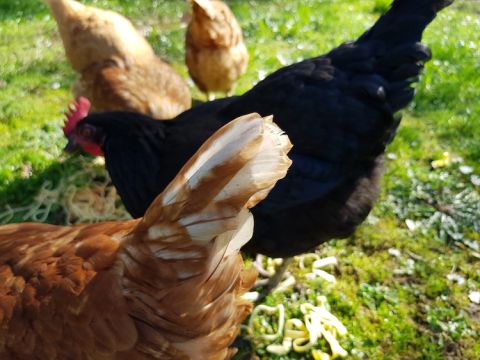
It’s fun watching the animal interaction. Friendships occur where you would least expect. For example, there was a period when the hens considered the sheep as a sort of henhouse and would shelter under them during the night.

Once I came home to find two of them in the house.
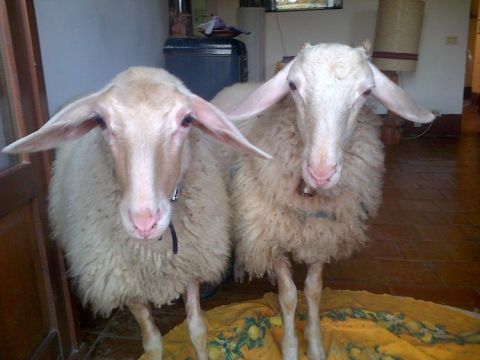
Our last ram we called Gregory Pec, as he tended to gregariousness and pecora means sheep in Italian. He would follow me round the vineyard and pick up my work tools.


In fact, Gregory became so gregarious that at 70 kg he put his horns down and chased me as I was trying to lead him by a rope into the sheep pen. I just had time to jump into Avni’s car and slam the door. Managing to grab hold of the rope through the car window, I tied it to the steering wheel and let myself out of the passenger door.
Needless to say that was the end of Gregory. We gave him back to the sheep man, feeling he was a hazard for wine tourists. But I miss him.
We still have our friendly and prowling fox … again depends on your point of view. The hens aren’t impressed as he carries one off every now and then. And Gigi neither as he thought he had it all under control.
Looking back
We’ve had quite a year. We walked the vines through the summer months and took them to a good harvest. We bottled our Brunello 2016s, Riserva 2015, Rosso di Montalcino 2019 using a new, rented bottling machine; it felt like we were moving from a cranky Fiat to a sleek Ferrari. The smoothest way to bottle. We will never look back.
What else did we do this year?
We forged ahead with our viti-forestry project, to be developed over the next two years. Let me explain the idea.
Have you heard of mycelia? Mycelia grow underground and are the branching filaments of fungi. In a cubic inch of soil there exist up to 8 km (5 miles) of mycelial threads, tiny microscopic filaments that connect more than 95% of all plants on the planet, from grasses to trees. They tunnel their way through the soil. In fact they make the soil by feeding off and breaking down organic debris. I have read that taken together mycelia weigh more than all other organic matter on the planet. Mycelia evolved symbiotically with plants in relationships called ‘mycorrhizal networks’. The mycelia provide the trees with nutrients and water harvested from below ground and the trees provide the mycelia with sugar (from the sun via photosynthesis). Plants would not exist without mycorrhizae and we would not exist without plants.
The implications of this for agriculture and by extension for viticulture are beyond our imaginings. If we could discover to what extent (and even whether) vines can work together with the mycelial world of the forests, we could go a long way towards learning how to map our work in the vineyard in order to facilitate this relationship.
There are two basic types of mycorrhizae: one type works together with trees and plants that tend to fruit, such as apple trees, maple trees, linden, olives and vines (endomycorrhizae), and the other works with the trees of the forests, in our case at San Polino predominantly ilex, oak and ash (ectomycorrhizae).
In Montalcino we have many hectares of forest which border on vineyards.

I would love to know:
- Do the vineyard mycorrhizae and forest mycorrhizae work together? If this were so, then would the vines be able to gather much of their nutrient intake from the forests? Could this be so? Possibly.
- To what extent do the mycorrhizae of the vineyard manage to make available to the vine the mineral nutrients from the rocks beneath the soil? This would have serious implications regarding issues of the self-sustainment of the vineyards themselves. If you think about it, we don’t fertilise the forests, so why should we do this for the vines?
We have decided to do some experimentation in the vineyards by planting endomycorrhizal trees in place of the vineyard stakes. We have chosen to plant maples which were used in the vineyards of the Etruscans and the Romans. The system is known as testucchio, whereby the vines were maritate, or married, when trained up and to the trees. In a way that would be considered as permaculture today, the vines and maples benefited each other in a system of symbiosis, each providing what the other needed. Maple roots are not deep so they don’t bother the roots of the vines. On a mycorrhizal level the vines and maples should extend their mutual capacity in searching for nutrients and water. The foliage of the trees provides greater aeration for the vineyard, the tree canopy can protect the vines from autumn hail. Another positive is that the bees love their flowers and the more pollinating insects you have in a vineyard, the healthier its local environment.
Not only this. In our times of global warming it will be interesting to see whether the foliage canopy of the trees can protect grapes and vines from the burning UV effects of the sun in the hottest parts of the day.
This project can be seen as a synthesis of all of our interests here: Gigi’s interesting biodiversity mapping project in the Brazilian Amazon, Daniel’s degree in biology and interest in botany, Giulio’s study of geology, Avni’s experience of growing up and working on the agricultural collectives in Albania in the 1970s. He tells us stories about accompanying his mother high into the rugged mountains above their village to collect wild herbs and medicinal plants to sell to doctors and medical labs, and how this knowledge of the natural world framed his life.
Very importantly, this year of pandemic-inspired isolation has provided us all with much time for reading and thought.
This winter I followed a course on mycology which was the most fascinating and jaw-dropping study that I have ever done and a culmination of all the interesting things I have been reading over the years. The world turned upside down on its axis. The course was thorough (I admit, myself less so) but what came to the fore was the ‘re-minding’; our natural world is a mighty complex place. Viticulture is just one tip of this sophisticated, entangled system and we have still much to learn when we talk of organic farming, or biodynamic approaches. It is fabulous stuff – truly what dreams are made of.
We will call our viti-forestry project ‘Entangled wines’ because that is what our wines are: colourful threads in the magical tapestry of the world.
In the meantime we enjoy the sun. The blackthorn is blossoming, as is the hawthorn. The almonds too. It is Gigi who points this out to me every year. It’s his favourite season. (See main image above.)
The rosemary is flowering and we will prune the roses to governable size. I cut the grass for the first time two days ago, leaving large islands of wild mint and thyme, dandelions, vetch and daisies.
Soon the asparagus will be out and if it rains next week, we will go spring mushrooming, another hobby that grew out of my mycology course. All through the winter we ate forest mushrooms.
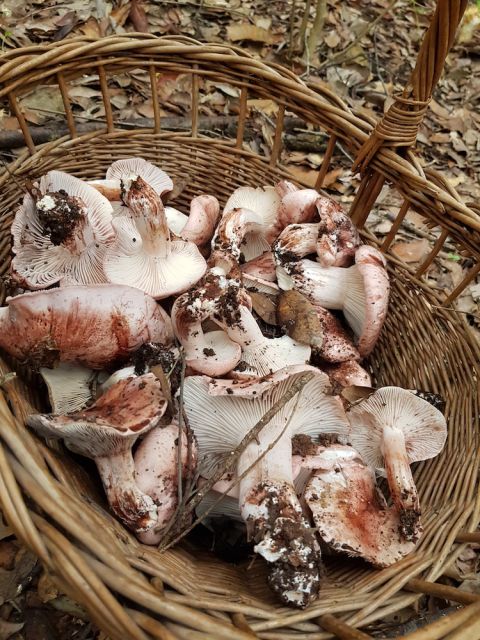
A wonderful discovery: I spent hours in the woods and apart from getting the fright of my life when chancing upon a sleeping wild boar, it’s absolutely true that trees exude a wonderful aura of calm.
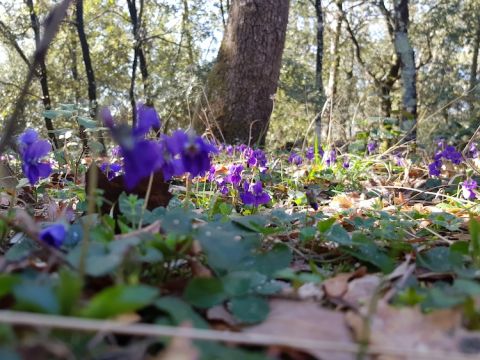
Let the spring sun shine down on us.
The bees are waking up and we will plant more lime trees, which the bees go crazy for, and more pyrocantha, a spiky shrub with bright orange berries, the bees’ El Dorado for pollen capturing.
Lots and lots to do, grapes to grow and wine to be made.
Bye-bye, lovely friends.
















