
It was an email from Ben Little, author of the spellbinding book Pignolo: Cultivating the invisible, which connected some very important dots.
Ben lives in Friuli, and I asked him about how he was coping with the heat. He replied:
'OMG, yeah, it's seriously cooking here today 39 °C [102 °F] … actually I'd say this is the first year in the last 12 that I'm seeing such a prevalence of fires.
'I'm up in the northern tip of the Colli Orientali, close to one of the wettest areas in all of the Italian pensinsula … Monte Musi!!! So I'm currently fortunate to be away from most of the current fire action, but waking this morning there was a first faint whiff of smoke in the air. In fact it's still there as I write.
'I can only imagine what it's like down in the Collio and Carso areas, where there have been big fires around Gorizia and Trieste for the last week.
'Thing is, it has hardly rained at all this year. Everywhere is so dry. My home diary notes tell me that June 20th was the last date for a brief late afternoon splash. But down in the heart of the Colli Orientali & Collio I know those who haven't seen rain for months.
'Deep rooted older vines are thus far holding up quite well. To be honest I'm growing to love old vine humility, their wisdom, their stamina and endurance. The future of viticulture, if indeed there will be one, is going to be all about Caring for the Elderly. Regeneration baby. I nearly wrote a piece for the JR writing competition but got sidetracked :)
'Kinda ironic when one thinks about what the economy currently thinks about the old and the elderly in all walks of life. Big life change of perspective is looming.
'Anyway, as you'd expect, the young gun vines planted over the last few years are suffering.'
We don't always appreciate the importance of old vines and old vineyards when it comes to the climate crisis. It's not all about romantic stories and the history that they represent. Old vines play a vital role when it comes to the long-term future of the wine industry in the face of rapid climate change and the reality of increasingly extreme climate events. A number of winegrowers have told me that their old vines cope much better with heatwaves, drought, frost, flooding and disease pressure than their young vines or vines from modern clones do.
It's partly because the roots for the old vines go deep – most of them are not and have never been irrigated, so they had to survive right from the word go by building deep rather than surface root systems. However, there are other possibilities and this is where we have much to learn and understand from these old vines. It may also be something to do with their clonal material – diverse, resilient, not nursery-bred for high yields. It may be something to do with the undisturbed and richly alive mycorrhizal networks which underpin the vineyards they are rooted in and which connect one vine to another. It may be that, like trees, vines 'learn' with time and age, and can even 'support' each other. It might also be something to do with their physical structure – often these old vines are untrellised bush vines with thick trunks. It might also be that the soil and sites in which they are planted have better water-holding capacity, deeper drainage, access to underground water stores and better temperature regulation. And perhaps it is also something to do with the fact that many of these vineyards were planted before chemical agriculture became 'normality', and many of them are in sites and regions where industrial agriculture is too difficult/impossible/not affordable. Perhaps non-industrial, non-chemical farming techniques have a role to play. Perhaps in vineyards where tractors don't continually run the rows to spray, prune and pick, the less compacted soil can regulate drainage and temperature. There is much to research.
Thanks to a tweet from Jancis on this subject (which sparked off a really interesting conversation about vine heat resilience in general), Ben Little, and Sarah Abbott's Old Vine Conference contacts, we soon had people responding with comments and sending us photos showing visible differences.
Cathy Corison tweeted, 'I don't have side-by-side photos, but I've watched those beautiful, ugly old ladies sail through heat spells for over a quarter century. CS Clone 2 on St George rootstock, planted in 1971. 50 years old last year!'
Dom Porto Carras (@DPortoCarras) tweeted, 'Dear @JancisRobinson, These photos are from our vineyard at Meliton Slopes in Sithonia Halkidiki, Greece where our vine plants aged 30–57 years old are coping effectively with the high temperatures!'

Leila Killoran (@leilaonwine) replied with an offer of photos of old v young vines in the heat: 'Same parcel, one planted in 2018, one in 1983. These vines are just outside Limoux (technically, this parcel is on the edge of Malepère). I only bought the property in January, it's been a very high yielding, conventionally farmed property for >30 years. They are same variety, on same rootstock (SO4). The soil is largely the same, slightly thinner topsoil with the young vines. The old vines were planted in 1983, and are generally healthy, with the exception of some esca and a little oidium [powdery mildew] this year. They were pruned using taille razes precision (which I’d never used before), which has given a lot of leaf cover (been handy to protect the grapes in the heat). The young vines were planted in 2018, and have really struggled in the drought. We have removed almost all bunches, to prevent the vines wasting energy. The pictures don't really show the extent of the yellowing of the leaves, but it is quite noticeable when compared side by side! The inter-row grass cover has completely died!'

Wendy Vallaster (@fromvantospain) made a particularly striking comment: 'Maybe check in with DO Cebreros, there was a fire last year that ripped through La Movida (a vineyard) on the side of the mtn beside the village, average vine age there 75 yrs, the vines lived.'
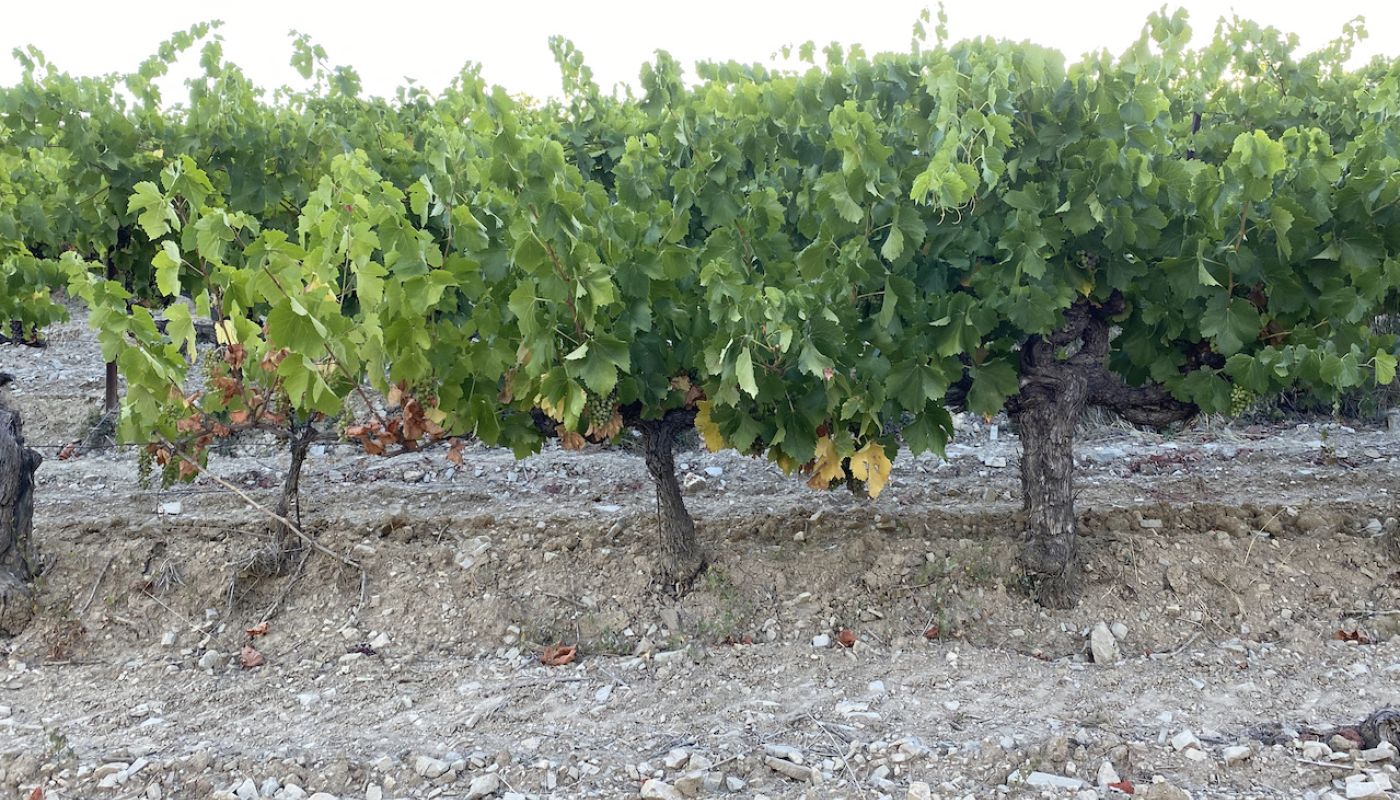
Kate McKinlay of Dom de Mourchon in the southern Rhône wrote to say, 'I saw your call out on Twitter for generational differences in resisting these extreme conditions' and explains, 'here you have three Grenache vines planted side by side aged 7, 15 and 55+ [main image at the top of this article] – if only this were the natural order of things for us humans! Since the start of the growth cycle this year the extent of our rainfall has been 50 mm [2 in] in early April, nothing at all in May and two lots of 10 mm in June. This lack of water has been exacerbated by an unusual amount of mistral since the start of the season. The Syrah are well on their way to finishing veraison by the end of the month and the Grenache, which have set an unusually large yield, are feeling the pull on their resources and are only just starting to change. We are currently busy dropping grapes from the younger vines and have just finished our third round of watering this year’s plantation (having only watered the new vines once last year). The upside is that we have used 40% less copper than last year and we are convinced that being in our second year of conversion to biodynamics has boosted resilience.'
Valentí Llagostera of Mas Doix in Priorat sent us photos of very young vines (planted last February), young vines (planted five to seven years ago) and old vines (planted at least 50 years ago). 'How has the drought and the high temperatures affected the vines and grapes? In the case of the very young vine (planted this February), some plants have completely dried out. Others with the help of manual irrigation have survived. In the case of young vines (five years), total dryness of part of the leaves and partial in many. Not very green leaves, which make the plant not work well. In the case of the old vines – at least 50 years – some grapes have dried but 80% are healthy and growing well. Plant leaves do not suffer in the same way. Longer roots that allow you to continue working well. Lower yields but with good quality. It remains to be seen how the summer will continue. More drought will mean lower yields, smaller crops and an advanced harvest. To be taken into account: the characteristic of our soil, pure slate – PRIORAT!'

Ben Little headed into the Colli Orientali vineyards for us, where it was 36 °C (97 °F) at 11 am, and sent me dozens of photos (it was hard to pick! so many beautiful old vines…). His WhatsApp message said, 'As another comparison with the lush canopy and vigour of the old vines. Here's some other youthful vines nearby. Notice how much of the lighter green underside of the leaves you can see. They are shutting down, in survival mode. Meanwhile the old vines are happy out, or as much as any of us would be, in the heat. BTW many of the old vines were planted in 1896 🤓 notice the practice of layering, the row width of 4 metres allowing for mid row planting. Notice the mulberry fruit trees. Gravity is pulling me towards these wonderful lifeforms, pure joy to be in old vine company 😀.'

Brigitte Chevalier of Dom de Cébène sent in two photos, with this emailed message: 'First photo: a 75-year-old Carignan vine on slate soil. Thanks to their deep roots, old vines explore a larger volume of soil and can take in more water than vines with less developed root systems. Second photo: a younger Carignan vine which I planted 10 years ago, on slate soil, on an adjacent plot. This young Carignan vine is beginning to be well established, but the light green colour betrays the beginning of water stress, at least on this vine in the photo. In both cases (young and old vines), vegetative development was weak this year, with an earlier stop in growth, which occurred at the end of June at Domaine de Cébène. The cessation of growth limits the leaf surface and therefore evapotranspiration. Could the vines have found a balance by limiting their leaf area and the size of their "water pump"? We chose these two vines over all the others in the plot, because they seem to illustrate the two distinct behaviours in the face of high temperatures. But it is difficult to conclude that all our old vines at Cébène would be better able to withstand high temperatures and that all our young vines would not be able to withstand them as well…'.

Raffaele Foglio, in charge of marketing and sales of Villa Bogdano in Friuli, wrote to us, saying, 'Please find here attached photos made today of our "old boy" the Cassone Padovano and younger vines of Tocai Friulano confirming the better status of the old vines. Unfortunately we are facing a really difficult vintage especially due to lack of of water/rain and the terrific hot temperature. Nevertheless, old vines at the moment demonstrate their resilience.'

And David Gleave of Liberty Wines wrote to say, 'Yesterday I asked Giovanni Manetti of Fontodi how the vines are coping and he replied: "For now, they are coping well with the drought, quite surprisingly. One hypothesis is that they are adapting naturally to the change in climate. Another is that all the years of organic viticulture with crop cover between the rows and the use of our own compost has increased greatly the presence of organic substances in the soil which help capture the right amount of moisture for the roots."'
Restoring soil health and preserving our old vines may mean the next generation will still have wine on the table.













