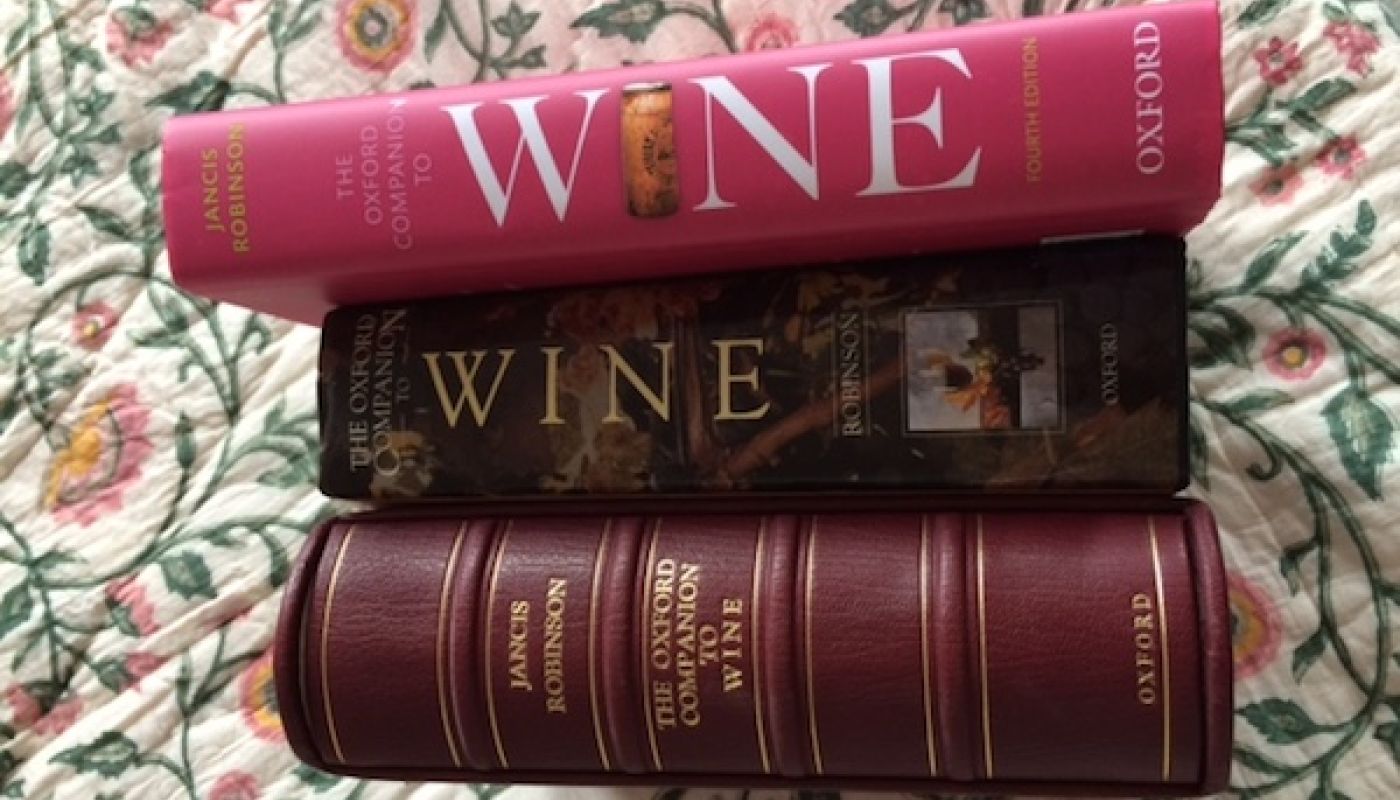
I’m hoping that if you are reading this, you may be familiar with a book known to my husband and children, only very slightly sourly, as my fourth child. The Oxford Companion to Wine is very much part of my family. In fact the first edition was born three years after our youngest child, but its gestation was very much longer than that of any human: six years.
I see my contract was dated November 1988 and the book was not published until 1994. But it was hardly surprising that it took so long. My brief was to come up, from scratch, with 800,000 words on wine in the format of an Oxford Companion. Oxford University Press’s revered series of reference books began with one on English Literature in the 1930s and had been followed up with exhaustive tomes on subjects such as Art, Music and Medicine since.
The content is always an alphabetically arranged collection of entries written by experts in their field. More than half of the first edition was originally written by one of nearly 100 contributors, with the most significant ones being Viticulture Editor, peripatetic viticultural consultant Richard Smart, and Oenology Editor, the late Professor A Dinsmoor Webb, who had recently retired from Davis. They suggested most of the other contributors on scientific matters and marshalled their contributions. The biggest difference with subsequent editions was that email did not exist. All contributions were submitted on paper, often fax paper, which had all sorts of ramifications for the editing process. But it was a particular thrill to be commissioning articles from world-famous historians, I must say.
Preparing that first edition was what occupied me most during the strangest period in my professional life. The early years of that extraordinary shoulder-padded decade the 1980s were more hectic and more public than any I have known. I presented the world’s first TV series about wine, The Wine Programme for Britain’s new broadcaster Channel 4, and followed it up with two more series shot around the world, so that I was frequently recognised in the street. I was the wine correspondent of The Sunday Times, Britain’s biggest-circulation broadsheet. I am amazed to see that I somehow published eight books in the 1980s, including Vines, Grapes & Wines, the precursor of Wine Grapes (co-authored with José Vouillamoz and Julia Harding in 2012), and Vintage Timecharts, an analysis of how various types of wine age. Oh, and I also produced our first two children, did up a new house and qualified as a Master of Wine. My husband Nick Lander meanwhile was running L’Escargot, one of London’s most celebrated and busiest restaurants. I wonder today how on earth we did it all. It would have been impossible if we also had to keep on top of emails.
But then came recession, and my friend Hugh Johnson to distract Channel 4 with his TV series on the history of wine. Life suddenly went very quiet. I spent the years 1988 to 1993 (OUP need a year to edit and print a book as long as a Companion) in solitary isolation, hunched over an extremely rudimentary computer and a fax machine, hoping it would spew forth an entry from one of the many contributors that I could edit rather than having to generate text of my own. (I set myself a target of 1,000 finished words a day.) In those days contributions would arrive on paper and, once edited, they all had to be painstakingly typed out. The prospect of having to fill the double columns of the Companion’s 1,000 blank pages with words, and words accurate enough for an OUP reference book at that, was truly scary.
The two solid years’ work on the fourth edition of the Oxford Companion to Wine (published on 17 September 2015) has been a breeze compared with the first time – not least because of the existence of email, and of an assistant editor, ex copy editor and top Master of Wine Julia Harding. But the Companion is still a massive responsibility that weighs down heavily on both of us.
Unlike the first time around, the book has an established reputation and a place on the bookshelves and in the hearts of wine lovers and students around the globe. I know just how many people have passed wine exams with at least one well-thumbed copy by their side. Which means that we have to try extremely hard to get everything right – in an era when wine drinkers are far, far more sophisticated and knowledgeable than they ever have been. They are also more curious, which means that we have to deliver ever more detail.
The problem is that there is a physical limit to the size of a single-volume book, given the thickness of paper and strength of book-bindings. So, while the Companion exists in printed form (the fourth edition will be the first to be sold in a digital version too – other than as published on JancisRobinson.com), its length is restricted.
Because the wine world has been changing at such a dizzy rate, each edition has required massive surgery. We reluctantly had to drop all the entries on wine-based spirits in the third edition. And because we were limited to a million words for this fourth edition, we have had to be extremely discriminating in our editing of what was in the third edition.
This new fourth edition is the most radically different edition to date. The first edition had 3,000 entries. This new fourth one has 4,000 entries, of which 300 are completely new (plus 200 new very brief ones or cross-references). You can read more about the 300 new entries in Nine years of new words. Every single one of the almost million words in the fourth edition has been scrutinised carefully to be sure that it deserves its place in the 2015 edition and by far the majority, almost two-thirds, of the entries have been revised and updated, often surgically. Indeed some entries, such as the extensive and crucial one on the origins of what its author Patrick McGovern calls viniculture, has been completely rewritten. I was all too aware that many important discoveries about the history of wine have been made since the first edition was written well over 20 years ago so have made sure that all the historians, as well as all the other contributors, were given the chance to update their entries.
The fourth edition has benefited from the hard work of 187 contributors all over the world, 58 of them new. Viticulture Editor is, again, the hardworking Dr Richard Smart, while, in an effort to increase the European influence on the winemaking entries, Oenology Editors were Professor Denis Dubourdieu of Bordeaux and his assistant Valérie Lavigne. Such names as Michael Broadbent MW, Stephen Brook, Bob Campbell MW, Huon Hooke, Hugh Johnson, Jasper Morris MW, Linda Murphy, David Schildknecht, Victor de la Serna, Walter Speller and Dr José Vouillamoz, to name only a small proportion of all the brilliant people who contributed to the book, will be familiar to many wine lovers. (Well over 20 of our contributors are Masters of Wine.)
As with the third edition, Julia has been responsible overall for all the viticulture and oenology entries and has liaised particularly conscientiously with the host of scientists who have shared their knowledge with us. Many of them are based at the Australian Wine Research Institute, one of the most active and communicative of its sort – but we are hoping that the Bordeaux effect counterbalances the antipodean one.
It is my dearest wish therefore that no one tells me airily, as they have tended to do in the past, that they don’t need the fourth edition because they have the first one.
Find out more at oxfordcompaniontowine.com.