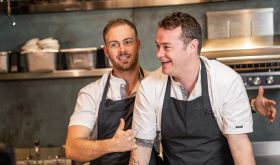
Alain Coumont does not look like the kind of businessman whose New York office receives 50 emails a day from companies and individuals around the world looking to secure a franchise. But then not many businessmen are sitting on quite the successful and fashionable formula that makes up Coumont’s rapidly expanding Le Pain Quotidien empire of organic bakeries, cafés and food shops.
Tousle haired, restless and wearing a pair of distressed designer jeans, Coumont, 44, looks more like an ageing rock star or sportsman than a talented cook and baker who over the past 15 years has built up his business, PQ as he constantly refers to it, to this level. Today, there are now over 60 branches worldwide mainly in Belgium, France, in and around New York and LA but with a nascent franchise in the UK and Turkey and openings to follow shortly in Kuwait, Lebanon and Dubai.
Coumont had flown into London to look over the first English copies of his book, Cook+Book, which tells his life story and the sequence of accidents that led to PQ as well as listing a series of his recipes elegantly illustrated by Jean-Pierre Gabriel, one of Europe’s best food photographers and an old friend.
The book will obviously appeal to all those who enjoy baking bread, pastries and desserts, as well as the soups, salads and tartines that make up PQ’s menu. But Coumont’s life story to date will also fascinate anyone keen to understand what impels such talented individuals to become chefs and just how hazardous the restaurant business can be.
Coumont was always likely to be a chef – he began cooking for his parents’ friends’ dinner parties while still at school – but he then followed a pretty disjointed career path which began with apprenticeships under some of France’s top chefs followed by spells as a private chef to the very wealthy in New York, something he gave up because, as he writes, ‘I was starting to get a bit fed up of throwing out half full 2kg tins of caviar.’
On his return to his native Belgium he managed to open his own restaurant which brought him into contact with the marvellous Poila<hat>ne bread then baked only in Paris. Coumont initiated a commercial arrangement to ship Poila<hat>ne’s bread from Paris to Brussels daily but this arrangement soon ran foul of EU bureaucracy and Coumont decided to bake his own 2kg sourdough loaves, having found a run-down property in a part of Brussels whose potential reminded him of his time in New York.
There then followed a series of accidents beginning with the café’s name Le Pain Quotidien, or daily bread, which surprisingly has, on this occasion, no biblical connotations whatsoever. Instead, it was a comment Coumont’s father once made referring to something that was not one of his usual habits ‘ ce n’est pas mon pain quotidien.’ The phrase stuck, fitted precisely the simple bakery and café Coumont originally envisioned and, perhaps, best of all, cost nothing.
And the other integral feature of all PQ’s, its large communal table, initially cost not much more. While all PQ cafes follow the same basic design pattern using simple pine furniture, the large table dates back to just before the first bakery opened when in a warehouse Coumont stumbled across a table measuring 3.82 metres by 1.12 metres and bought it (it is still in service 15 years later). “If I hadn’t bought that big table, “Coumont explained, “I wouldn’t be here today because I am sure that this is what has distinguished us from all the competition. I am quite convinced that if PQ just had tables of 2’s and 4’s like the competition we simply would not have been so successful.
“When I look back at PQ’s growth since 1990 I believe that 30% of our success is due to the food, 30% to the atmosphere, 20% to the friendly service I insist upon and 20% to the location, “ Coumont continued. “But by that I don’t mean that we want to be in those areas with the highest footfall but rather on a corner, close to a few clothes stores or a florist or where there are a few trees in any crowded city. One reason people enjoy PQ, I believe, is that it is a very simple concept incorporating seemingly inexpensive farm food – bread, butter, eggs, jam and cold meats – but all set right in the heart of a metropolis.”
But the fact that Coumont and PQ have survived and prospered to such an extent is remarkable given the financial mishaps that dogged the company, often it is quite obvious from reading the book, as a result of Coumont’s initial commercial naivety. The book is littered with sequences of under-capitalisation; of partnership deals struck with ultimately inappropriate partners and at what can only be described as lousy royalty rates. It also, however, includes several fortuitous instances of financial dexterity on Coumont’s part in one instance with him benefiting from a mix-up in the paperwork on the mortgage for the first PQ café, whose building had just collapsed, to finance another site so that he could carry on baking.
When I asked Coumont whether it would be accurate to describe his career and consequent professional success as ‘the result of a series of accidents’ he heartily concurred. “I just don’t think I could ever do it again – I would rather go fishing,” he added with a smile.
But there seems little chance of that now. Over the past three years Coumont has spent a great deal of time restructuring PQ, buying back former master licences so that the company can dispense with sub-franchisees to maintain the level of quality and strengthening the management, particularly in New York, ready for further expansion. “PQ has emerged much stronger as a result, I believe. The DNA of the business still remains as it was when I first opened it in Belgium but I now think of myself as an art director with a team working alongside me setting the strategy, designing and baking the new products and selling the licence to new countries.”
Now that PQ seems to have the structure that Coumont obviously wanted for it he is delighted that as a result of these accidents he is still in the driving seat. Reflecting on what must have been some very hair raising moments not usually associated with a career as a baker, Coumont ended by saying, “ to be still alive and working in this company is really wonderful.”
Cook+Book, Memories and Recipes published by Francoise Blouard, 232pp. £25, 37.50 euros, US$35.