
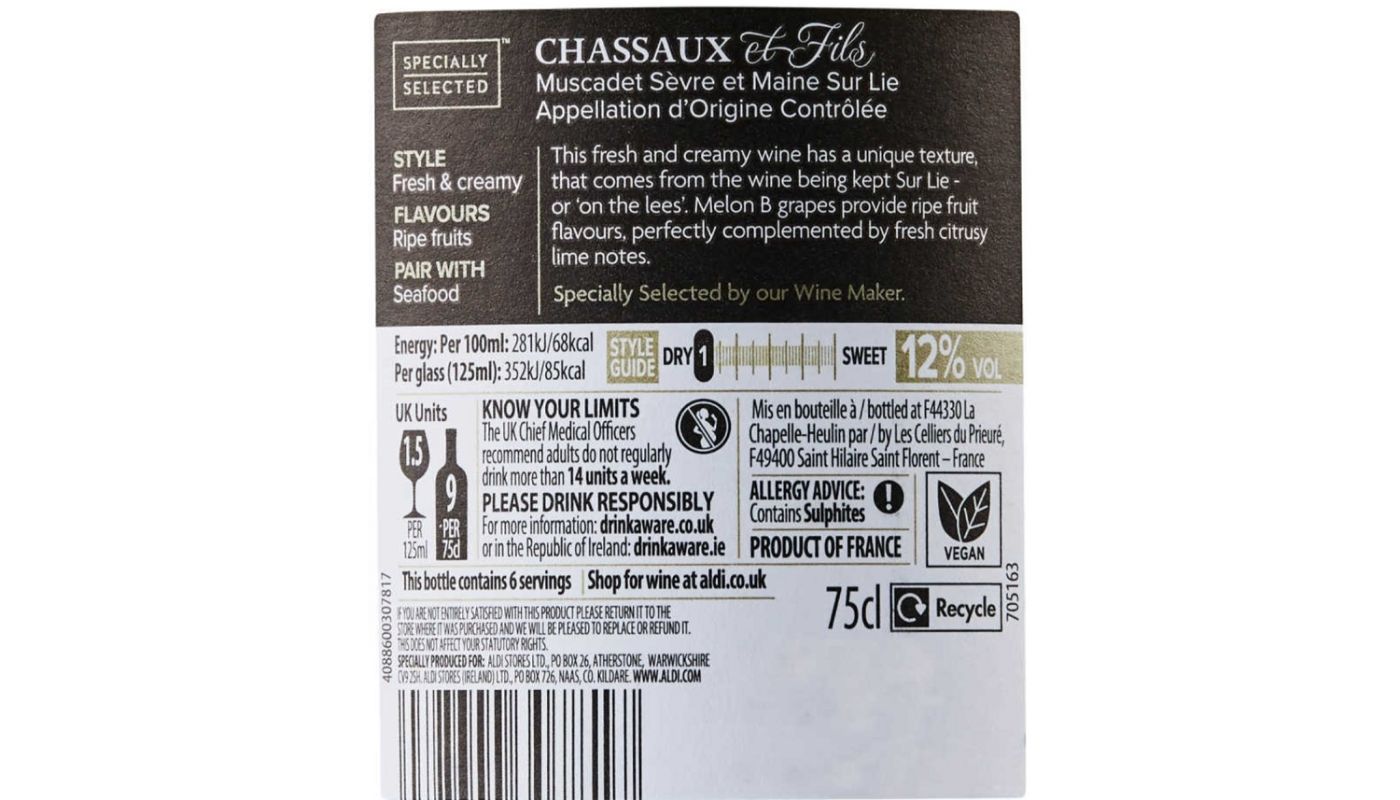
It has long seemed strange that, while labels tell us every little detail of what goes into processed food, we are told nothing about what goes into wine.
I remember raising this with a UK wine-trade official back in the 1980s and getting a very frosty reception indeed – as though I was letting the side down by raising such a consumerist issue. I was given the party line that it would be impossible because of the difficulty of distinguishing between ingredients and processing agents such as finings which, in theory but not always in practice, don’t remain in the wine.
Others have argued that winemaking techniques vary from year to year and that it would be impossibly expensive to create different back labels every year. Some wine producers have adduced the slightly alarming argument that consumers would be put off by the information, or that there wouldn’t be room to list everything that goes into their wines. And others again have argued that there would be too little interest in wines’ composition to justify all the effort.
One has to admire the combined forces of the world’s wine trade for having managed to escape the exacting demands of ingredient labelling for so long. But of course nowadays we live in a world of allergies and intolerances, and 21st-century consumers demand and expect transparency.
The wine trade’s intransigence in this respect was first breached in 1989 when warning labels about the harmful effects of alcohol on the unborn became mandatory in the US, and in France in 2006. In 2005 came the now ubiquitous ‘contains sulphites’ on wine labels, an acknowledgement of the fact that the sulphur compounds present in wine, and widely used to keep wine and all sorts of fruit products stable and fresh, can adversely affect people with asthma. UK supermarket Waitrose receives four or five queries a week about sulphites.
But generally those who produce wine have been rather out of sync with those who buy it, or might buy it – especially younger consumers. They are now being actively encouraged to seek out much more information about what is in wine by clever marketing campaigns focusing on doubts about a product that has until now provided so few clues as to its composition. Film star Cameron Diaz really got up wine producers’ noses last July when she launched what was described as ‘clean wine’. Avaline organic wine is not that special in any respect other than in its marketing. According to its website, it was created as a reaction to the fact that ‘there’s no obligation … to name any of the more than 70 additives that are used in the winemaking process to alter the taste, color, and mouthfeel of what is in your glass’.
In response to this my fellow Master of Wine Richard Bampfield, with 40 years’ experience in the wine trade, wrote on the Sustainable Wine website that the term clean wine had ‘raised hackles amongst the wine fraternity who, understandably, resent the accompanying claim that most other wines must, by definition, be dirty. However, much though I envy those who see the world in terms of black and white, I seldom do; in this case, I too would defend the wine industry against claims that it is dirty but I also believe that much of what goes on is, at best, grubby.’
I assume that he is referring to some more commercial brands’ use of added colouring matter, flavourings and deliberate sweetening to disguise shortcomings. Even some expensive wines contain added tannin and acid – and sugar was routinely added to most of France’s finest wines to be fermented into alcohol before the climate could be relied upon to deliver fully ripe grapes. Nowadays, as readers of Samantha Cole-Johnson's recent Diary of a Napa harvest intern know, there is no shortage of commercial additives specifically designed to rescue wine from various afflictions and harmful bacteria.
Well-known producer of Chêne Bleu wines in south-east France and wine think-tank organiser Nicole Sierra Rolet is another realist. She noted recently during an online debate about wine labelling, also organised by Sustainable Wine, ‘I continue to believe the wine world is very vulnerable to a scandal about the bad stuff that some people have been doing to their wines [and their vineyards], that will get many more headlines and take us all down with them. This is an accident waiting to happen and we have to act fast.’
Fortunately for us all, the EU has a plan – and since Europe is by far the dominant wine-producing and wine-consuming continent, the plan is highly likely to be enacted globally. Since 2017 the Brussels-based CEEV association of European wine producers has been considering the question of wine labelling and has now convinced both producers and EU officials that both ingredient listing and nutritional labelling (calories, for example) are a good thing.
These welcome new labelling provisions are part of the debate surrounding – don’t groan – the new Common Agricultural Policy, with the new rules likely to come into force in 2023.
What is special about the proposals, which are very much in line with those of the OIV, the Paris-based international wine trade association, is that for the first time for a food and drink product, the ingredients are to be presented digitally rather than spelt out on the label. CEEV is developing a digital platform open to wine producers both in and out of the EU (so even English ones…) that will oversee e-labels for wines so that, wherever they come from, they follow the same protocols.
This seems pretty sensible to me. Those of us obsessed by the minutiae of how various wines are made and what was used to make them can study these QR codes and their like to our hearts’ content while wine drinkers won’t find their labels too cluttered.
Nutritional information will apparently be spelt out so that calorie counters and those with diabetes are simply fed. But those with specific allergies will need to get their phones out to read the detail of what each wine contains. The pandemic and associated tracking and communication systems have increased familiarity with QR codes.
I have long thought that the wine trade is far too dilatory about the many people who find either reds or whites disagree with them. The problem is that people who work in wine tend to drink any sort of wine. With unbridled enthusiasm. So they are really rather unsympathetic towards what they see as faddiness. As a result, remarkably little wine research effort has been directed towards wine allergies and intolerances.
I would however point out that by far the most potentially harmful ingredient in wine – all wine, whether natural, ‘clean’, organic or whatever – is alcohol, if that weren’t seen as letting the side down.
Those who do spell out what’s in their wine
One of the first wine producers to list ingredients was Randall Grahm of California when he owned Bonny Doon Vineyard. Quite a few natural wine producers are proud to write simply ‘fermented grape juice’ on their labels. Here are some of those who list the ingredients in all of their wines.
- All wines on sale at Co-op stores in the UK
- Ridge Vineyards, California
- Atlas Wine Co, California
- Ampelos Cellars, California
- Omero Cellars, Oregon
- Shinn Estate Vineyards, Long Island
- Westwell Wines, England
A Brexit postscript
A UK lawyer with a keen interest in wine laws and regulations is Dominic Buckwell of Upper Lodge in Sussex, which he and his wife claim is the world's smallest vineyard. He nobly examined the small print of the Brexit deal on Boxing Day and commented:
‘There is a specific note in Art 4 (5) about NOT requiring allergens on the label that are used in production but not present in the final product. This looks to me like a marker down about keeping processing agents off the mandatory labelling requirements.
‘Perhaps more immediately important, the procedure for import or export of wine between the UK and EU appears to be simplified so that rather than the dreaded VI-1 form certified by a lab and government agency, the requirement is only for the form shown in appendix C – which appears to be self certified.’













