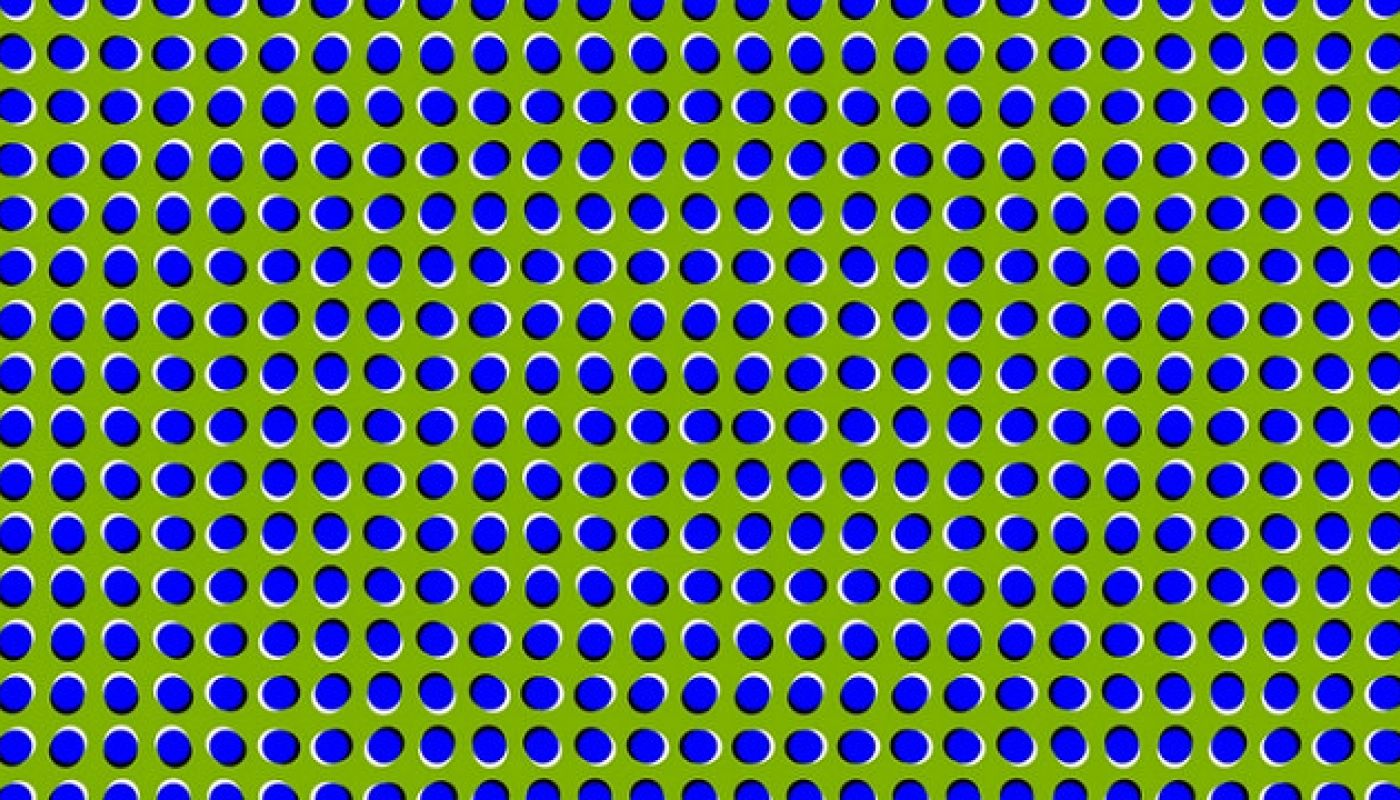
Implicitly, we trust our senses. Our sight, hearing, taste, touch and smell are constantly assessing the environment around us and feeding us messages which we accept as reality. Seeing movement in our peripheral vision alerts us to potential threats. Touching something unexpectedly hot triggers instinctual recoil. Smelling open sewers warns us that a wine is ripe with brett.
Yet it is embarrassingly easy to fool our senses. Audio illusions demonstrate how gullible our sense of hearing can be.
Optical illusions do the same for our vision.

Stare at this too long and you start feeling decidedly queasy. It’s the exact same sensation you get from staring at MW tasting exam papers.
With the audio and optical illusion, our brains are essentially misinterpreting the data. Our senses are not at fault, but the perception is not right – although some might argue that an objectively ‘correct’ reality doesn’t exist at all. Try using that argument in an MW tasting exam when you’ve just misidentified a bordeaux as a burgundy, however, and you get no sympathy at all. Making up a new type of wine called borgundeaux doesn’t work either.
The implications for how we perceive wine goes much further than blind tasting, however. Indeed, this is the theme of Jamie Goode’s latest book, I Taste Red.
Someone once said that we humans use only 10% of our brains. That might have been true for the someone who once said it, but the rest of us are using the full complement – the problem is our scant understanding of how it all works. Goode’s book investigates this in the context of wine, and disrupts many of the conventions of tasting with which we are all so familiar.
The crux is that our brains are constantly ‘editing reality’. That means ascribing apparently absolute properties to a wine is intrinsically flawed. Goode also considers how a reductionist approach – whereby you describe a wine’s component parts, including lists of distinct flavours – is less ‘realistic’ than a holistic approach, whereby you drink the whole bottle. Sorry, I mean whereby you consider the qualities of the wine as a whole.
The problem is that, like borgundeaux, practicable alternatives to the established wine-tasting protocol don’t really exist. But that doesn’t mean we shouldn’t consider what they might be.
Perhaps wine needs its own language; a set of original words that provides a precise, holistic description of wine. Rather than co-opting various flavour descriptors that are often approximate at best (‘hint of loganberry’ et al), and which may not resonate for different cultures, you could simply create words that would describe the classic styles of wines.
Moseloquent. Shirazzmataz. Sherrudite.
But realistically, of course, inventis lingvoj estas fremdaj al ĉiuj – which translates as ‘invented languages are foreign to everyone’ for those of you who don’t speak Esperanto.
What about pictures? If they paint a thousand words then surely they are the ideal alternative to the more loquacious kind of tasting note. Indeed, this possibility has been quite widely considered by many in the wine world. For example, in 2015 our own Ferran Centelles wrote about it (ironically) in Is wine a tasting note or a drawing? The catch, of course, is that while anyone can write, not everyone can draw.
Perhaps the solution is the emoji tasting note? Let me put it this way:

Or perhaps wine should borrow from craft beer, which is so often cited as the accessibility standard to which wine should aspire. Where trendy ales use the International Bitterness Unit (IBU) scale to indicate style, perhaps we should express red wines in terms of Total Polyphenolic Index (IPT). Look, Marques de Riscal 1929 has a puny IPT of 44, but Ch Ducru-Beaucaillou 2009 has an IPT of 90! Buy buy buy!
Sadly, that's all too believable.
I suspect that we must be resigned to sticking with the current system of wine description: that is, tasting notes rich with adjectives, plus an ostensibly objective numerical score. It may be far from perfect but it has endured quite simply because, in reality, there is no alternative.