
See my tasting notes on 50 Rutherglen stickies.
For the second time in my life I recently underwent a professional ambush – by the sweetest wine on the planet. The first time was on my very first visit to Australia in 1981 when I arrived at Morris of Rutherglen in north east Victoria, never having tasted Liqueur Muscat and Liqueur Tokay before. Mick Morris, in grubby singlet and shorts, had laid on 30 of these super-strong 'stickies', long aged in ancient casks in furnace-like sheds, for a tasting outdoors in the baking heat.
Months before my trip last month Colin Campbell, considerably better dressed maker of Campbell's Rutherglen stickies, wrote to me asking if, when I was in Melbourne, I would taste all the available wines from Rutherglen's eight producers of these marvels. Never learning from history, I agreed, even though as my schedule gelled it became clear that I was due to arrive in Melbourne at lunchtime and was expected to host a wine dinner at 6.30 that evening before flying out the next morning, not leaving much time for the tasting, let alone recovering from it. It also transpired, neared the time, that there would be a total of more than 50 wines, all with an alcohol level nudging 18% and a residual sugar level of up to 250 g/l (meaning that up to one quarter of the wine is sugar).
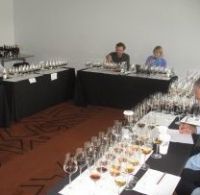
Merely surviving this assault by sugar and alcohol was going to be challenging enough. What I hadn't appreciated until Colin Campbell walked me to the room he had reserved in the local conference centre for the tasting was that I could not simply sit in a corner and assess the wines in private. All eight of the producers would be there, eager to hear my pronouncements. Fortunately, I had suggested that Melbourne wine writer Max Allen shared the tasting with me, so he was able to talk some of the not inconsiderable time when my teeth were stuck together. (The picture shows Max and me behind banks of glasses, flanked by the producers.)
These wines really are some of the most extraordinary in the world, and nowhere else has the vine stocks and arid climate to grow and mature anything like them. Based on shrivelled red-skinned, small-berried Muscat and Muscadelle grapes, they can no longer be called respectively Liqueur Muscat and Liqueur Tokay. The EU didn't like the word 'liqueur' and the Hungarians were livid about the Australians' borrowing their word 'Tokay'.
A classification system was devised whereby the most basic, youngest examples that should taste about five years old are called simply Rutherglen. Then comes Classic, wines that are an average of about 10 years old and display a bit more obvious oak ageing, more finesse, deeper brown and more richness because barrel ageing has concentrated the wine. More expensive, almost treacly and about 15 years old, is Grand, while the tiny quantities – maybe just 30 litres – bottled as Rare are more than 20 years old and, in the way of very old sherry, can be so concentrated that they are almost painful to taste.
The name Tokay was outlawed in 2005 and the Australians were given 10 years to phase in an alternative. A competition yielded nothing they considered usable but Campbell cunningly squeezed half a million dollars out of the federal government on the basis that Rutherglen's eight stickie producers had nobly made a significant concession so that all other Australian producers could benefit from those made by the EU in the bilateral trading agreement. This was spent on hiring an agency to survey the fortified wine market and come up with new names for the wines that used to be called Tokay and Sherry in Australia.
There has been considerable criticism of the resulting alternative names, Topaque and Apera, but they have been adopted and wines carrying the name Topaque are now available on export markets. I wondered why the wines could not simply be labelled with their average age but apparently a Classic might well be made up of equal parts of five and 15 year old wine which would not meet official requirements for wine labelled as 10 year old. And Muscadelle, a grape variety otherwise most often found in Monbazillac in south west France, was thought to be a name too confusingly similar to Muscat to use.
The two wine types Muscat, and – ahem – Topaque, tend to cost about the same, from about £10 a half bottle for the youngest version up to the equivalent about £80 a half-litre for the Rare oldest bottling. On the basis of what I tasted, I'd say Classic bottlings averaging 10 years are generally the best value, with the Muscats tasting even sweeter than the slightly tangier Topaques.
The eight producers that make up what they call the Rutherglen Network are an unusually close-knit group of wine producers, used to tasting and criticising each others' wines. What was notable was how young Jen Pfeiffer of Pfeiffer, 32, and seventh generation Simon Killeen, 25, of Stanton & Killeen are, even though they are making a historic wine style that Colin Campbell admitted was almost in danger of extinction in the 1980s.
It was fascinating to see how each set of wines so vividly reflected the personality of their maker, even though in some cases the wines had presumably been made by a previous generation. Five of the eight were established in the nineteenth century but Rutherglen Estates is only 15 years old while Pfeiffer dates from 1984 and, as keen-as-mustard Jen P put it, 'I had the privilege of seeing our solera building up. My father had the foresight to put wines away to develop into aged wines so we could release a Grand and a Rare bottling for the first time only four years ago. We are custodians.'
They all have slightly different vineyards, techniques and therefore styles. Some age their wines in ancient soleras whereas others make a new blend every time. Morris freshens his wines every 12 months. I had always assumed one could hang on to these bottles almost indefinitely but apparently one should drink them, chilled, within a few months of bottling in order to keep their freshness. They are a fine accompaniment to cheese, the younger Muscats are some of the few wines that can stand up to chocolate, and Simon Killeen, a particularly bright spark, likes to use them in cooking.
Amazingly, I had a real appetite for my dinner in Melbourne that night.
THE RUTHERGLEN EIGHT
All Saints Particularly sweet, straightforward wines.
Bullers Big, burly wines.
Campbells An upholder of tradition. Slightly drier, more savoury wines than some.
Chambers Quirky wines chock full of character.
Morris Hyper traditional, extremely rich wines aged in low-roofed tin sheds. Some great old ingredients.
Pfeiffer Particularly fresh wines that reflect the youth of the producer, and winemaker.
Rutherglen Estates The biggest, youngest producer specialises in Muscat.
Stanton & Killeen Dirt floors to cool the wines. Very frank, fruity, almost modern wines with good structure.













