Find our 600+ tasting notes via our Guide to 2009 Rhône coverage.
As in Bordeaux, the vignerons of the Rhône Valley certainly didn't undersell the virtues of their 2009s this time last year – and now they are asking us to believe that Nature has given them a second good to great vintage in a row. We shall see.
My task last month in the Rhône Valley was to taste as many significant 2009s as I could, and I have been able to top up the 500-odd tasting notes I took there with others taken at the London tastings of UK merchants currently making offers of 2009 Rhône wines – although some producers are reluctant to release their 2009s without a firm commitment on the part of the merchant to take some (more) of the rain-diluted 2008s off their hands. It seems likely that, at the cellar door at least, 2008s may seem rather overpriced, but prices for the generally much more successful 2009s should be stable.
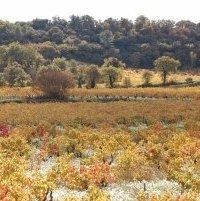
The vineyards of the southern Rhône were looking particularly beautiful in the autumn sunshine, still in leaf with the yellows, oranges and reds of the season and the carpet of little white Diplotaxis erucoides between the vines. I had the chance to notice how particularly prolific these were at Château Rayas, where I waited in vain for owner Emmanuel Reynaud. Most unusually, he was still picking his 2010 grapes on 21 October.
The 2009 harvest in the southern Rhône was, by contrast, particularly early. Spring had been cool and wet but the summer was exceptionally dry. With less than 30 mm of rainfall between 9 June and 14 September, the drought was even more pronounced than in 2007, then a record year in which only 35 mm fell during the same period. (The average for the last 20 summers is 161 mm.) As a result of the particularly small berries that these conditions produced, average yields in Châteauneuf were less than 28 hl/ha when the maximum permitted is 35 hl/ha.
But low yields are not necessarily a sign of quality. (Yields were relatively high in 2007.) I think you can taste the effect of this prolonged drought on some of the wines that simply seem to lack juice. They may have wonderful deep crimson colours and attractively ripe, warm perfumes, but some of them have a dried-fruit character and finish suddenly with the most rasping of tannins. I visited the veteran Rhône négociant Marcel Guigal in Ampuis in the north of the valley after my stint in the southern Rhône. He looked triumphant when I mentioned this characteristic. 'The brokers are all cross with me because I haven't bought as much from the south as they'd like, but that's why!' he said.
Not that this criticism applies across the board. There are some truly lovely Châteauneuf-du-Papes – and I found the fault generally less common in Gigondas, with its higher, cooler vineyards and limestone soils – although even here many of the wines have 15% alcohol on the label (which is unlikely to be an exaggeration). As Vincent Avril of Clos des Papes explained it, '2008 was the year of the vigneron but 2009 was the year of the winemaker. I got my tannins ripe but the sugars were so high that the yeasts struggled a bit and the fermentations were very long. If you ferment too quickly, the wines won't be complex.' Certainly some of the wines tasted as though they may even have contained some unfermented sugar, even if most of them carried their elevated alcohol pretty well.
If the summer was particularly dry, it was also very hot. There were 24 days on which the thermometer reached 35 ºC, compared with only seven in the last 'great' vintage 2007. Even September was notably hot, although at least it cooled down at night. In these hot, dry conditions – a bit like the heatwave year of 2003 – the vines shut down and stopped ripening. It took a good downpour of 64 mm in mid September, fortunately followed by a keen mistral that dried the grapes, to kick-start photosynthesis again. Avril started picking his red wine grapes on 25 September but many other growers started much earlier, panicked by falling acid levels in the grapes.
A handful of the southern Rhône wines tasted as though they had been acidified but there was also evidence of extremely skilful winemaking, wines with real polish and complexity. There were very few unappetisingly overripe wines among the regular bottlings of Châteauneuf-du-Pape, and virtually all of them seemed clean and technically correct. It was a rather different story with the so-called Cuvées Spéciales, the limited-edition supposedly crème de la crème bottlings. Too often these seemed an exaggeration of some feature – more like red-wine creations, or exhibitions of winemaking technique, than real expressions of Châteauneuf. The great thing about Châteauneuf is that it is a blend of different grape varieties and different terroirs throughout the appellation. But many of the regular bottlings today are denied one strong feature – perhaps an almost overripe lot, or one from a special sort of soil, or a particular lot of Syrah or Mourvèdre – that has been chosen as the featured aspect of the Cuvée Spéciale, for which a substantial premium is routinely demanded. And the names of these special bottlings! Papal Tears, Immortelle, Noble Révelation and Feminessence are just a few.
As Rhône native and UK wine importer Christian Honorez of H2Vin is advising this year, 'there is little need in 2009 to spend a fortune in buying the micro-garage-single-barrel-great-grandfather vines cuvées. Instead look for the trademark of the Domaine, a cuvée at the winemaker's heart, made in sufficient volume to keep a lower price.' There were many instances in which I preferred the regular bottling to the special one (especially with the white Châteauneufs, however skilfully they tend to be made nowadays) – and, as in 2007, we should be able to enjoy the riches of 2009 all the way down to Côtes du Rhône level.
In general the northern Rhône 2009s seemed to be more relaxed, eloquent and convincing to me – a phenomenon that was already evident in the range of northern and southern Rhône 2009s I first tasted back in May, Michel Chapoutier's top bottlings known as his Sélections Parcellaires. I will write in more detail about the north in the New Year, after my Christmas recommendations, which will be published on the next four Saturdays.
Find our hundreds of tasting notes via our Guide to 2009 Rhône coverage.