



Guest contributor
The following is a presentation given recently in London by Brian Croser of Australia as the annual lecture organised by Santa Rita of Chile, for whom he is a consultant. Needless to say, we three authors of Wine Grapes are very flattered but had no idea he was to be so complimentary.
Carmenet is an old Médoc synonym for Cabernet Franc. It is also the name given to the Bordeaux family of wine-grape varieties by Levadoux in 1948 in his classification of France's ampelographical assemblage into eco-geogroups, varieties grouped by their region of origin and genetic relationships.
How do I know that? The bible tells me so!
The bible is Wine Grapes by Jancis Robinson, Julia Harding and José Vouillamoz, surely one of the greatest contributions to viticultural scholarship in modern times.
The Carmenet eco-geogroup of varieties from the region of Bordeaux includes the blood relatives Cabernet Franc, Cabernet Sauvignon, Carmenère, Gros Cabernet, Merlot, Merlot Blanc and Hondarribi Beltza.
Cabernet Franc is involved as a parent or grandparent of all of these varieties.
Fer and Hondarribi Beltza are natives of the País Vasco, the Basque area of Spain on the French border, and are the grandparents of Carmenère. As one of the grandparents of Carmenère, Fer is included in the noble house of Carmenet.
The Carmenet family also includes Petit Verdot, which has no genetic relationship with the Cabernet family and probably was domesticated from wild grapevines of the Pyrénées-Atlantiques region south of Bordeaux.
The Carmenet eco-geogroup does not include the important Bordeaux varieties Malbec and Sauvignon Blanc despite their genetic links with other members of the Carmenet group, Malbec sharing a mother with Merlot, and Sauvignon Blanc as the mother of Cabernet Sauvignon.
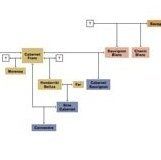
This complex family tree of the Bordeaux varieties is laid out in the Cabernet Sauvignon pedigree diagram on pages 162-3 of Wine Grapes, which can be downloaded here and is partially reproduced above.
What is remarkable is the overwhelming authority that this group of varieties exerts on global viticulture.
In another tour de force just released [as a free ebook], Professor Kym Anderson of the Wine Economics Research Centre at the University of Adelaide has compiled a statistical compendium of Which Winegrape Varieties are Grown Where? A Global Empirical Picture.
Of the 'World's top 35 winegrape varieties in 2010 (ha)', Cabernet Sauvignon is the most widely planted variety on the globe, Merlot is second, Sauvignon Blanc is eighth, Cabernet Franc is seventeenth and Malbec (Cot) is twenty-first. Considering there are 1,368 wine grape varieties described in Wine Grapes and many more not included, 5 in the first 21 is remarkable and testimony to the quality of wines produced from this genetic lineage.
The Cabernet family account for nearly 20% of all wine grape plantings on the globe.
We begin with Sauvignon Blanc.
Sauvignon Blanc (number 8 in global plantings)
The queen of herbaceous aromas and flavours, Sauvignon Blanc makes the most distinctive white wines of all white varieties with the possible exception of some of the Muscats and Gewurztraminer.
Sauvignon Blanc's father has not been identified, a long-lost old variety of the Val de Loire where it mated with Savagnin (Traminer), a variety of the north-east of France (Alsace) to produce Sauvignon Blanc and its full sister Chenin Blanc. Sharing the parent Savagnin, it is a half-sibling of Silvaner, Verdelho and Grüner Veltliner, among others.
Savagnin is in turn a daughter of Pinot Noir so it is with Pinot's grandchild Sauvignon Blanc that Burgundy meets Bordeaux.
Sauvignon Blanc was first recorded in the Bordeaux region in the early 18th century, migrating over from the Loire Valley some time before that.
The word Sauvignon is probably a derivative of sauvage, (wild) referring to the similarity of the leaf to the wild vinifera varieties of the region.
Using both Kym Anderson's book and Wine Grapes and extrapolating, it seems the global production of Sauvignon Blanc wine is about 70 million cases, some of which is blended with Sémillon and other varieties.
France is the biggest producer at 27%, followed by New Zealand at 18% and growing, then South Africa at 9%, Chile and Moldova at 8% each and California and Australia at 6% each. Argentina is at 2%.
Sauvignon Blanc's distinctiveness has been the subject of much research and is attributed to methoxypyrazines (IBMP and IPMP), which contribute herbaceous, capsicum and asparagus aromas, and to varietal thiols (4MMP, 3MH, 3MHA), which contribute citrus, grapefruit, passionfruit, cats' pee and broom-bush aromas. Terpenes, leaf aldehydes (hexenal) and norisoprenoids complete the grape variety's contribution to aroma, and fermentation creates esters, higher alcohols and fatty acids, which contribute to aroma complexity.
Apart from its own distinctive wines, Sauvignon Blanc achieved fame as a parent together with Cabernet Franc of Cabernet Sauvignon, contributing some of its green aromatic qualities to that great variety.
Merlot (number 2 in global plantings)
Probably so named because as the earliest-ripening Bordeaux red variety it was the favorite of the blackbirds.
Merlot was first mentioned in the late 18th century as a true native variety of Bordeaux born of a cross between Cabernet Franc and the very early ripening old variety of Brittany and the Charentes, Magdeleine Noire des Charentes.
Because of its early ripening habit, Merlot has moderate tannins and acid at harvest and does inherit some of Cabernet Franc's ability to retain methoxypyrazines producing some green flavours in cool, wet climates and soils where vine vigour and fruit shading are too great. Merlot does have the green gene moderately expressing.
Fully ripe, Merlot has good colour, significant rich tannins and plum and fruitcake aromas and flavours.
More than 160 million cases of Merlot are produced globally but a significant proportion of it is blended with the other Bordeaux varieties.
Again France is the main producer with 43% of total production, next is Italy with 10%, USA with 8%, Bulgaria with 6%, Spain and Chile with 5% each, Australia and Romania with 4% each and Moldova and Argentina with 3% each.
Carmenère
Carmenere is another Bordeaux native first mentioned in Bergerac in the late 18th century.
It is very late ripening and has a double dose of the green gene from its parents Gros Cabernet and Cabernet Franc. For those reasons it has all but disappeared from cool Bordeaux but has found refuge in the warm and dry internal valleys of Chile.
The story of Cabernet Gros is complex. Cabernet Franc is a native of the Basque area of Spain and there it crossed with another lost Basque variety to produce Hondarribi Beltza.
Hondarribi Beltza crossed with Fer, yet another native Basque variety, to produce Gros Cabernet.
Gros Cabernet crossed with Cabernet Franc, its grandfather, to create Carmenère in Bordeaux.
Carmenère is then both a child and great grandchild of Cabernet Franc and received a double dose of the green gene of Cabernet Franc.
Carmenère is the latest ripening of the Bordeaux varieties and has the greatest propensity to retain methoxypyrazine green flavours.
Ripened properly with good fruit exposure in a warm climate, Carmenère is a high colour, high tannin, exotic flavoured variety.
Only 5 million cases of Carmenère are produced on the globe and 84% of that is from Chile with a surprising 14% contribution from China, where it is called Cabernet Gernischt.
Cabernet Franc (number 17 in global plantings)
The daddy of them all, Cabernet Franc is believed to be of Basque origin where the most archaic of its clones exist and where it is called Acheria, 'the fox'.
Somehow it arrived in Bordeaux an orphan of unidentified parents and was collected from there by Cardinal Richelieu in 1631 and sent to his steward Abbé Bretton in Chinon and Bourgeuil. It is the oldest of the Carmenet Bordeaux family.
Cabernet Franc ripens later than Merlot and earlier than Cabernet Sauvignon and has medium to high colour, unusual silky tannins and floral aromatics which can be easily submerged by its tendency to hang onto methoxypyrazine greenness. It has the original green gene together with Sauvignon Blanc, with which it has no genetic relationship.
As well as being increasingly valued for its own qualities, it is the parent of Cabernet Sauvignon, Merlot and Carmenère.
Globally 33 million cases of Cabernet Franc are produced and a great proportion is blended with other Bordeaux varieties.
Again France dominates with 66% of production, followed by Italy with 13%, USA with 7%, Hungary and Chile 2% and Argentina, Spain, Canada and Australia 1% each.
Cabernet Franc is a variety of the future, combining the strength and sinew of Bordeaux with the subtlety, suppleness and aromatic finesse expected of Burgundy.
Malbec (Cot) (number 21 in global plantings).
Malbec has no genetic relationship to Cabernet Franc, Cabernet Sauvignon or Carmenère. Malbec does not have the Cabernet Franc green gene.
It does share a mother, Magdelaine Noire des Charentes, with Merlot, and received some of Magdelaine's genes for early ripeness similar to Merlot.
Malbec's other parent is Prunelard, an old variety from the Haut-Garrone and Tarn in the Central Pyrenees and it has Prunelard's deep colour and slightly rustic tannins..
Malbec is a child of the Cahors area, whence it was taken to the Gironde in the 18th century.
Malbec also has a high tartaric to malic acid ratio at ripeness and its acid and pH are relatively unaffected by the malolactic fermentation.
Malbec has greatly diminished in Bordeaux but Cahors remains its natural habitat and Argentina its new colony. It is a very good blender with Cabernet Sauvignon because it adds colour and ripe fruit flavours without adding any green characters.
21 million cases of Malbec are produced globally, mostly as a single variety. Argentina dominates production with 75% of the total, followed by France with 17%, Chile with 3% and California and Australia 1% each.
Cabernet Sauvignon (number 1 in global plantings).
Truly Cabernet Sauvignon is the king of wine grapes in quantity and in quality.
I still can't understand how Shiraz (as wonderful as it is) unseated Cabernet Sauvignon as the most revered of Australia's red varieties as it used to be up until the 1980s.
What I can understand is why it is the variety that defines Chilean fine wine.
Cabernet Sauvignon is a child of Cabernet Franc and Sauvignon Blanc that appeared in Bordeaux in the late 17th or early 18th century.
What a fortuitous accident, a grape perfectly suited to Bordeaux's cool maritime climate and gravelly alluvial soils, able to produce prodigious colour and tannin with wonderful blackcurrant fruit flavours and the ability to age into something complex and very special over decades, even a century.
Being the offspring of Cabernet Franc and Sauvignon Blanc, Cabernet Sauvignon inherited the green genes from both sides. Its propensity to retain methoxypyrazines is greater than that of Merlot and Cabernet Franc but not as strong as Carmenère. Cabernet Sauvignon is later ripening than all of the Bordeaux varieties other than Carmenère.
In some cool seasons and regions it does require ameliorative blending to add flesh and ripeness and to balance the leafy propensity with ripe fruit flavours. It is probably the most blended variety of all.
Merlot is its favorite partner because it ripens so early and completely in the cooler regions that suit Cabernet Sauvignon and enhances the Cabernet flavour profile and with softer tannins.
Petit Verdot, originally from the Pyrénées-Atlantiques is a late ripening variety unrelated genetically to the Cabernet family and therefore without the green gene but with good tannin structure to stiffen up Cabernet of weaker seasons.
Malbec is another variety unrelated to Cabernet, but earlier ripening, that performs the same supporting role in Cabernet blends.
Finally traditionally in Bordeaux and the Languedoc and especially in Australia, Shiraz has played the supporting role to Cabernet Sauvignon again adding ripeness and weight without augmenting green characters.
On the other hand, Cabernet Sauvignon grown in warm to hot climates, deprived of even a hint of its leafy heritage, lacks the spice, complexity and verve that defines the best Cabernet Sauvignon wines.
Globally 176 million cases of Cabernet Sauvignon are grown and with blending this probably ends up at a quarter of a billion cases.
France still leads the way with 19% of production followed by Chile at 14%, USA at 12%, Australia surprisingly at 10%, China at 7%, Argentina at 6%, Bulgaria at 5% and South Africa at 4%.
In conclusion
The core of the Carmenet dynasty of varieties is Cabernet Sauvignon and Merlot, both arising in Bordeaux in the 17th and 18th centuries, the same time frame as the New World was being discovered and colonised.
Very soon after colonisation, these varieties were sent to the New World and it is a matter of record that South Africa, Australia, New Zealand, Chile, Argentina and California have cultivated Cabernet Sauvignon from early in the 19th century, perhaps a mere 100 years fewer than France. Cabernet Sauvignon is as much a part of the history of the new world as it is of Bordeaux.
Cabernet Sauvignon is not a fashion that has suddenly opportunistically been adopted by the New World as a so-called 'international variety', it belongs to the history of each of these New World countries as much as to France.
Each country has its own unique versions of this great varietal genotype and its wines. The wines are as different in style as the very different terroirs and peoples of the countries involved. But they are connected by the genetic imprint on their wines of this great suite of varieties and the king, Cabernet Sauvignon.
Thank you to Bordeaux and France for these wonderful wine grape varieties.
Everything in “Member”, plus:
Everything in “Professional”, plus:














