Broadening the range of styles: 2000 to today
As the ABC movement took hold, wine lovers turned away from California Chardonnay, and restaurant wine lists throughout the United States reduced by-the-glass selections largely to only one key Chardonnay. Rombauer and Kendall Jackson Reserve became benchmarks for more generous renditions of the state's number one variety. Kendall Jackson Reserve was launched in the mid 1980s and by the 2000s had become the standard for a rich style of Chardonnay with a bit of residual sugar. It filled a previously untapped spot in the market selling as a mid-priced wine, neither as expensive as boutique wines, nor as cheap as mere jug wine. Kendall Jackson was marketed as a wine for anyone. While its style of relying on residual sugar was less common upon its release, by the end of the 1990s it had been copied the world over.
Interestingly, in the case of Kendall Jackson Reserve, the residual sugar came not from Chardonnay itself but from blending in a small amount of unfinished, so sweet, Gewurztraminer. The wine was a multi-regional blend. While the everyday consumer couldn't get enough of it, the specialist wine drinker turned away from Chardonnay because of it. Although higher-end customers and wine geeks criticised the variety, the state’s acreage did not significantly decrease. Sales of lower-priced Chardonnays remained strong. Premium producers whose style was championed by collectors seeking wines recommended by Parker and Wine Spectator directed sales towards this sort of collector, while producers of the more classic style relied on long-standing devotees as sales slowly decreased. The backlash of the ABC movement failed to distinguish between the different styles of Chardonnay. As wine lovers turned away from California wines, interest in the fresher styles associated with Old World producers took hold. In California, even some of the celebrity producers of the riper styles began to consider bringing greater freshness to their approach.
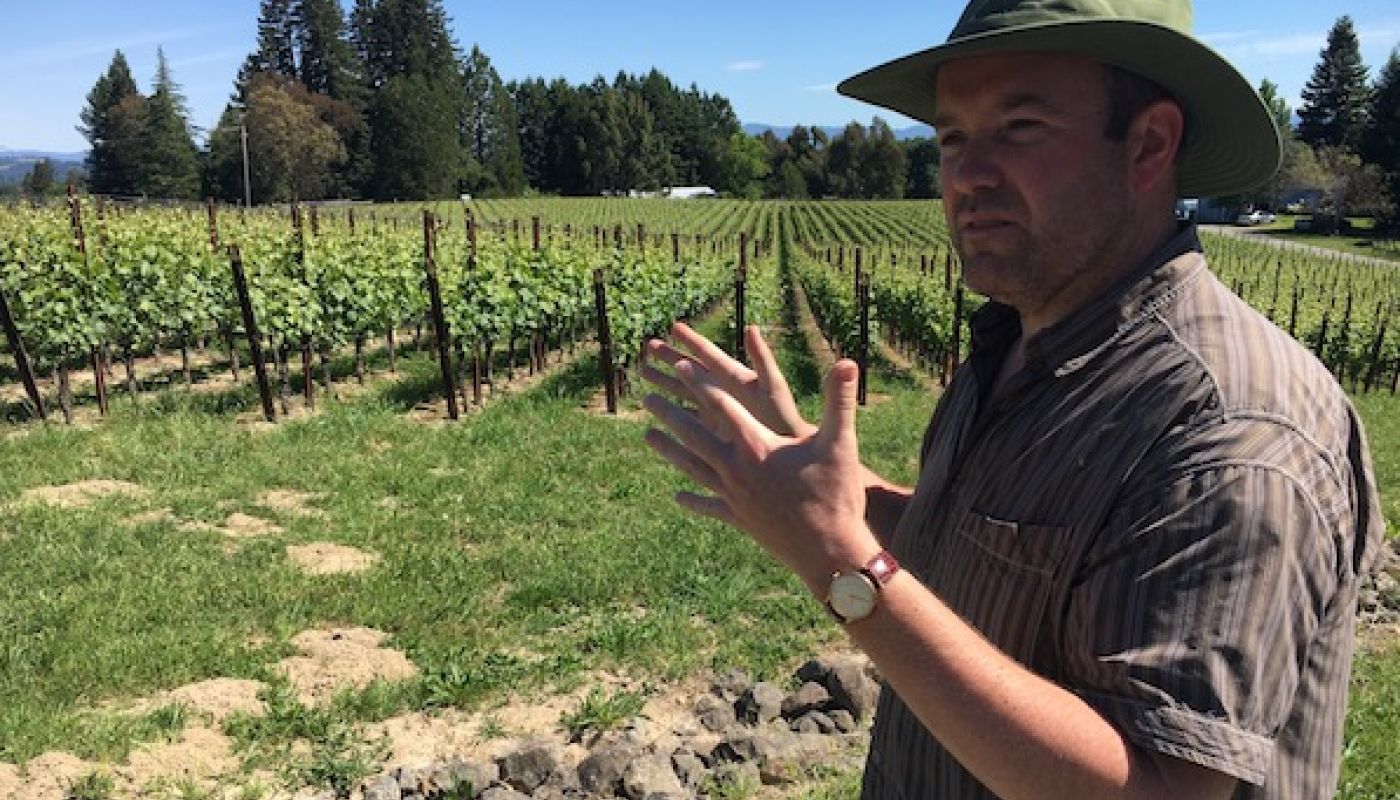
Gaining acclaim for generous wines in the late 1990s, DuMOL winemaker Andy Smith (pictured above right) was already beginning to reconsider his approach in the early 2000s. By 2003 when the winery began planting their own estate vineyard in the cool-climate part of Russian River Valley known as Green Valley, Smith made the decision to establish the vineyard in a manner that would support not only greater freshness but also more nuance in the wines. The DuMOL estate was established with California heritage clones.
Smith decided on the innate complexity of California heritage selections, rather than nursery clones, or heat-treated material from UC Davis. He selected budwood from the Morelli Lane Vineyard in Occidental that he'd worked with already for DuMOL, and used it to establish his DuMOL estate vineyard. The Chardonnay block at Morelli Lane was planted by Steve Dutton in the mid 1990s for Peter Michael winery, taking cuttings from Chardonnay vineyards in the Occidental area also planted through vineyard selections, or what we would call heritage selections, rather than nursery clones. The vineyard sources for Morelli are still being confirmed. What is clear is that the fruit from these selections at both Morelli and DuMOL differs from the Wente selections in that it always has open clusters of small berries which tend to have thicker skins, which gives impressive natural fruit density and phenolic presence. Smith chooses very slow, gentle pressing in order to extract less tannin from the skins.
A portion of the site is also planted with cuttings from the original block of Wente selection Chardonnay in the famed Hyde vineyard in Carneros. Smith took inspiration from the vineyard practices of Hubert Lamy in St-Aubin in Burgundy and planted the site with closer spacing, also training the vines relatively low to the ground. The vineyard architecture proved relevant to Smith’s new goals of greater nuance and freshness as the closer spacing and vine height means the fruit zone is consistently shaded by its neighbouring vine rows. The method demands more internal leaf pulling to reduce disease pressure, but it also ensures that subtler aromatic precursors are preserved rather than burned off through sun exposure. More exposed fruit leads to richer, darker flavours. The shaded fruit zone of DuMOL instead offers finer-tuned, almost pixelated flavours such as freshly cut celery leaf, or citrus blossoms. The contrast can be vividly seen when tasting across DuMOL’s other single-vineyard Chardonnays. Sites with similar elevation, aspect, soils and vine material, made in the same fashion but with wider vine spacing, have quite a different fruit character. Freshness with mouth-watering acidity is found in both, but the flavours of the estate planting are more nuanced and complex. At the same time, Smith has slowly shifted to earlier picking. While in the late 1990s DuMOL wines were around 15% alcohol, today they are rarely more than 14%. More than that though, Smith also turned to reducing the richness in the wine produced in the cellar – reducing bâtonnage to shift the mouthfeel and weight of the wine from creaminess to more linearity, and reducing the use of new oak from 50% or more to between 25% and 30%, for example.
The DuMOL estate is at around 200 ft (60 m) elevation in fine-powder Goldridge soils set over compressed sandstone. In the cellar, DuMOL uses Burgundy-inspired techniques that have become more common in California Chardonnay. Smith relies on whole-cluster pressing, oxidised juice, barrel fermentation and ageing with full, natural, malolactic conversion, with 12 months in French oak barrels followed by six months in tank.
Closer vine spacing was not unheard of in California before DuMOL’s decision. Previously the Rothschilds had motivated a similar close-spacing approach to the Cabernet Sauvignon vineyards at Opus One in Napa Valley. But the approach had not been widely used in any variety, and very little for Chardonnay. Soon after DuMOL planted its estate vineyard, independently of Smith, Sashi Moorman began planting what is now the Domaine de la Côte (DDLC) vineyard with closely spaced vines in the far west of the Sta Rita Hills. The site was planted entirely to California heritage selections, but for the first decade only to Pinot Noir. In 2014, the DDLC team also established a steep, closely spaced Chardonnay block which was harvested for the first time in 2018.

In 2010, sommelier Rajat Parr partnered with Moorman to create Sandhi, a Chardonnay-focused project based in the Sta Rita Hills. (Moorman is seen walking a Sandhi vineyard above.) Although the winery also makes Pinot Noir now, it started from a love for fresher expressions of Chardonnay. The wines of Sandhi quickly expressed two key movements in California. For one, the wines are known for their consistently lower alcohol levels. At the time Sandhi started, the move to picking earlier (to produce wines not only below 14% but more often below 13% alcohol) was in such contrast to the riper styles associated with California that many perceived the wines as having little flavour. For Parr, they expressed instead respect for the classic wines of early California, as well as the quiet subtlety shown by the French wine described in Prial's 1981 article (see part 3) – wine that instead of seeking to impress up front, takes time to reveal itself in the glass. Secondly, the Sandhi project also represents the last decade's increase in small-scale producers in the state.
The challenge of the global financial crisis of 2008 hit wine sales and wineries directly. As a result, a shake up happened both in long-term grape contracts for iconic vineyards, and in how wine was sold in the United States. Smaller, négociant-style wineries reliant on buying fruit rather than farming the land themselves emerged. Sandhi is made entirely from purchased fruit from iconic sites of Santa Barbara County.
At the same time, frustrated by the riper wines dominating the California landscape, Parr and Sonoma Coast producer Jasmine Hirsch decided to join forces. In 2011, they created the In Pursuit of Balance (IPOB) tastings, initially dedicated only to Pinot Noir, and then two years later also to Chardonnay. For its five-year duration, IPOB served as a lightning rod both for wine lovers seeking California wines with the freshness associated with Old World styles and for critics irritated with the shift in consumer interest away from ripeness. Both Parker and Wine Spectator made repeated, dramatic criticisms of both IPOB and its founders. During its tenure, IPOB was often either credited with instigating newer, fresher styles throughout the state, or blamed for generating unnecessary division in the wine community. However, looking back, it seems clear IPOB was simply an expression of a larger trend, not its cause. IPOB also paralleled the perspective being championed by then San Francisco Chronicle California wine critic Jon Bonné. Indeed, Bonné also served on the tasting committee that selected IPOB participating wineries.
Even so, numerous younger, small-production wineries benefited from the attention garnered via IPOB. From the Central Coast, wineries such as Clendenen-trained Gavin Chanin of both Chanin and Lutum wines, as well as Justin Willette of Tyler found new audiences. (For Tyler that success has drawn the attention of a new international collaboration. Étienne de Montille has now joined forces with Willette to make the not-yet-released Montille-Willette wines from the Sta Rita Hills.) Further north, already existing wineries such as Drew from Anderson Valley, Matthiasson from Napa Valley, as well as the longer-established Littorai and Failla from Sonoma also benefited. IPOB also helped return attention to some of the classic producers of California Chardonnay, reminding the public that stalwarts such as Au Bon Climat and Mount Eden had been there all along.
Outside IPOB, smaller-production wineries are proliferating, many of their founders being dependent on full-time jobs making wines for established wineries. For most, their existence depends on buying fruit by the ton. For a few, such as the notable Enfield Wine Co in Napa Valley and Ceritas in Sonoma County, attention has turned instead to finding more affordable vineyards to farm themselves in order to ensure greater control of farming for nuance and quality.
DuMOL is far from the only producer previously known for riper styles to have turned towards greater freshness. Second-generation producer White Rock in Napa Valley has steadily shifted from their bombastic wines of the early 2000s to a style that brings together the honest ripeness of Napa Valley with mouth-watering freshness. In Northern Sonoma, Copain became so associated with the IPOB mantra for freshness that its fans seemed to forget that its founder Wells Guthrie was once a Parker-celebrated winemaker. As these shifts in style have occurred, medium and larger wineries have followed suit. Around the same time that IPOB dissolved in 2016, Copain was sold to Jackson Family Wines. More recently even winery Murphy Goode, strongly founded on riper styles, has publicly championed a turn towards lighter-bodied, fresher wines.
At the same time, wineries such as Kistler in Sonoma and Aubert in Napa Valley have maintained their talent for richness with nuance regardless of the IPOB movement, continuing to garner respect from lovers of their style.
All together, the result is that Chardonnay from California includes a range of styles across quality levels broader than ever before seen in the state.
Additional reading
Gerald Asher, 1990, 'Chardonnay: Buds, Twigs and Clones', Gourmet
Robert Benson, 1977, Great Winemakers of California
Doris Muscatine, Maynard Amerine, Bob Thompson, 1984, The Book of California Wine
Thomas Pinney, 1989, A History of Wine in America, Volumes 1 & 2
Frank Prial, 2001, Decantations: Reflections on Wine
Nancy Sweet, FPS, UC Davis, 2007, 'Chardonnay History and Selections at FPS', FPS Grape Program Newsletter
George Taber, 2005, Judgment of Paris: California vs France and the historic 1976 Paris tasting that revolutionized wine
FPS Grapes, Grape Variety: Chardonnay
Focus on Chardonnay (proceedings of a four-yearly meeting of Chardonnay producers from around the world, available from the participating wineries only)
University of California Oral History Project: including Ernest Wente, Wente Family, Mike Grgich, Zelma Long, Eleanor McCrea, Maynard Joslyn