We were entertaining an American specialist in fine wine the other day. She was over in London from her base in California and we ordered Isola e Olena's 1997 Cepparello, a classic Tuscan at the peak of its powers. By mistake the waitress brought us a 2012 light red varietal Trousseau grown in Lake County and made by the California sommeliers' darling duo Arnot-Roberts. 'Ooo yes, that would be great', she enthused over this grape, obscure even in its native Jura, let alone in the northern reaches of California wine country.
Such is the way of the sophisticated wine-drinking world today. We all seem to be engaged in a constant search for the truly esoteric. But what of the macro trends? Which grape varieties have been taking over modern vineyards? Kym Anderson is an economics professor who has established the Wine Economics Research Centre at the University of Adelaide. He distils the stimulating and essentially fluid world of wine into arid tables of statistics, all available free at www.adelaide.edu.au/wine-econ.
According to his charts, the grape variety that has, to quote the stereotypical disc jockey, zoomed up the charts most dramatically is Spain's most famous red wine grape Tempranillo. The total area devoted to Tempranillo increased almost fivefold between 1990 and 2010, by almost 200,000 ha (594,000 acres), so that it shot up from being the world's 24th most planted grape in 1990 to fourth position in 2010, beaten only by the ubiquitous Cabernet Sauvignon and Merlot, and a Spanish pale-skinned grape that it has since overtaken.
Many of the world's wine lovers may be surprised to discover that it has been only this century that the two red Bordeaux grapes overtook what was until very recently Spain's most planted grape, the white wine and brandy grape Airén. Part of the reason why Airén and Tempranillo, Spain's two most planted grapes, feature so strongly is that Spain has been so short of water (irrigation has been allowed only relatively recently) that vines have to be planted very far apart to take advantage of water supplies. Since by far the most expedient way of comparing grape variety influence is to record the area of vineyard devoted to them, Spanish varieties arguably seem more important than they would be if judged on the basis of the amount of wine produced.
Nevertheless, the enthusiasm with which Tempranillo has invaded the world's vineyard is remarkable. Unlike Syrah (aka Shiraz), the other grape that climbed more than 20 places between 1990 and 2010 to become one of the 10 most-planted grapes in the world, Tempranillo is pretty much a one-country grape. It may be by far the most planted Spanish grape in Portugal (and one of Portugal's very few vine imports), but about 90% of the world's Tempranillo is grown in Spain.
In recent history Tempranillo has been known as the most important grape of Spain's two most respected fine red wine regions, Rioja and Ribera del Duero in the north of the country – although it was only in the fourth quarter of the last century that Tempranillo definitively overtook Garnacha (known as Grenache in France) in the former. As recently as the mid 1960s, Tempranillo represented typically only about 40% of the blend in a red rioja. But Spanish winemakers have tended to prefer Tempranillo to Garnacha because it ripens easily, is relatively productive, and is more stable and withstands oak ageing much better. It is also much more like the revered Cabernet Sauvignon in structure, producing wines with the tannins to imbue them with a reasonably long life as well as savoury, not too sweet, fruit that often reminds me of dried tobacco leaves.
In the 1990s Spain discovered varietal labelling, calling wines after the grape variety that was principally responsible for them. Although there was a brief period of manic planting of the famous international (mainly French) grapes such as Cabernet Sauvignon and Chardonnay, growers soon realised – to no one's great surprise – that Spanish varieties were generally better suited to Spanish vineyards. The obvious choice was Tempranillo, a grape variety that had basically become a brand, thanks to its réclame in Spain's two most respected wine regions Rioja and Ribera del Duero.
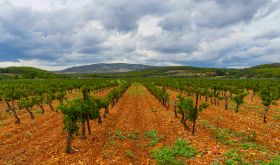
The result has been feverish planting of Tempranillo in southern Spain, particularly on the plains of Castilla-La Mancha. Tempranillo was traditionally known as Cencibel here but it is the T-word that appears on the labels of such wines as find their way into bottle, in the hope that some of the glamour of Rioja and Ribera del Duero will rub off on these much simpler wines. Vast tracts of Airén have been replaced by Tempranillo in Castilla-La Mancha, which by 2010 was home to more than 70,000 ha (173,000 acres) of Tempranillo, twice as much as grew in either Rioja or Ribera del Duero. This means that not only has Tempranillo become Spain's most planted grape, but La Mancha now grows more than a third of all Spanish Tempranillo, the great majority of it pretty young vines. La Mancha, Don Quixote country with extremely hot summers and cold winters, is not generally associated with fine wine. The Peñin Guide, Spain's wine bible, devotes only about 20 of its 1,000+ pages to La Mancha, despite the fact that it constitutes about 45% of Spain's total vineyard area.
La Mancha Tempranillo, produced from young vines in very hot vineyards, rarely has the stuffing and freshness to produce serious wine, and it is perhaps significant that, unusually, the Spanish authorities announced in July that a total of four million hectolitres 105.7 million gallons) of wine, enough to fill 533 million bottles, were to be distilled into industrial alcohol to make way for the 2014 grape harvest. Spain has an embarrassing surplus of cheap wine and wine-trade tales of deals to be had abound. Even some of Rioja's finest wines can represent great value at the moment.
Tempranillo's ascendancy has been at the expense not just of the pale-skinned Airén but of Garnacha, Spain's second most important red wine grape. In 1990 Garnacha was the world's most planted red wine grape, but by 2010 it was down to seventh place overall, its total area having shrunk by a third. I have long thought this is a shame since old Garnacha bushvines all over Spain are capable of producing lovely reds even without oak, chock full of flavour but with bargain price tags. Fortunately there are now just-perceptible signs that Spaniards are re-evaluating their Garnacha, perhaps tiring of the low-quality Tempranillo wine lake. See the ground-breaking Contino wine below, a rare example of a varietal Garnacha produced by a top quality Rioja producer.
SOME SPANISH FAVOURITES
These are all made from Garnacha and/or Tempranillo. Rioja has had a run of good vintages, and producers have the delightful habit of releasing wines only when they are ready to drink.
Evohé Garnacha 2011 Vino de la Tierra de Aragón
£8.55 The Sampler
Bodega Classica, López de Haro Reserva 2005 Rioja
£8.25 The Wine Society (from 3 November)
CVNE Reserva 2008 and 2009 Rioja
£14.50 Waitrose, Majestic, Wine Rack, Fresh and Wild, Wimbledon Wine
La Rioja Alta, Viña Ardanza 2004 and 2005 Rioja
From £21 The Wine Society, Divine Fine Wines, Oxford Wine Co, Slurp.co.uk, Roberson, Berry Bros
Contino Garnacha 2010 Rioja
£23 a bottle from The Wine Reserve, D Byrne, Brook & Vine and Islington Wine.
Roda Reserva 2008 Rioja
From £28.20 Tanners, Eton Vintners, The Wine Library, Fortnum & Mason