17 January 2018 Dr José Vouillamoz, co-author of Wine Grapes, presents some wines worth discovering. It's interesting to compare this with Ferran's recent survey of Spain's Atlantic island wines, grown on Tenerife.
In July 2017 I had the chance to make a trip to the island of Pico in the Azores, a Portuguese archipelago situated in the middle of the Atlantic Ocean, around 1,450 km (900 m) west of Lisbon, and composed of nine volcanic islands: São Miguel, Santa Maria, Faial, Terceira, Graciosa, São Jorge, Pico, Flores and Corvo.
They were discovered between the 14th and 15th centuries, and viticulture is said to have been introduced in the early 15th century by Henry the Navigator, who brought back vine material from Crete (Candia) or from Cyprus. Others suggest that Franciscan monks introduced viticulture from Madeira and mainland Portugal. Regardless of who really did introduce the first vines, wine production quickly flourished in this mild and humid Atlantic climate thanks to the hard work of Carmelite and Franciscan monks. So much so that in 1816 André Jullien reported in his seminal book Topographie de tous les vignobles connus that wine was produced on all nine islands to a total of more than 30,000 pipes (13.4 million litres) a year, exporting to Brazil, the United States, Russia, England, Holland and Angola. My picture here shows a typical windmill – once used to mill grain – in the middle of vineyards on Pico.
American plagues
In 1850, the accidental introduction of powdery mildew from America resulted in a dramatic decrease of the vineyard area, and prompted the introduction in 1854 of the naturally resistant variety Isabella belonging to the American species Vitis labrusca, soon followed by some other American (non-vinifera) vines such as Jacquez and Herbemont. The subsequent, and just as accidental, introductions from America of downy mildew in the 1870s and of phylloxera in the 1880s nearly sounded the death knell of the local historical European Vitis vinifera varieties, supplanted by lesser-quality American species or hybrids. Today, viticulture has survived on four islands: Terceira, Graciosa, Pico and São Miguel (as shown in Figure 1 below).
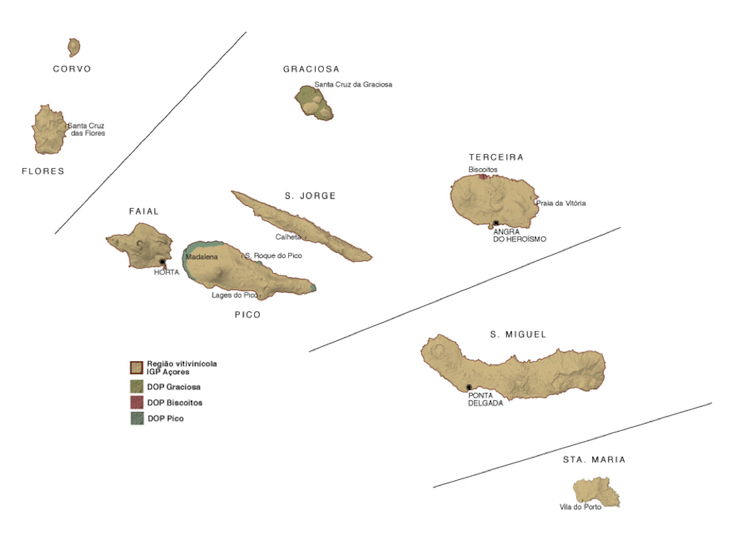
Figure 1. Azores islands, vineyards and appellations (taken from http://www.vinetowinecircle.com/en/regions/the-azores/)
Grape varieties
A total of 33 grape varieties are currently authorised on the Azores, 15 for red wines and 18 for white wines:
| Red wines | White wines |
| Agronómica | Arinto dos Açores (Pedernã, Terrantez da Terceira) |
| Aragonez (Tempranillo) | Bical |
| Cabernet Franc | Chardonnay |
| Cabernet Sauvignon | Galego Dourado |
| Castelão (Periquita) | Generosa |
| Complexa | Gouveio |
| Gewürztraminer | Maria Gomes (Fernão Pires) |
| Merlot | Malvasia (Malvasia di Lipari) |
| Pinot Noir | Malvasia Fina (Boal) |
| Rufete | Moscatel Graúdo (Muscat of Alexandria) |
| Saborinho (Negramoll) | Riesling |
| Tinta Barroca | Rio Grande |
| Touriga Franca | Seara Nova |
| Touriga Nacional | Sercial (Esgana Cão) |
| Vinhão | Tália |
| Terrantez do Pico | |
| Verdelho | |
| Viosinho |
The most important traditional varieties found in old vineyards are: Arinto dos Açores, Verdelho and Terrantez do Pico, described in more detail below.
Arinto dos Açores
This is the most widespread variety in the Azores, where it was known under the traditional name Terrantez da Terceira until 2012, when an official decree changed it to Arinto dos Açores. DNA profiling performed in 2016 suggested that Arinto dos Açores has a possible parent–offspring relationship with Verdelho (see Figure 2 below). Since Verdelho is more ancient and more widespread elsewhere, it is likely to be the parent, the other parent being unknown. This relationship needs further investigation to be confirmed.
Verdelho
Already mentioned as being grown in the Azores in the 16th century, Verdelho was supposedly introduced from Madeira by Franciscan monk Frei Gigante. DNA profiling performed in 1999 confirmed that the Azores and Madeira have the same Verdelho; in 2011, it suggested that Verdelho is a natural progeny of Savagnin; in 2016, it suggested that Verdelho has a possible parent–offspring relationship with both Arinto dos Açores and Terrantez do Pico (Figure 2). This putative family tree needs further investigation to be confirmed.
Terrantez do Pico
This is the least common of the three most-planted traditional varieties in the Azores. It is different from all the Terrantez ‘Something’ grown on Madeira as well as on mainland Portugal. DNA profiling performed in 2016 suggested that Terrantez do Pico has a possible parent–offspring relationship with Verdelho. Since Verdelho is more ancient and more widespread, it is likely to be the parent, the other parent being putatively Bastardo (Trousseau) (Figure 2). This parentage needs further investigation to be confirmed.
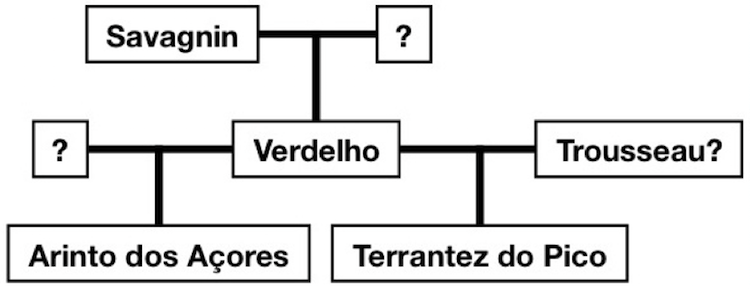
Figure 2. The three most important local varieties in the Azores belong to the same family tree: Verdelho, itself a progeny of Savagnin, putatively begat both Arinto dos Açores and Terrantez do Pico, the latter possibly by crossing with Trousseau (Bastardo). The parentages of Arinto dos Açores and Terrantez do Pico need more analyses to be confirmed.
Network of dry stone walls
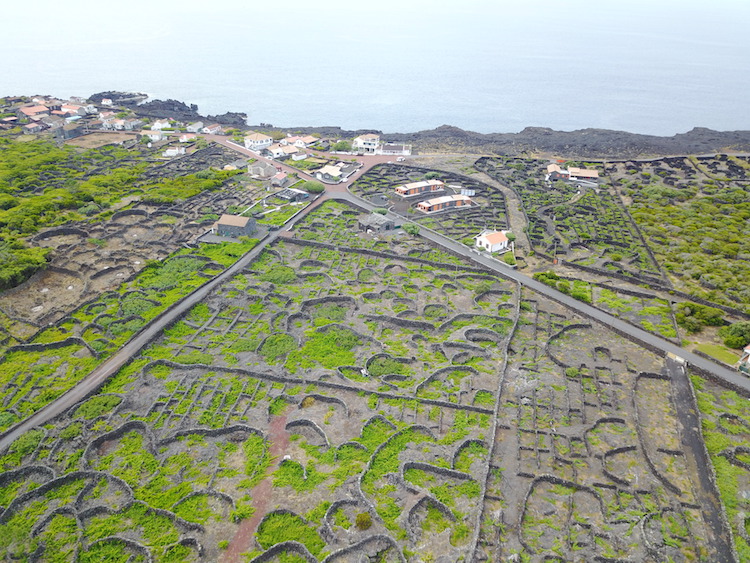
Protected by UNESCO World Heritage since 2004, the vineyards of Pico are planted on volcanic soils and surrounded by spectacular, reticulated dry-stone walls made of black basalt stones (see below).
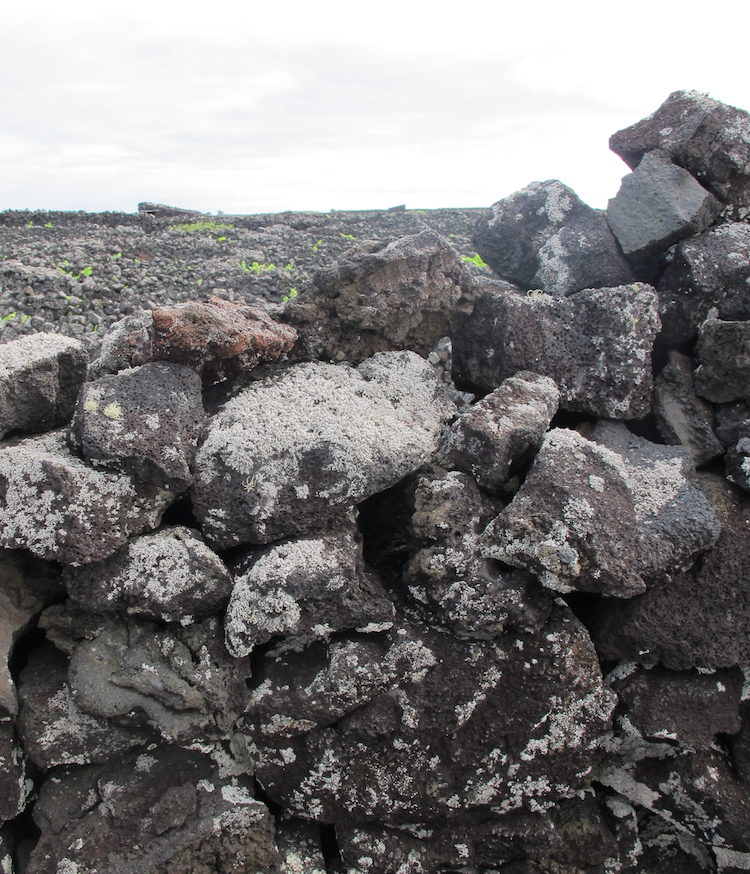
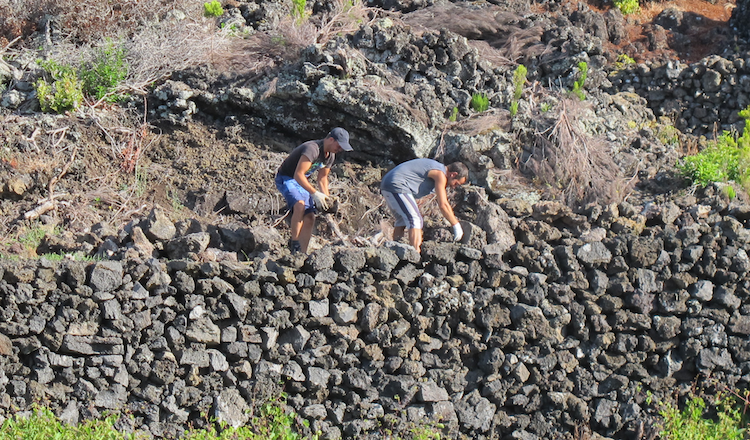
It is usually considered that the main reason for building this spectacular and laborious network of walls (see below) was to protect the vines from strong winds and from salt spray from the ocean. While this is certainly a major advantage, I was fascinated to learn from Paulo Machado of the Azores Wine Company that the first and foremost reason was more down to earth: the black basalt stones first had to be removed from the ground to render the soil fertile. Killing two birds with one stone (a basalt one!), the basalt rocks were used to build protective dry-stone walls.
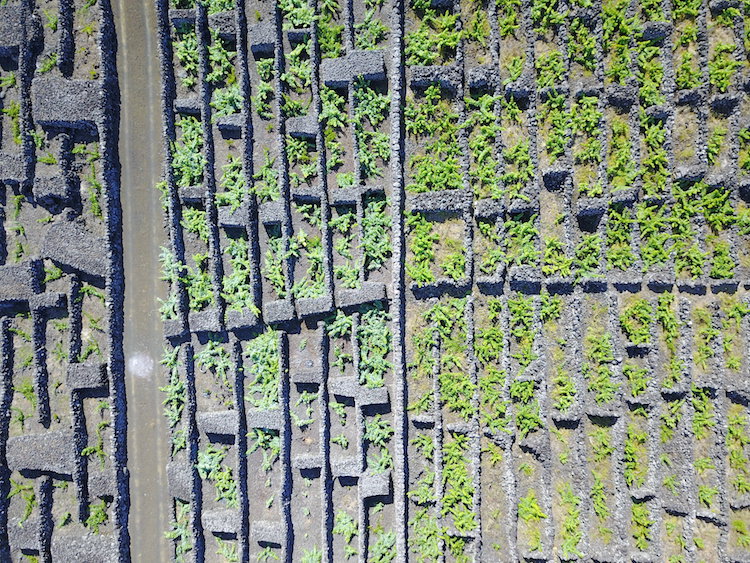
The plots are divided into jeirões (singular jarão), servidões, canadas and currais (singular curral) created by traverses in order to facilitate access and wind protection (see Figure 3 below). The bocainas provide exiguous paths from curral to curral, in which one to six vines are planted.
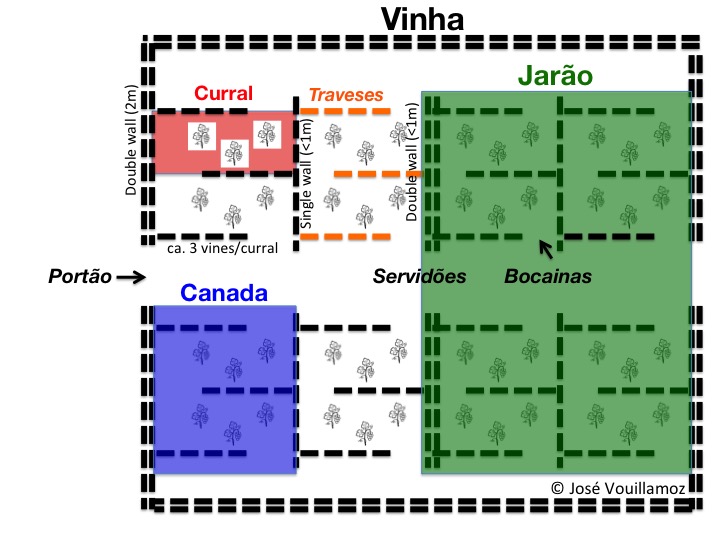
Figure 3. Typical structure of the network of dry-stone walls on Pico. This structure varies according to the availability of basalt rocks.
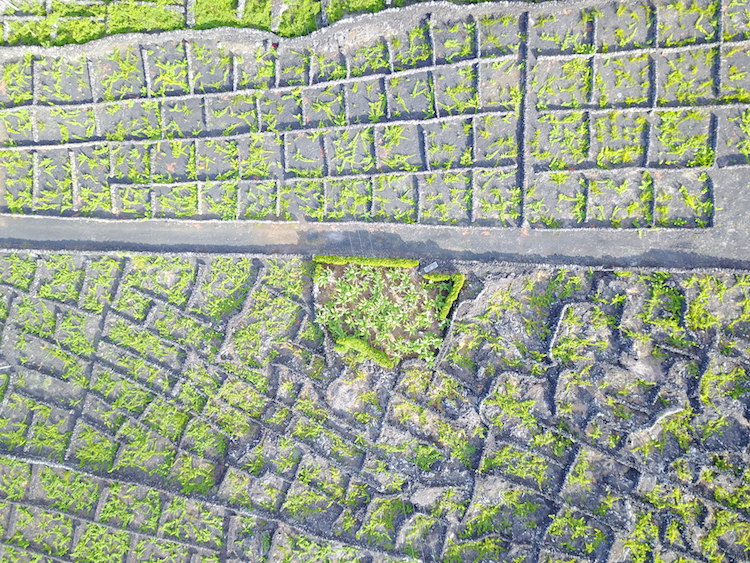
Circular walls were built for banana cultivation, although some of them are used today for grapevine cultivation and vice versa (pictured below).
Climate
The climate on Pico is strongly influenced by the Azores High, which also influences a large part of western Europe. The typical maritime climate combines mild temperatures with low thermal amplitude, heavy rains (especially in winter), and an elevated average humidity. Climate variation is also influenced by the orography (mountain formation) and geology of the island, the distance from the ocean, and the exposure to the sun. The frequent mist is favourable to fungal diseases, and anti-fungal spraying is a necessity on these islands.
More information about viticulture on Pico can be found here (in English and Portuguese)
WINES TASTED AND REVIEWED
The following wines were kindly sent to my Swiss home by the producers, and were tasted on 7 October 2017.
Some of these are great wines, but let no one think they will be cheap. One of my favourites was Terrantez do Pico 2015 (scored 18.5). Only 300 bottles were made and it sells for about €40 on the island (it's imported into the UK by Red Squirrel). And my favourite of all was Vinha Centenaria 2015 Pico (19) but it's not for sale yet.
Picowines CRL (Cooperativa Vitivinicola da Ilha do Pico)
Founded in 1950, the Picowines co-operative is the most important producer on the Azores.
Whites
PetNat Branco 2016
Sparkling wine, traditional method. Blend of Arinto dos Açores, Verdelho and Terrantez do Pico, with indigenous yeasts, without added SO2, unfiltered.
The 1.5 cm of lees at the bottom of the bottle started dancing like a medusa after I removed the crown-cap closure. The wine shows powerful aromas of mango and nectarine. The bubbles sparkle a lot, exploding in the mouth, resulting in an enormous effervescence. The acidity is considerable. The flavours remind me of apple cider, pear and mandarine. Quite an experience, although too fizzy for me. (JV) 11%
15 Drink 2017-2018
Frei Gigante Espumante 2016
Sparkling wine, ‘méthode ancestrale’. Arinto dos Açores, sample bottled in March 2017, to be released at the beginning of 2018. Named after Frei Gigante, the Franciscan monk who allegedly introduced viticulture to the Azores.
Removing the crown cap turned out to be a dangerous experience. The liquid literally squirted out one meter above the bottle, splashing my computer, leaving only a third of the wine in the bottle! I assume that some sulfites will be added to the commercial bottling in order to avoid bottle re-fermentation. Nevertheless the wine was interesting, with aromas of ripe apple and peach that were also noticed in the mouth, with a nice acidity balancing the structure, and a chalky persistence. (JV)
15.5 Drink 2017-2020
Frei Gigante 2016 Vinho Regional Açores
Arinto dos Açores mainly. Named after Frei Gigante, the Franciscan monk who allegedly introduced viticulture to the Azores.
Very ripe and powerful nose of heady flowers (lily) and resin. Round in the mouth, with considerable acidity. Simple and linear, with a short finish on beeswax. Puzzling, this wine might need some more time in the bottle. (JV) 13%
15 Drink 2018-2022
Frei Gigante 2013 Vinho Regional Açores
Arinto dos Açores mainly. Named after Frei Gigante, the Franciscan monk who allegedly introduced viticulture to the Azores.
Fresh nose of flowers, balsam and larch. Almost tannic mouthfeel with some bitterness. Very persistent on lemon and pomelo, with pleasant acidity. A wine with personality. (JV) 13%
16.5 Drink 2017-2022
Espalamaca 2016 Pico
Recently launched varietal Arinto dos Açores with partial malolactic fermentation in French oak vats.
Powerful and clean aromas of pear with a little bit of volatile acidity. Full-bodied with perfect balance, showing complex flavours of apple, peach, mandarin, nectarine, orange. Nice acidity, reminiscent of a German Riesling, with similar finesse. The finish is on kumquat. This wine has a great drinkability and vibrant acidity. (JV) 13%
17.5 Drink 2018-2030
Cavaco sur lie 2016
A Vinho Verde style red wine, slightly fizzy, made from Herbemont, an American hybrid locally known as Jose Nunes; unfiltered/unfined, without SO2 added, prone to gushing out of the bottle.
The bottle showed 1 cm of lees at the bottom, and the 'explosion' on removing the crown cap shows that the wine had re-fermented in bottle. The nose is therefore dominated by yeast aromas, and so is the mouth. The tannins are dry and the flavours remind me of cooked strawberries. Probably not meant to travel. (JV) 11%
14 Drink ?
Lajido, Fine Old Reserve 2003 Pico
Fortified blend of Arinto dos Açores, Verdelho and Terrantez do Pico.
Medium dry. Some volatile acidity, nutty aromas, dried figs. Dry mouth, starting with strong acidity, showing a slight hollow in the middle, then revealing bitter oranges and lemon, with apricot stones on the finish. (JV) 17.5%
17 Drink 2017-2040
Lajido, Fine Old Reserve 2004 Pico
Fortified blend of Arinto dos Açores, Verdelho and Terrantez do Pico.
Medium dry. Substantial volatile acidity, complex nose of confit apricots, whisky and currants. Dense mouthfeel, with nuts and almonds, balanced acidity, very persistent, finishing on toasted bread. An excellent wine, a hypothetical blend between white port and sherry. (JV) 18%
18 Drink 2017-2040
Azores Wine Company
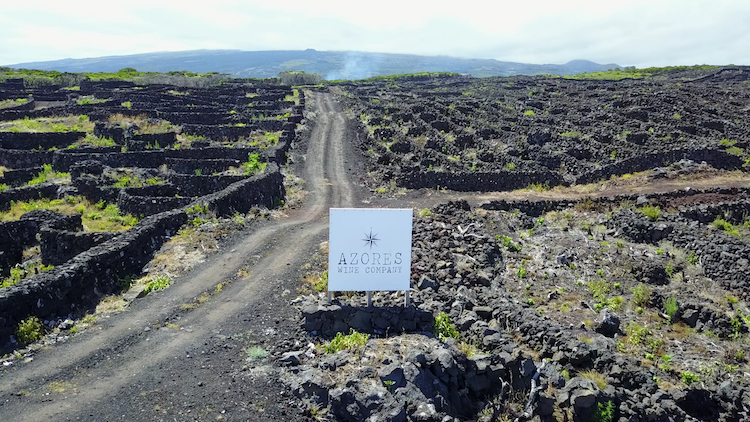
 Founded in 2014 by renowned oenologist António Maçanita, economist and hospitality industry expert Filipe Rocha, and fourth-generation winegrower Paulo Machado, the Azores Wine Company is a young but highly successful joint venture promoting the local heritage and historic grape varieties.
Arinto dos Açores Espumante Extra Brut 2014
Not yet on the market, a traditional-method sparkling wine made from Arinto dos Açores.
Complex nose of crystallised honey, hawthorn flowers, hazelnuts. Fine bubbles, flavours of orange peel, raspberry coulis, very good balance with good persistence on citrus, providing drinkability. (JV)
17 Drink 2018-2025
Arinto dos Açores 2015 Pico
Aromas of volcanic stone, citrus, green melon. Full-bodied, balanced, with the acidity rising to a crescendo, honey flavours, a bit hollow on the mid palate, with a simple and short finish on marzipan. (JV) 13%
16 Drink 2018-2024
Arinto dos Açores 2016 Pico
Sulphur aromas, overripe apples, lemon confit. Light body with high and slightly unbalanced acidity that dominates the finish. (JV) 13%
15 Drink 2018-2020
Arinto dos Açores Sur Lies 2016 Pico
Complex nose of chalk, butter, bread, old wood, orange peel. Dense structure, balanced acidity, ethereal, with hints of light tannins, finishes on coconuts and iodine. A wine that made me salivate! (JV) 13%
17 Drink 2018-2025
Terrantez do Pico 2015 IGP Açores
Complex nose with intense resin, volcanic earth, apple blossoms, iodine. Honey on the palate, marzipan, excellent structure with good maturity and balanced acidity. Very long, with lime and iodine flavours. A great Atlantic wine, somehow reminiscent of a German Riesling. (JV) 12.5%
18.5 Drink 2018-2030
Vinha Centenaria (DOC Pico) 2015 Pico
Made from centenarian vines. The photo below shows thick dry-stone walls in the oldest vineyard on the island, approximately 80–100 years old.
Grapefruit, aromas of lees, still young and changing a lot with aeration, after which apricot fruit dominates, with a hint of volcanic stone. The mouth is phenomenal: clean, dense, spherical, with superb acidity. Slightly bitter, with some tannins, it is endlessly long with flavours of lime and kumquat with a bit of saltiness. This is a unique wine with strong personality, a wine that generates deep emotions. (JV)
19 Drink 2018-2040
Rosé Vulcânico 2015 IGP Açores
Straightforward with strawberry aromas and a bit of sulfur, light mouth with crisp acidity, flavours of lemon, orange peel, and English candy. A bit short on the finish. (JV) 12%
14.5 Drink 2018-2019
Saborinho Tinto 2015
Not yet released on the market. Saborinho is a synonym for Negramoll or Tinta Negra Mole, a variety grown on Madeira, as well as in the region of Colares on mainland Portugal under the name Molar.
Balsamic, blueberry, leather, fruit purée. The attack is lively, the mouth is fruity, but the wine is a bit astringent, finishes on bitter almonds and rough tannins. (JV)
14.5 Drink 2018-2020
Isabella a Proibida
The forbidden variety Isabella has been deliberately crossed out in red on the front and back labels, in compliance with the appellation regulation. Azores Wine Company chose to make a varietal wine in tribute to this variety that contributed to maintaining viticulture on the Azores.
Smells like Isabella fresh grapes, with ripe raspberry but also burnt rubber and wet dog (some would say foxy but I have never smelt a fox...). The mouth is bitter, with a taste of resin and metal. Finishes on rubber and resin. Unpleasant, no wonder it is now forbidden… (JV) 12%
13 Drink ?
Adega A Buraca’
A boutique winery producing wine along with traditional handicrafts and other local products.
Buraca Wine 2009 Vinho Licoroso Seco 2009 Pico
Verdelho and Arinto dos Açores.
A hypothetical combination of Sauternes with Madeira, this unique wine offers complex aromas of nuts, dried apricots, beeswax. The mouth is smooth, rich without being sweet, the acidity increases to a crescendo and gives a backbone to the wine. The finish is very persistent with flavours of lemon, dried orange peel. No excess of alcohol. Great wine, ample and sapid. (JV) 17%
18.5 Drink 2018-2040