
12 December 2017 Tenerife is the largest and most central of the seven Canary Islands, 2,000 km (1,240 m) from Madrid but 100 to 400 km from the coast of Africa.
The tropical climate with a mean year-round temperature of 22 ºC (71.6 ºF) and long sunny days attracts six million tourists a year, mainly from the UK and Germany. Some producers claim that Tenerife is the second sunniest wine region in the world after Chile’s Atacama desert. The highest mountain in Spain, the Teide, dominates Tenerife and reaches an elevation of 3,718 m (12,200 ft).
The 8,000 ha (19,770 acres) of vineyards on Tenerife (5,000 of them producing appellation wine) are divided into five appellations: Yconde-Daute-Isora, Valle de la Orotava and Tacoronte-Acentejo in the north and Abona and Valle de Güimar in the south. This mosaic of appellations makes sense for locals but can be a bit confusing for others.
This may be the main reason for the creation of the 70-strong producer association. They aim to build a global brand called Tenerife Wine coexisting with the appellation system but simplifying the message to consumers. The brand was launched in July 2017 and provided me with a good reason to travel there and accept the opportunity to blind taste a selection of the best wines chosen by Tenerife Wine producers. It is still too early to know the impact of the new association but joining forces in order to better promote their wines surely makes total sense.
Conversely, the diversity of the island is obvious as you travel round the Teide extinct volcano from east to west. The north (Yconde, Orotava and Tacoronte appellations) are much more humid and rainy (400–700 mm/15.7–27.6 in a year), thanks to thick clouds brought from the Azores by trade winds that are blocked by El Teide. This singular climatic effect can be seen clearly from the top of the mountain and generates a beautiful landscape known as el mar de nubes, the sea of clouds (pictured below).

The southern part (Abona and Güimar) is drier (300 to 400 mm of rain a year) and historically has been a white wine area planted mainly with Listán Blanco. In the village of Vilaflor in the appellation of Abona are the island’s highest vineyards, planted from 1,300 to 1,600 m. Volcanic soils are predominant especially in the north. They have great drainage, retain humidity and also encourage roots to go deep in search of precious water. In fact yields on the island are really low, ranging from 3,000 to 4,000 kg/ha, and mechanisation is almost impossible in most vineyards.
One of the particularities of Tenerife is the abundant array of local grape varieties, most of them ungrafted as phylloxera never hit the island. Some of the oldest vineyards in Ycoden are propagated by layering, an ancient reproductive technique abandoned post-phylloxera. Today some producers are banking on single varieties, in contrast to the traditional field blends, allowing us a better understanding of their individual characteristics.
Listán Blanco and Listán Negro are the principal grapes, mostly produced in a delicate style. However, after the tasting, my preference was for the powerful, smoky and sometimes leathery Baboso Negro (known as Alfrocheiro in Portugal) and the mineral and chalky Vijariego Negro (Sumoll). As for the whites, I don’t have a clear favourite. The fragrant and aromatic Malvasias shone as clearly as usual, while an electrifying blend of Verdello and Albillo garnered 18 points from me. Marmajuelo demonstrates that it can be successfully produced in a ripe, broad style. Negramoll (which goes under many names elsewhere), the main grape in Tacoronte Acentejo, seems not to attract the attention of producers; just four of all the wines tasted had a tiny percentage of it. The recovery of Listán Prieto, the well-travelled Mission of California and País of Chile, is indeed very good news and today it is producing attractive red and sparkling wine.
Emigration has been a problem, and land is extremely expensive compared with some other less expensive regions in Spain: up to €70,000 a hectare (eight times the price of some other Spanish agricultural land). You will understand, therefore, why I am so happy to see so many new wine projects with some old vineyards being recovered, making a quality-oriented wine industry a reality.
My blind tasting of 48 wines was grouped by appellation. The following is an overview of each region.
- Tacoronte-Acentejo is in the north east with 1,700 ha (4,200 acres) of vines ranging from 100 to 1,000 m (328–3,280 ft) elevation. Terraced vineyards are common to avoid soil erosion on these slopes. Most of the wines are youthful and easy-drinking reds with low alcohol levels. This was not a top-rated region although Bodegas Crater is producing a superb Malvasía. Furthermore, Bodegas Insluares presented their thrilling sweet wines sold under the name Humboldt, with their 2005 Vendimia Tardía scoring 18 points. I really feel enthusiastic about this wine as it tastes halfway between sweet madeira and very old sherry.
- Valle de la Orotava is a beautiful valley flooded by 1,000 ha (2,471 acres) of vineyards mainly located on the Teide foothills (300–700 m/984–2,297 ft). Here the traditional cordon trenzado, or plaited cordon, training system (see Canary islands – where vines creep up on you ) is used. They are wines with great delicacy, chalkiness and no over-extraction at all. Unsurprisingly for followers of www.JancisRobinson.com, Suertes del Marqués achieved great scores. Bodegas Tajinaste is also a winery to follow; its CAN 2015 is opposite in style compared with Suertes del Marqués but is it also deliciously made.
- Ycoden Daute Isora (1,000 ha/2,471 acres) is in the north west. The vineyards range from low coastal elevations to 800 m (2,625 ft) inland, although some reach 1,400 m. This is one of the most humid parts of the island. Two projects here are of particular interest. Firstly I have the pleasure of introducing the young and very talented winemaker Borja Pérez. Then there is the terroir-hunting, single-vineyard-oriented Enviante company consisting of four brilliant friends: Roberto Santana, Alfonso Torrente, Laura Ramos and José Martínez. Today they focus on Almansa, Ribeira Sacra and Extremadura as well as Tenerife. The wines from Enviante have been closely followed at www.JancisRobinson.com, getting enviable ratings. Both Borja’s and Enviante projects are focusing on a non-interventionist winemaking philosophy, looking for charm rather than power, adding very little sulphites and encouraging terroir. The results are very convincing in the wines’ youth. However I am unsure of their ageing capacity, as they are quite evolved and play with an oxidative character. If they demonstrate the ability for maturing without turning too oxidative, leathery or farmyardy, they will become great bottles of wine, but I am slightly sceptical about this. Special mention should be made of the two delicious wines sold under the name of Táganan by Envínate. The generic white may be the saltiest wine I have ever tasted whereas the Parcela Maraglagua red is a subtle and exquisite expression of a century-old vineyard.
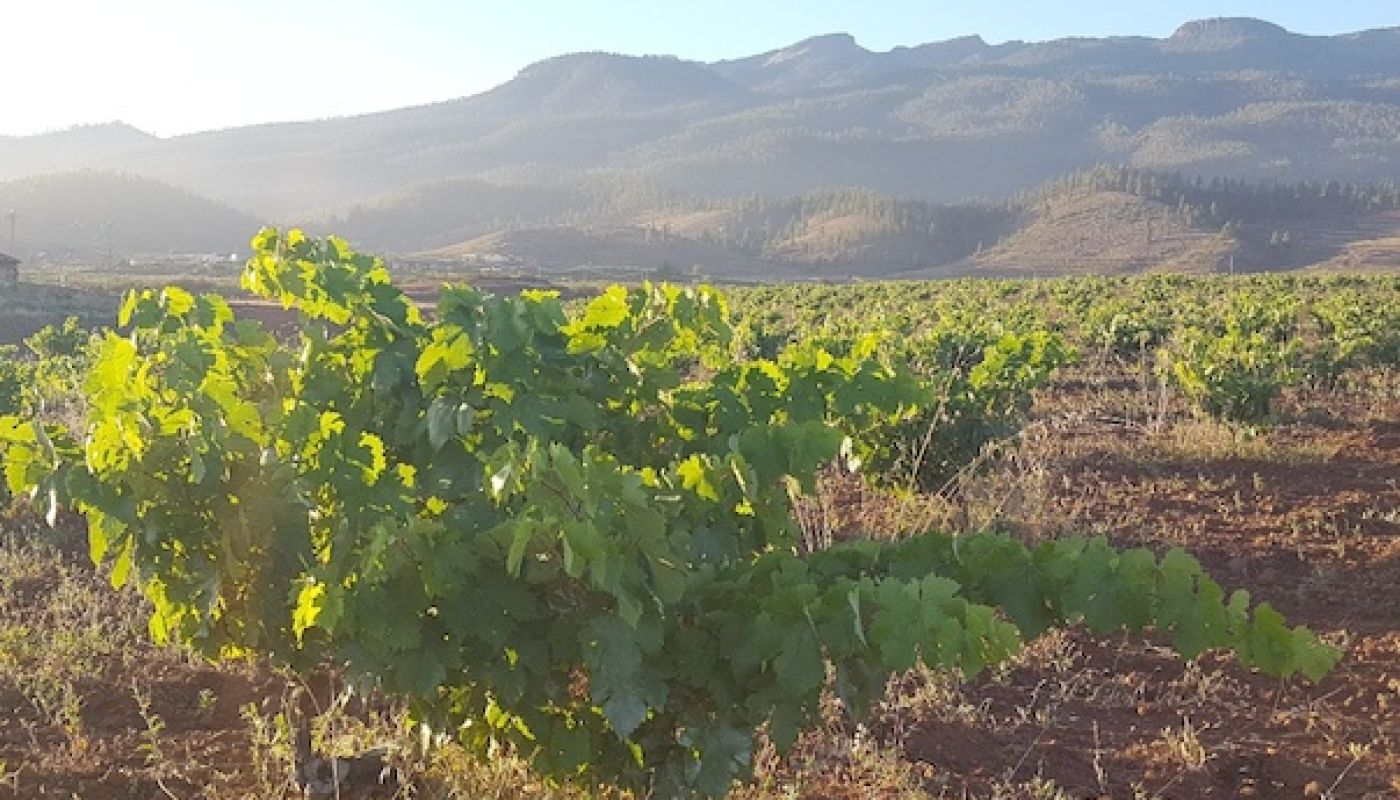
- Abona (1,500 ha/3,707 acres) in the south of the island was a great discovery, with particularly dry conditions, elevations up to 1,500 m (4,920 ft) in Vilaflor and the very poor volcanic soils producing wines that taste almost salty to me. One name shines in the region. Altos de Trevejos was established as recently as 2012 by a long-established viticulturist family. They are producing wines that are among the most exciting on the island. Their Albillo/Verdello 2015 was my favourite wine of the whole tasting. The main picture top right is of old vines in Abona; the picture below is of a tasting corner in the cellars of Altos de Trevejos.
- Valle del Güimar (700 ha/1,730 acres) is located in the central area of the south part of Tenerife with the majority of the vineyards located between 200 and 800 m (655–2,625 ft) elevation. The plots are really tiny; the mean is less than 1 ha per parcel. The whites are the ones to be followed, especially the intense, powerful, creamy and sometimes exaggerated wines produced by El Borujo under the brand Los Loros, another notable enterprise.

In a nutshell, if you like low-alcohol, unconventional, delicate but expressive profiles, salty or chalky characters and small, independent wine producers, Tenerife is a region to take notice of. I’m not entirely sure of the origins of this saltiness and chalkiness. I have heard many opinions. Some cite the proximity to the sea, other producers talk about the relationship between pH and tartaric acid, but I am not entirely convinced. Scientific researches point to stress of the vines and the subsequent generation of a higher percentage of succinic acid. Whatever the reason, more research is needed to resolve this relatively long-standing question.
Tenerife wine's historical importance
Finally I would like to share a great moment of my visit to the island. I had the opportunity to meet Carlos Cologan, a historian and researcher with ancient British roots. He has recently published a 700-page magisterial book on the commercial trade in Tenerife wine, just 1760 to 1797. It is a spectacular work based on researching an old archive containing tens of thousands of letters from 1625 to the end of nineteenth century. The archive is owned by the Cologan family itself and it is kept in a very atmospheric location known as the historical archive of Santa Cruz de Tenerife province.
The archive evokes days gone by. Many of us will first have been made aware of the glorious days of wine from the Canary Islands thanks to William Shakespeare (1564–1616) who, in Twelfth Night, has Toby Belch calling for ‘a cup of canary’. It is known that in 1630 almost half of Tenerife’s Malvasia was marketed through London.
But the real discovery in Cologan’s research contradicts the long-held view that Malvasia was the most important Canary Islands wine. The records show that in the eighteenth century the most traded wine by far, energetically traded in fact throughout the Atlantic and Indian Oceans, was called ‘Vidueño’ (meaning wine coming from all sort of grapes) or ‘Teneriffe’, based not on Malvasia but on Listán grapes. This is a new finding and changes the paradigm of Spanish wine history.
Two more extraordinary findings by Cologan are a letter from George Washington that confirms his preference for Tenerife wine over beer for his troops during the American civil war, and an agreement from the British First Fleet about loading Tenerife wines for the trip to Botany Bay in order to found the penal colony that became the first European settlement in Australia. In his book, Cologan also explores the important relationship between Tenerife and the powerful East India Company.
The archive is so beautiful, and Carlos’s researches so interesting, that I decided to record a short video (see below) so that you have the opportunity to experience it yourself. I hope you enjoy it.

The wines
All 48 wines (except the wines from Táganan) were tasted blind at the Casa del Vino of Tenerife, a picturesque centre of wine promotion in Santa Cruz de Tenerife – well worth a visit. I am also very thankful to the team of Casa del Vino, the Tenerife Wine Association and especially to its president Enrique Alfonso.
Wines are grouped by colour and appellation, with a few sparkling wines at the very end, and are then listed in the order tasted but you can change the order within the groups.
TACORONTE-ACENTEJO REDS

100% Listán Negro. Stainless-steel fermetation of whole bunches...
Blend of Listán Negro, Negramoll and Tintilla. Vineyards are...
Listán Negro, Syrah and Merlot. Hand-harvested grapes are sorted...
50% Listán Negro and 50% Negramoll. Grapes are grown on the...
Listán Negro and Negramoll planted on clay soils. Six months'...
Mainly Listán Negro. Harvest started at the end of August and...
VALLE DE LA OROTAVA REDS AND ROSÉ
Blend of Listán Negro and Vijariego Negro. Cordon-trained vines...
100% Listán Negro. Vines aged over 80 years old, from the El...
Ungrafted Baboso Negro grown on a little plot at 390 m to 450 m...
Listán Negro. Vineyards are located in the middle of Valle de la...
Blend of old-vine Listán Negro and Vijariejo Negro. The estate...
ABONA REDS
100% pre-phylloxera Vijariego Negro planted at 1,300 m elevation...
100% Baboso Negro. At 1,300 m elevation, Villaflor is the...
100% Baboso Negro. Eight months' barrel maturation.
Tasted blind...
100% Vijariego Negro. Aged for eight months in oak.
Tasted blind...
A blend of unknown varieties. Organic farming. 12 months' ageing...
YCODEN DAUTE ISORA REDS
90% Listán Negro and 10% Vijariego Negro from four different...
Baboso Negro from a single vineyard called La Vizacondesa. 20...
Mainly Listán Negro and Listán Prieto. 70- to 120-year-old vines...
REDS WITHOUT APPELLATION
A blend of Listán Negro, Listán Prieto, Baboso, Negramoll...
TACARONTE-ACENTEJO WHITES
85% Listán Blanco and 15% unknown varieties. Vineyards located...
The Crater winery was created in 1998 and is the joint project...
Listán Blanco and Moscatel fermented in stainless-steel tanks...
ABONA WHITES
Blend of Albillo and Verdello from Villaflor, the highest...
Old vines of Listán Blanco and Malvasía Aromática at 1,240 m...
100% Malvasía Aromática. Cold maceration. It is aged in 50%...
100% Albillo Criollo fermented in oak.
Tasted blind. It has...
VALLE DE LA OROTAVA WHITES
Unknown varieties. Most popular wine from this family-owned...
Listán Blanco from ungrafted vines that are over 100 years old...
100% Albillo. Tasted blind. The nose is already open and...
VALLE DE GÜÍMAR WHITES
Albillo Criollo vines on volcanic soils at 1,000 m elevation...
Albillo Criollo on stony clay soils. Very dry climate. This plot...
100% Listán Blanco from Las Dehesas, in the high area of Valle...
80% Marmajuelo and 20% Gual (ie Malvasia Fina, or Bual). Planted...
Blend of Malvasía and Albillo. Fermented in new American oak...
Hand-harvested Vijariego Blanco and Listán Blanco from different...
YCODEN DAUTE ISORA WHITES
100% Listán Blanco from four different pre-phylloxera vineyards...
100% Marmajuelo grown at 460 m elevation. Ungrafted vines on...
Hand-harvested Listán Blanco. Bush vines aged 60–120 years, on...
WHITES WITHOUT APPELLATION
Listán Blanco from different plots around Taganana village ...
ABONA SWEET
Malvasía on volcanic soils at 1,240 m elevation. Hand-harvested...
100% Malvasía. Production limited to 2,000 kg/ha. Naturally...
TACORONTE-ACENTEJO SWEET
Listán Blanco. Fortified sweet wine. Aged for 60 months in fifth...
100% Listán Blanco. Selected grapes were over-matured on the...
Blend of Malvasía and Marmajuelo from one of the warmest areas...
ABONA SPARKLING WINE
Listán Blanco sparkling wine. Traditional method, aged in bottle...
Listán Prieto. Slight maceration before winemaking in stainless...
VALLE DE LA OROTAVA SPARKLING WINE
Early-harvested Listán Blanco. Sparkling wine, second...













