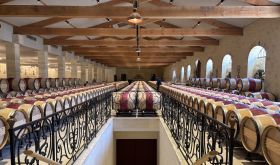
There was a time not that long ago when the easiest way to make money out of wine was to sell the barrels it was aged in. In the late 1980s and much of the 1990s the world’s winemakers seemed convinced that the shortcut to wine quality was to invest in small barrels which would magically confer sophistication and texture on even substandard fruit. Perhaps the saddest instance of this sort of misplaced investment is still to be seen in the generally under-equipped cellars of Bulgaria which, when I visited in 2003, were still piled high with barrels of dubious quality while the country’s vineyards had been perilously neglected. South American bodegas at one time routinely boasted of the number of new barrels they contained as though this were an objective measure of wine quality.
So strong was demand for the standard 225-litre barrique made from oak grown in France’s carefully-managed forests that the coopers were not selling but allocating their wares and, to judge from the harsh, mouth-drying, green wood tannins of some wines made in the furthest-flung corners of the wine world, newer or less favoured customers were occasionally short-changed. Oak needs to be seasoned over many years, ideally outside in a pristine environment, before a good quality wine barrel can be made from it. But there are many short cuts involving steam, smoke and mirrors.
Today things are very different. Demand for oak barrels is markedly less than it used to be. Some of the world’s biggest wine companies are buying just one third the number of new barrels every year that they used to. In the glory days even cheap wine might be treated to a spell in barrel to confer that magic on the blend. Today, in a much more competitive market where every cost has come under scrutiny, wines at the bottom end of the range are extremely unlikely to see anything as expensive as a new oak barrel, which can easily add a euro or two a bottle to production costs. If a winemaker decides that a wine needs the extra stability and textural luxury that oak can convey, the wine nowadays is much more likely to go into a barrel that has already been used once or several times. Many wine producers are re-using barrels for up to six or more vintages rather than buying new barrels every year, sometimes replacing the odd stave with a new one.
And there are many ways that a wine can be given oak treatment without going to the expense of buying barrels. One of the barrel salesman’s chief enemies is the technique known as “planks in tanks”. Oak staves or planks are suspended in stainless steel tanks so that some oak character can be absorbed into the wine without going to the laborious business of filling and emptying small barrels through tiny bung holes, and without risking oxidation or expensive and dangerous evaporation.
Even cheaper are the various ways of mingling wine with small fragments of oak, whether small chips in porous bags in a tank, or, increasingly popular, shavings. These are offered with every possible nuance that a top quality barrel can offer: high, medium or low toast; Vosges, Allier or Nevers forest; some may even be impregnated with bacteria designed to encourage the valuable second, softening malolactic fermentation. Used, red wine-soaked oak shavings are eventually carted off by some winery workers to be used as ground cover for their gardens.
But it is not just cost-cutting that has led to difficult times for coopers. The world’s wine drinkers who once upon a time rather relished the rich, toasty taste they associated with a stint in oak have turned against it. What they increasingly want is fruit, and even sometimes unadorned fruit – as witness the popularity of the wine style sold explicitly as Unoaked Chardonnay. As Peter Dawson, in charge of winemaking and viticulture for the vast Hardy group in Australia, put it to me, “the message got through that people want fruitiness in their wines not lashings of timber. If there’s pressure on margins, costs are likely to be cut – in this case probably to the benefit of wine quality.”
There is no doubt that oak can provide unparalleled qualities such as stability of colour and succulent texture to a seriously fine wine destined for long-term ageing. Even raw young fruit can be made to taste smoother and gentler by a stint in oak. But there is now an alternative technique which has been widely adopted, particularly to make younger, cheaper reds more palatable. Micro-oxygenation involves bubbling tiny amounts of oxygen through the wine which, in a very crude way, mimics the sort of reactions with oxygen encouraged by barrel ageing. It rarely benefits very fine wine but it can certainly rush coarse, tough young reds on to the marketplace by softening all their rough edges. “Microx” equipment is another enemy of the barrel business. If you drink enough wine to be interested in this article you have almost certain drunk many micro-oxygenated wines over the last five years or more – and it could have come from virtually any of the world’s wine regions. The technique was pioneered not in the New World but in Madiran in south west France to accelerate the ageing of the ultra-tough Tannat grape. Some practitioners, such as Michael Havens of the Napa Valley, even believe it can almost replace oak.
There is also a perceptible movement among really ambitious winemakers to use a technique that Chris Ringland, the New Zealander behind one of Australia’s first cult wines Three Rivers calls Macrox. This involves deliberately exposing the fermenting must, particularly of deep-flavoured, intensely rich red wines, to as much air as possible while they are made – fermenting them in vats with wide, open tops for example, and deliberately aerating them often so as to soften the tannins, make the texture as velvety as possible, and minimise the chances of any subsequent reduction, the opposite of oxidation, and its accompanying sulfide stink.
The barrel business has been responding to this slowdown in demand by dramatically increasing its portfolio to include a wide range of oaks not just from France and the US, the traditional sources for wine producers, but from all over eastern Europe, once an important provider of top quality oak. Many more different sizes of cask are now on offer, some producers thinking that larger containers such as a 450- or 500-litre puncheon or 300-litre hogshead suit certain types of wine better than the standard 225-l barrique.
You may well enjoy the benefits of a wine aged in top quality oak for many years to come, but it will surely be some time before
deliberately oak-flavoured wines are back in vogue.
Unoaked, unexpected and delicious
Alan de Val, Mencia 2003 Valdeorras
£7.99 The Winery at Liberty, W1 and or London W9
The perfect present for anyone called Alan, the name being emblazoned across the rather smart label, this super-fruity wine from the fashionable Spanish Mencia grape tingles with life and interest.
Mas Lavail, Tradition 2003 Côtes du Roussillon Villages
£8.85 Leon Stolarski of Nottingham
60 year-old bushvines just north of Pyrenees are grown in such dry conditions than the grapes themselves are tiny, thereby stuffed with their own tannins. Full, dense and sweet with excellent potential for ageing for the price. Roussillon is a more and more interesting source of fine reds as well as whites. The oaked Desirade is also very good, as it should be for £11.30.
Quinta da Covela Escolha 2003 Minho
£12.28 Corney & Barrow, London E1
A blend of Portugal’s own Touriga Nacional port grape with Cabernet Franc, Merlot and Syrah which just pulses with life and vivacity. Low yields on sand and granite give something seriously interesting but quite ready to drink.