No, the title of this article is not an April Fool. Although I am no great fan of overly personal blogs that detail every thought and deed, I sometimes think I ought to publish one, so unusual and varied are my experiences as a wine writer.
The great majority of tastings I attend are either visits to wine producers or professional occasions when you are served by someone who wants to sell you something.
But it can be a particular pleasure to taste with amateur enthusiasts of a particular sort of drink. I did this on successive evenings recently and the experiences were very rewarding, even if they could not have been more different, both in terms of what was tasted and who tasted alongside me.
I spent the first evening hunched over 15 vintage ports with a noisy group called The Port Forum in a dive called the Boot & Flogger, the favourite haunt, incidentally, of several of the nine editors of the Weekend FT we have known. It is part of the Davy’s group of wine bars around London that revel in being sort of posh spit-and-sawdust establishments. I’d been sent the menu beforehand on the basis that we tasters would be too preoccupied with the ports to give enough attention to the menu and had duly ordered my bangers and mash with onion gravy.
My invitation was, I think, a thank you for having expressed interest in a wonderfully comprehensive book on vintage port written by one of the Port Forum members but not yet, unfortunately, commissioned by a publisher. It was only because he approached me that I was even aware of the Port Forum and I was impressed by their obsessive enthusiasm.
Although it has only just over 700 members, it has notched up more than 100,000 forum posts, with the most popular subsections being ‘Port Conversations’, ‘Organising Tastings and Get-togethers’, and ‘Meaningless Drivel’.
I felt rather an intruder at this giant table for 200 glasses and 13 tasters, all professional men apart from one woman in the wine trade seated at the end. They obviously have sympathetic employers. Two of the members had come in to the Boot & Flogger at 11 that morning to decant the 15 bottles of vintage port to be shared between the tasters.
On reflection, I realise that’s a lot of port per head, but the idea was to compare all the vintage ports of the eighties declared by the major shippers Fonseca, Taylor, Dow, Graham and Warre, all the bottles being provided from members’ own cellars. The bottle of Fonseca 1985 arrived late, as did a member who had just flown in from a business meeting in Germany.
These men clearly all knew their port and each other extremely well and virtually spoke port shorthand. There was lots of loud remonstrance and a bit of mild joshing about prices paid and the size of their bottles. I was shown special grids that had been devised for both the layout of their tastings and totting up the scores afterwards. One member was teased for being always the last to submit his scores (but often the first to be asked for background information, I noticed).
‘The ‘83s are all a bit light, aren’t they?’ observed one black-toothed taster. It was agreed that the 1985s showed better than the rather dry 1980s, and certainly better than the weak 1983s. I felt like a party-pooper, gratefully accepting a spittoon, and excusing myself before the decanters had been drained dry.

This thoroughly boisterous evening was followed by one of almost zen tranquillity. Professor Nobuyuki Sato, the economist seconded to Chatham House who had organised the sake tasting at the wine-minded club at 67 Pall Mall on which I reported last October, proposed a second tasting of special sakes in our own home.
He was most concerned that the sakes be well chilled before serving so he and his wife, plus two large pull-along cases, turned up the morning of our tasting (when my system was still awash with 35-year-old vintage port) so that they could stuff our fridge with 26 bottles of sake in preparation for the evening.
The Satos left after the politest possible consideration of our glasses best-suited to sake tasting, miraculously ignoring the less-than-pristine condition of some of them.
I caused consternation by suggesting a 6.30 pm start when they had been expecting a six o’clock kick off. We agreed on 6.15 pm, on the dot of which they turned up with three Japanese sake producers and a slightly bemused Chatham House colleague.
While vintage port is dark red and comes in a standard 75 cl bottle, fine sake is almost colourless and seems to be packaged in an infinite variety of bottles. The usual capacity is 72 cl, four of the traditional Japanese unit of volume known as a gō, but we had some bottles that were square and green like a gin bottle, others looked more like champagne bottles, while our dessert sake came in a delicate tiny flask with a wooden stopper.
Vintage port is bottled so young that it throws the thickest of sediments and is put into thick, almost-black glass that protects the wine for the decades needed to mature it to a drinkable state. Sake on the other hand should be shipped as soon as it is released from the brewery each spring and should be drunk within the year. To that end the bottling date is usually given on the back label. This is useful – unless it’s given in Japanese imperial years. (We’re currently in year 29, apparently.)
Every time we non-Japanese had a question, which was often, the Japanese would go into a polite little huddle that sounded like the mewing of kittens before coming up with a consensus response. We winos learnt a new word, sakefication, for the process of making sake.
We learnt that the average alcohol level of sake is about 16% (whereas most wine is 13 to 14% and vintage port is 20%). Since dry wine usually contains less than 2 g/l sugar, we were surprised to discover that the residual sugar level of sake is typically as high as 30 to 40 g/l, about the same as a Vouvray Demi-Sec, while vintage port contains about 100 g/l sugar. But whereas port is very obviously sweet, most of these 26 sakes were so beautifully balanced that they gave the impression of being dry.
I fail to supply any neat connection between sake and vintage port – just the blessed life of a wine writer.
FAVOURITE EIGHTIES VINTAGE PORTS
Graham 1985
Warre 1985
Fonseca 1985
Taylor 1980
Dow 1980
Graham 1980
FAVOURITE SAKES
Born Tokusen Junmai Daiginjo
Sohomare Kimoto Junmai Daiginjo
Dassai Beyond Junmai Daiginjo
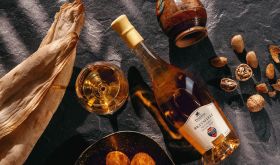
Dassai Junmai Daiginjo 23 Centrifuge (pictured above)
Isojiman Junmai Daiginjo Spring Breeze 42
Masuizumi Kijoshu
Sohomare Kimoto Junmai Ginjo