When it was announced in 1980 that Robert Mondavi of the Napa Valley was going to make a California wine with Baron Philippe de Rothschild, owner of the famous Château Mouton Rothschild of Bordeaux, it was a bombshell.
Joint ventures proliferated afterwards but back then they were unknown. Bordeaux kept to its much-vaunted self at the top of the wine tree. California was seen as an upstart, its wines untried parvenus. When in the 1980s my husband owned L’Escargot restaurant in Soho, London, with an all-American wine list, a party of French diners ordered their meal, looked at the wine list, and left.
Interest from such a famous Bordeaux personage as Baron Philippe was a huge compliment to the nascent Napa Valley wine industry. It was widely thought that his interest had been inspired by the results of the famous ‘Judgment of Paris’ tasting in 1976 when California definitively trumped France’s big names in a taste-off that came to be much celebrated (and is being repeated in various forms all over the world to celebrate its half-century this year).
In fact, however, the dynamic Baron Philippe had hatched the idea of a transatlantic co-operation long before and had interviewed prospective Californian partners at a wine business conference in Hawaii in 1970. It’s not surprising that he decided to go with the equally energetic Robert Mondavi, who had been recommended by one of Baron Philippe’s advisors. Although the Robert Mondavi Winery had been established as recently as 1966, the ebullient man himself would tell anyone who would listen of his passionate desire to prove that ‘California wine belongs in the company of the best in the world’.
But, for much of the 1970s, the two men had other preoccupations. Baron Philippe was engaged in a feverish campaign to have his beloved Mouton promoted from second to first growth – the same status as his cousin Baron Elie de Rothschild’s Château Lafite across the way in Pauillac. Mondavi, meanwhile, was distracted by a bitter lawsuit with the rest of his family over his departure from their Charles Krug winery.
In 1973, ‘the Baron’, as Mondavi always referred to him, saw Mouton promoted, the only change ever to the famous 1855 classification of the Médoc. And in 1978 Mondavi won substantial cash and vineyard compensation from his family and managed to regain total control of the Robert Mondavi Winery. Not only that, but the deleterious effects of the early 1970s oil crisis on the wine business were now firmly in the rearview mirror. So in 1978 Mondavi was invited to Mouton, on his second-ever visit to France, taking with him his daughter Marcie. Everything spoke of tradition and good taste. First a tour of the cellars and the famous wine museum, then dinner featuring important vintages of Mouton, of course, and then Yquem the Baron’s way – so cold that ice shards floated in it.
Mondavi was frustrated. His way was to talk business first; but it was not that of Baron Philippe, an inveterate host, who had his dining table moved around multiple locations in the luxurious converted stables that he’d made his Bordeaux base instead of the stuffy Victorian château across the gravel (raked daily). The Mondavis had to wait until the next morning to discuss the project, and not in a conventional office but in the Baron’s bedroom, with the Baron, as usual, still in bed.
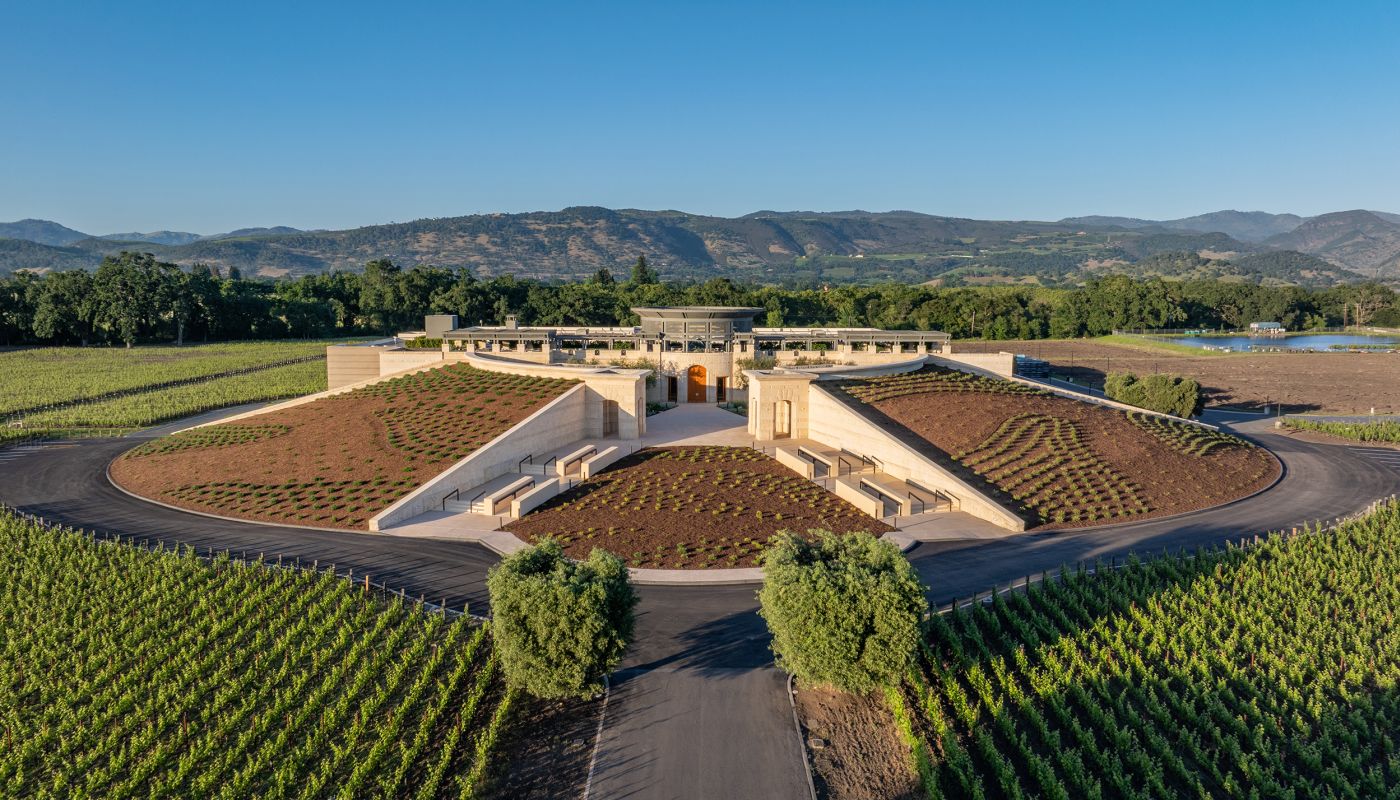
But at least it was relatively easy to draw up heads of agreement. This was to be a genuinely 50:50 arrangement, with the wine being the finest possible expression of Napa Valley Cabernet Sauvignon, Mouton’s dominant grape variety. The lead winemaker from each partner was to be responsible for making the wine in Robert Mondavi’s winery in Oakville until the grand Opus One winery was built across the highway in time for the 1991 vintage.
In late 1979, I was sent to the Napa Valley by The Sunday Times to write about the winemaking revolution taking place there. When the Mondavi–Mouton plan, about which I had heard not a thing, was announced a few months later, I was furious (but managed to incorporate the news in my eventual article). The next Frenchman to announce a Napa Valley adventure, in 1982, was Christian Moueix, then managing no less a property than Petrus, producer of Bordeaux’s most expensive wine. I’d interviewed him in 1981 for a book I was writing and tried to coax a potentially critical comment from him about the Mouton–Mondavi pact and was rather surprised that none was forthcoming. But, in fact, by then he had been seeking advice from Mondavi about potential California partners. Moueix’s Yountville estate, established with the daughters of John Daniel, a mentor of Mondavi’s, was initially called the John Daniel Society but for many years has been known as Dominus.
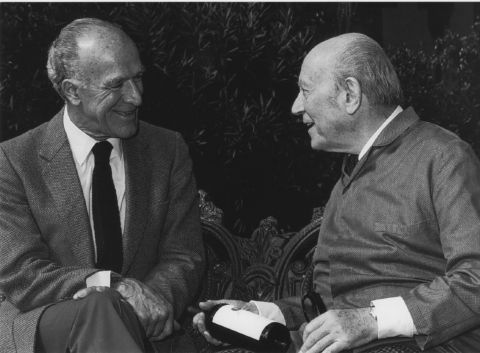
The encounter at Mouton in 1978 left the name and label of the joint venture undecided. The two principals settled on Californian Susan Pate to design the label and I remember encountering her when, in 1982 during our first few days making The Wine Programme for Channel 4 in Bordeaux, rain stopped vineyard filming and we managed at short notice to snag an interview with Baron Philippe in his bed. (He was nothing if not extrovert.) That day Pate was showing him the drawing of the profiles of Mondavi and de Rothschild back to back on the label of a wine supposedly to be called Janus. The drawing remains but the name (of a then-well-known Soho sex shop) does not. After much toing and froing it was decided to call the wine Opus One. Below, Mondavi (left) and the Baron discuss a prototype bottle.
When it came to making the wine, there was another problem. The two nominated winemakers, Mouton’s long-standing winemaker Lucien Sionneau and Robert Mondavi’s young son Tim, couldn’t communicate and, until firmly instructed to work together, initially made separate wines. The current Opus One winemaker Michael Silacci, at a tasting of 1979 to 2000 vintages in London last May, wondered whether Sionneau had even had a passport. And Tim didn’t speak a word of French. Frenchwoman Geneviève Janssens, a veteran of the Mondavi winemaking team today, had to translate everything. When the relatively inexperienced Californian asked Sionneau why he did a certain operation, he’d be told that was simply how things were done.
Despite this, Opus’s debut was ostensibly rather glorious. Originally called simply ‘Napamédoc Cabernet Sauvignon’, the 1979 vintage on its first outing sold for a record price at the first-ever Napa Valley Wine Auction in 1981. But neither it nor Dominus was received that enthusiastically initially when they reached the market. The Californians complained that both wines lacked fruit and were too French. The French simply saw them as beyond the pale. Opus One had one more problem. It was launched at a price wildly in excess of any other California wine – too much for American restaurant-goers to countenance. In 1988, the marketing team came up with what was then a hugely innovative idea: selling a fine wine by the glass. They even designed special miniature Opus One decanters for restaurants.
Finally, in 2004, Opus One truly infiltrated Bordeaux and the international wine trade by being the second (after Mouton’s Chilean joint venture Almaviva, subsequently imitated by Mondavi) non-bordeaux wine to be offered on La Place de Bordeaux, the traditional distribution system that sends Bordeaux’s wines around the globe. Having tasted every vintage of Opus One up to 2022 in two sessions over the last year, I can confirm that the wine is very much a Franco-California expression, quite unlike the alcoholic fruit bombs popularly associated with Napa Cabernet. Of the 43 vintages I tasted in the last eight months (no 2020 has been released), only the very first, the 1979, was definitively past it, while the bottles of 1983 and 1984 tasted were frail but still had some interest – more than any 1984 red bordeaux I can think of.
Since Opus One came on the scene, Napa Valley wines have evolved considerably, so that now there are hundreds of labels owned by a wide range of nationalities (including quite a few Bordeaux producers). The prices of some of them make Opus One, or even Bordeaux first growths, look like a bargain. (The Harlan family’s output is notably ambitiously priced.) Prices of ‘Napa Cabs’ soared with the economy in the early years of this century but the Valley’s embarrassing surplus of expensive wine is now widely acknowledged.
With a shrinking domestic market, America’s dominant wine state is further hampered by having lost both one of its major US distributors recently as well as much of its principal export market, Canada. The Wine Institute has, unusually for a generic body, been investing hopefully in Latin America, Eastern Europe and even Africa.
Superior Opus One vintages
Apologies that so many of these vintages are currently commercially unavailable in the UK but perhaps some can be found in, and may emerge from, private cellars. Vintages from 2010 onwards are widely offered by the six-bottle case in bond.
1982 12.1%
1986 12.5%
£220 per half Hedonism
1987 12.5%
£410.40 Bordeaux Index
1991 13.5%
£595, £1,260 per magnum Hedonism
1993 13.5%
1994 13.5%
£255 per half Hedonism
1995 13.5%
1999 13.5%
2001 14.1%
2004 14.1%
2005 14.0%
£396 Lay & Wheeler
2007 14.7%
£280 Squelch Marketplace, £525 Hedonism
2008 14.5%
2010 14.5%
£891.46 per magnum iDealWine UK
2013 14.5%
2016 14.5%
£436 Vintage Drinks/Wright Wine Co., £475 Hedonism
2018 14.0%
£325 Uncorked
2019 13.5%
£435 VINVM
2021 14.0%
2022 14.0%
£297.16 iDealWine UK
For tasting notes, scores and suggested drink dates, see Opus One 1979–2000 and Opus One 2001–2022. For the many international stockists, see Wine-Searcher.com.
The image at the top of this article is courtesy of Seth Johnson.