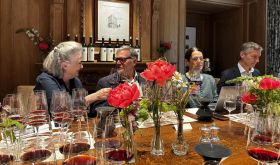
What makes Charles Chevallier, winemaker at Château Lafite since 1983, smile? It is not the extraordinary elevation of his first growth Pauillac to most highly valued bordeaux of all, fuelled by its unrivalled popularity in China. Nor is it the way that even Lafite's second wine, the once lowly Carruades de Lafite, now sells for more than the most admired second growths. What really turns this genial oenologist on is sweet Sauternes in general and Lafite's sister property Château Rieussec in particular.
Last February I spent a few days comparing the 1995 and 1996 vintages in Bordeaux under the auspices of the Conseil des Grands Crus Classés en 1855, the generic organisation of the top châteaux. Hearing that I was keen to taste the sweet whites as well as the dry reds, Chevallier insisted on participating in the tasting himself, and indeed, because he is so interested in these under-appreciated treasures, suggested that we tasted all the wines in each vintage blind. This is most unusual practice among Bordeaux winemakers showing off wines to journalists, but Chevallier's love of Sauternes is pure rather than commercial.
This is just as well since making and selling Sauternes is a pretty unrewarding task. You can make exciting sweet white bordeaux only by ensuring that you select only perfectly ripe grapes that have been satisfactorily turned into what look like disgustingly mouldy raisins by a capricious fungus called Botrytis cinerea, or noble rot. The grapes rot satisfactorily only when heat and dampness are in perfect alignment and the rot tends to affect different bunches, sometimes individual grapes on the same bunch, at different rates. So to make really good Sauternes, your pickers, who have to be available at a moment's notice over several weeks, may have painstakingly to comb a single vineyard up to 10 times.
Then the amount of juice that can be squeezed from these disgusting-looking dessicated berries is tiny, only a fraction the amount yielded by a nice juicy red wine grape. All in all the production costs of Sauternes are many times those of a red bordeaux, yet the prices tend to be far less than their red-wine equivalents. Only the top 20 properties or so can afford, or are prepared, to aim for maximum quality every single vintage, even if it sometimes means producing painfully small quantities and sometimes nothing at all.
Demand for the latest vintage of Sauternes, and the wines of its neighbour Barsac, which has its own appellation, has been even more sluggish than demand for the 2010 red bordeaux, even though the vintage is extremely promising for sweet white bordeaux. The particularly dry summer meant that the grapes were extremely ripe before botrytis set in after rain in early October but the cool nights meant that acidity levels are more obvious than in the big, blustering 2009s. This may have led some to underestimate these wines.
What is vital in a fine Sauternes is that there is not just a gorgeous richness with all sorts of associated fruit and flower flavours as well as honey, crème brûlée, butterscotch and barley sugar, but also a sufficient, counterbalancing freshness that stops the wine being cloying and heavy. That acidity can keep top Sauternes alive for decades longer than its red-wine counterparts.
Charles Chevallier reported that in 2010 picking in Sauternes had to be done very quickly, once botrytis had really taken hold in the second half of October, but before predicted rain and cold. Backed by the Lafite Rothschilds, he was able to deploy an army of 90 pickers, half of whom were sent from Château Lafite in Pauillac. 'It's a great experience for the Pauillac pickers to see how to pick botrytised grapes', he observed approvingly. He, and indeed anyone who cares about the future of Sauternes such as those running the lively new specialist website Bordeaux Gold, are keenly aware that many of Bordeaux's greatest wine fans never set foot in the Sauternes region well to the south of the city, limiting their travels to the glamorous names in the Médoc, Graves, St-Émilion and Pomerol. 'What can we do to lure the trade down to Sauternes for primeurs tastings?' he asked me rather exasperatedly at the end of a tasting that visibly delighted him.
There is a global malaise affecting sales of sweet wines in general, of course, which is such a shame as the best of these are some of the most complex wines known to man. The problem is that the worst of them are so appalling: sticky, unappetising, and fattening into the bargain. Between these two extremes are some of the more disappointing Sauternes from properties that simply cannot afford to be as fastidious as the better-funded ones. But, as Charles Chevallier pointed out, 'it's very tricky for the smaller properties, so we really shouldn't criticise them'. Many of these estates have been running at a loss for years.
Christian Seely, who runs AXA's wine properties, including some glamorous red-wine properties in Bordeaux, the over-performing Château Suduiraut in Sauternes, Disznókő in Tokaj and Quinta do Noval port, so is well placed to comment on the plight of sweet wines, observes, 'I believe they are among the very best bargains in the wine world today for people who are seeking a taste of the very best there is. When you compare the astonishingly reasonable price of one of the great premier cru Sauternes such as Suduiraut with what you need to pay to buy a premier cru or a super-second red Bordeaux, you are clearly putting one of the great wines of the world in your cellar at a bargain price. I also think that they have become much more enjoyable to drink when they are young than perhaps used to be the case. Suduiraut 2007 is quite delicious now and we serve it all the time, which does not stop it from being a wine that will last a century if you want. Finally, for those who buy wines with an eye to possible future appreciation in value as well as for drinking, it is worth remembering the tiny scale of Sauternes production: maybe six million bottles from Sauternes and Barsac in a good year. It would take a very small shift in world demand (for example a little development in the Asian market, for whose cuisine these great wines are so well suited) to change entirely the supply and demand equation, and to make great Sauternes very much harder to get hold of. Buy now while stocks last!'
One problem with sweet wines is knowing when and how to serve them. Charles Chevallier had been careful to chill our 25 bottles of Sauternes, all carefully wrapped in silver foil to disguise their identities, down to 6 ºC and then to take them out of the fridge an hour before our tasting. There were 16 1996s but only nine 1995s had been submitted by members of the Grands Crus Classés because it was a much less successful vintage – even if welcomed in the flat, forested Sauternes region as the best in five long years. Indeed even Chevallier decided not to include his Rieussec 1995 in the tasting because he did not expect it to meet his own high standards and confessed after the tasting that, although he had anticipated some bitterness and lack of fruit, the overall quality of the 1995s shown had impressed him.
I tasted the two vintages of the most famous Sauternes Château d'Yquem separately with the current director of the property, Pierre Lurton, who pointed out that Yquem 1996 is 'not that sweet – but that is the future of Sauternes: freshness'. The 1995 and 1996 Yquems were rather atypical of their vintages with the 1995 not nearly ready and the 1996 wonderfully appetising, lemony and versatile. Such is the nature of great Sauternes that some from each vintage did not seem ready to drink yet, including Chevallier's own admirable Château Rieussec 1996. But overall the 1996s were notably more successful than the 1995s – and I'm pretty sure that that the 2010s will trump them both.
FAVOURITE SAUTERNES & BARSACS
2010
d'Yquem
Doisy-Daëne, L'Extravagant
Climens
Coutet
Suduiraut
Doisy-Daëne
Guiraud
Lamothe Guignard
Rieussec
1996
d'Yquem
Rieussec
Doisy-Daëne
La Tour Blanche
Nairac
1995
d'Yquem
Clos Haut-Peyraguey
Sigalas Rabaud
See detailed tasting notes for 2010s and 1996 and 1995 compared.