24 December 2019 A much-needed guide to a country whose wines have changed out of all recognition. See this guide to our book reviews.
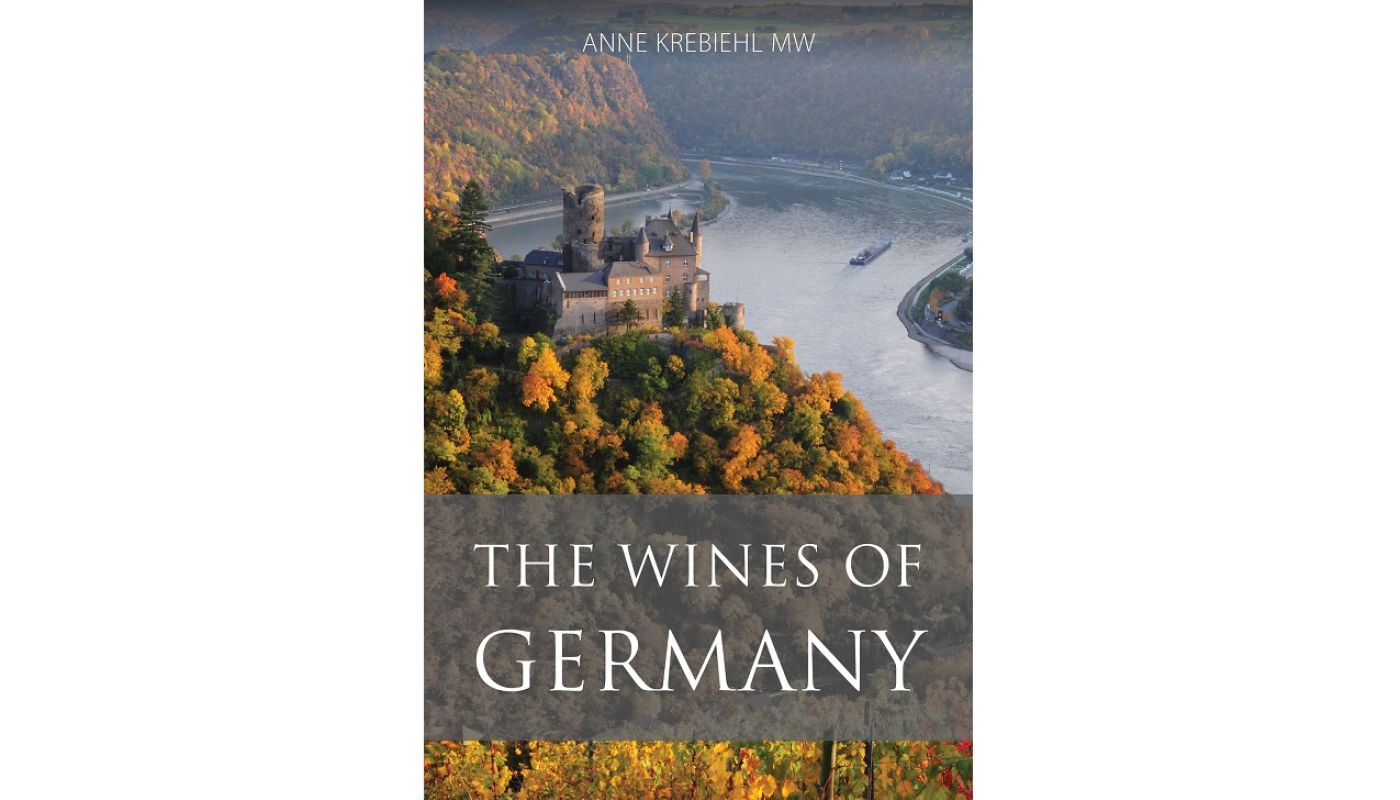
The Wines of Germany
Anne Krebiehl MW
Published by Infinite Ideas
ISBN 9781906821852
£30
It’s a pretty formidable challenge to throw at someone: write a book on Germany’s wines. Maybe it’s only the 14th-largest wine-producing country in the world and maybe it has only 103,000 ha (254,520 acres) of vineyards, and maybe there are really just a handful of key grape varieties. But Germany’s 13 wine regions support 16,000 wine estates, a fiendishly complex regulatory classification system, a mosaic of terroirs and a convoluted history. To condense this into 280 pages requires laser focus.
German-born Anne Krebiehl, a Master of Wine since 2014, wine writer, educator and consultant living in London, took on this daunting task, saying that a book like this ‘can only ever be a sketch’. While she acknowledges that with a subject this vast there are inevitably gaps, to call it a sketch is to do a great disservice to what she has achieved here.
In a lean, unsentimental and even stringent style of writing, she’s managed to make a brilliant judgement on where to apply broad brushstrokes and where to crouch down with a microscope. Her authorship is precise, clean – not quite austere or unemotional, but decisive and perspicacious. No words wasted.
Wines of Germany differs, in some ways, from the usual format of the Classic Wine Library series in that Krebiehl doesn’t serve up chapters in orderly WSET-like chunks of history, economics, viticulture, soils, grape varieties, regions and producers. Instead, she’s homed in on the pivotal and the puzzling.
Giving no quarter, Krebiehl deals systematically with the myths, messiness and misconceptions which have dogged a wine country that baffles even the most well informed, while highlighting its glorious strengths.
In her introduction, she writes that ‘it is only now that Germany is emerging from the convulsions of the twentieth century to become its true self and allow the uniqueness of its vineyards and diverse landscapes to take centre stage’. This book is an examination of the history and flash points of German wine that both formed and obscured the potential greatness and how it is emerging, butterfly-like, from the chrysalis of change.
She doesn’t shy away from being critical. Her summation of German wine law in the chapter entitled ‘A perpetual palimpsest’ is fairly damning: ‘a muddled, complicated beast’. She drily wishes the German Wine Growers’ Association luck in their latest attempt to move towards a ‘provenance-based quality system’, adding that it will take years.
On German history as a whole, she’s adroitly side-stepped the pothole so many authors fall into, of laborious detail that is best saved for students with time for poring over manuscripts. Here, she sketches lightly and quickly, moving resolutely on to topics much more relevant to the world of German wine today: Riesling and its singularity; Spätburgunder and the evolutionary curve German producers have moved along; climate change (with fascinating insights from Dr Hans Schultz, climate specialist and president of Geisenheim wine research centre); Sekt and its surprising past and future. Her detailed analysis of TDN is particularly interesting.
As I’ve found with most of the Classic Wine Library series (see my review of Rosemary George MW's recent book on Chablis, for instance), the real life of the book lies in the producer profiles, which in this case are organised by region and preceded by incisive description and analysis of the regional culture, landscape, history and wines. Here, she really does manage to capture the spirit of each of the wine regions.
Krebiehl explains that her selection of producers is based on finding a representative cross-section ‘with a focus on leading lights with international presence and more recent, up-and-coming estates which represent the future’. She adds a caveat to her recommendations by saying that, of necessity, many producers who merit mention are not included, but I found her choices to be varied, interesting and exciting.
The profiles themselves are a pleasure to read. Her Riesling-crisp prose shines a sharp light, but here, unlike in the rest of the book, there is a sweetness, a curve to her words. She analyses the kaleidoscope of regions, varieties, vineyards and styles through the people who make the wines and the wines they make. As with the rest of the book, there is a pitch-perfect balance between detail and summary. And at the end of each profile she suggests a wine from that producer to try, and why. They are joyful little postscripts, such as ‘Try: [Julia Bertram’s] Dernauer Goldkaul for one of those heart-stopping Pinot moments’; ‘Try: [Dr Corvers-Kauter’s] Assmannshäuser Spätburgunder for sheer poetry’.
My usual gripe with the Classic Wine Library series applies here and it’s about the maps and photos. The former are black and white, making them hard to read and clunky. There are one or two grainy black-and-white photos, but the few glossy colour photo pages lose their impact by being tipped into the middle of the book rather than illustrating the chapters and sections they relate to.
That’s a petty gripe, and not Krebiehl’s fault. And it does nothing to undermine the importance and value of this book. It’s been too long since a comprehensive guide to Germany and its wines has been written in English, and this book deserves a place on every serious wine lover’s shelf.