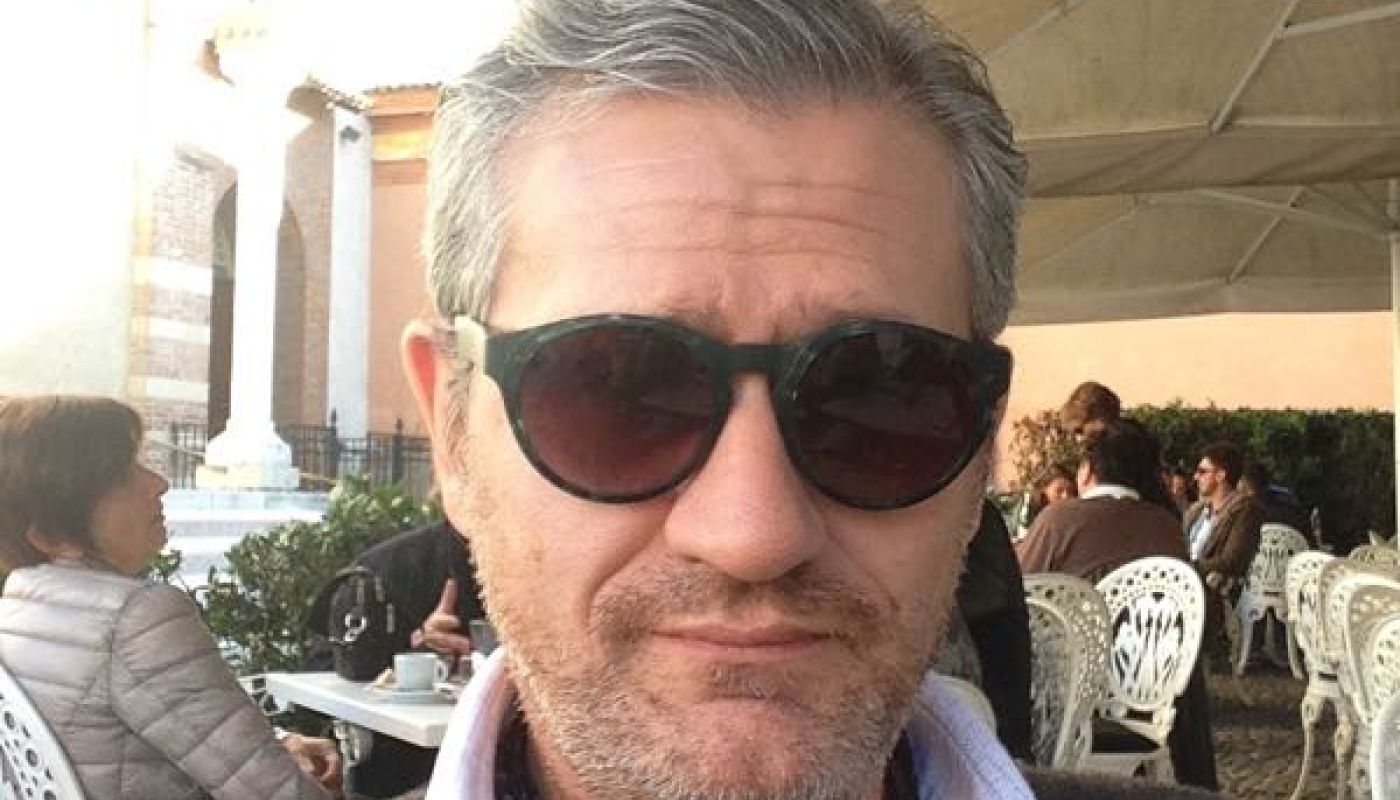
We're publishing both articles submitted to our popular wine writing competition by Pierazzo da Feltre (right), who describes himself thus:
I am 53 years old, male, I live in Veneto, Italy. My job is producing quality pasta, my hobby is eating quality pasta. So I suppose I am quite a happy guy. I am a scholar of the ‘la grande bellezza' in all its manifestations, because I was born in Italy.
Sorry for mistakes in the text, my English is not perfect, feel free to correct anything if the case of publication. Sorry also for uncomfortable assertions, I am not used to writing for the public. Feel free to erase some parts.
The secrets of Proseccoland
Just back from an ordinary pranzo (lunch) with my friend Enzo. Just an hour ago we were lazily sitting at a little old wooden table outside Trattoria La Trave (the tavern of the beam), close to Asolo, in this clear and sunny September day, in the countryside of Veneto. A sweet smooth whirl of the first fresh air of autumn, the first tweed jacket, what a joy. Imagine some faded colour pictures of the seventies, in Italy; imagine, feel the smell in the air. Porcini and polenta were astounding, as usual. We ordered a caraffa (jug) of prosecco, of course. Not the prosecco spumante you are accustomed to, but the kind we in Veneto usually drink, the frizzante (fizzy) one.
Prosecco frizzante is sparkling but not too much, say low pressure, something between the French pétillants and crémants, and it is usually transported and sold locally to the osterie and trattorie (taverns, both terms) in 54-litre demijohns, simply because a glass bottle won’t make of him a better wine.
He is humble and gentle, like the people I love the most.
Pale greenish yellow, few tiny bubbles. The charmat method keeps aromatics and fruitiness to the fore. The smell is an explosion of white flowers, unripe apple, pear; the taste fragrant, fresh, delicate, slight; no more descriptors, end of his complexity. But he is good, and makes you feel happy even if you aren’t an expert. This is his first secret.
He is poor, like our grandfathers. Actually we spent just a few euros for a one-litre jug.
'Proseccoland' is historically a peasant land, which has repeatedly known famine. All our grandfathers were extremely poor, virtually without exception; it is really impossible for us to think of cutting half of the yield for making a more complex wine. So we decided long ago that our wine had to be simple: 18 tons of grapes per hectare is the standard yield for DOC Prosecco now, and in the past we got even 30 tons per hectare. This keeps this wine fundamentally cheap. Poverty is his second secret, which by the way remains an incredible goal, if we think globally.
This also means huge quantities in the market and the name prosecco running long distances, more like bordeaux than bourgogne (maybe the example is not well suited, but it conveys the idea). People all over the world, especially if they are not experts, love simplicity, but in these times they are also more and more informed, so they start to perceive and ask about quality, to some extent. The condition for success is to have quality, but in big enough quantities to be recognised and sought after from virtually everyone. Prosecco has this double potential, this is the third secret of his success.
Mario Soldati, the father of all Italian wine connoisseurs, in the sixties described this kind of wines as vino passante (sort of 'passing wine', actually it cannot be translated any better). Nobody since then has given a better description for simple wines, usually made by the farmers for their own personal use, usually kept in tonneaux or in demijohns and used before the next harvest, but also sold to the nearby taverns as vino da tavola (table wine) in the strict meaning of the term. Kilometres, zero … maybe one or two ... No more.
The concept that all wine has to be bottled to be good is a nonsense if we are talking about easy fresh wines. That’s a mass-retailers' deception. They create a wonderful label, they write on it an important name, they fill a beautiful bottle with some 'no matter what', which by the way costs less than half of the mere cost of his own packaging, so they sell you one thing for another, ruining the dignity of both the table wine and the fine one, creating a purgatory between the two: the mass wine. It’s a pity to think that 90% of people’s first sip is inside this purgatory, this does not help the wine industry at all. The fourth secret of prosecco is his double-faced attitude: Remaining a peasant passante wine even in a bottle without losing his simple, gentle soul. But I do hope to see demijohns and bulk quantities of prosecco frizzante, in the future, simply because it makes sense. The prosecco spumante is another story, maybe next time.
We, the 'tasting pack' (myself included), passing our time from one tasting event to another, should sometimes reset ourselves and enjoy a real and simple passante glass of wine for what it actually is, a little joy. This is the only real ground floor of our passion, the C scale, the foundation of the building.
The vino passante reminds us all that no matter which wine you are accustomed to drink, expert or not, you can open a Vosne-Romanée Grand Cru at every dinner or not (I do, actually, OK, just kidding), but if you are not able to feel the joy of a simple, fresh, fragrant, well done glass of peasant’s wine, then something of your passion has been lost between a bordeaux and a supertuscan tasting event.
Sip a delicious vino passante on an Italian sunny autumn day, just outside a country osteria, chatting with a few good friends or, even better, your loved one, eating slow food with slow attitude, without any hurry. Now look at yourself from above, you are into the old faded picture. I bet you won’t be able to spit, this time.
One last secret: Say 'prosecco': I mean, say it loudly. It is music, it carries along a kind of beauty. Barmen and bartenders all over the world can easily assert.
After reading this, you’ll probably disagree with me about several issues, and this is good because I made you keep thinking. Anyway I can assure you that your Italian is slightly better than ten minutes ago.
Barman, a shadow please
Still hot in San Marco Square. The local long black boats, say gondole, keep carrying along loads of tourists happy to pay a real fortune for being able to take home a piece of dream, probably along with some odd uncanny souvenirs. Maybe they are right, maybe not. We are the few natives, much more rare than the American ones, probably because Venice can be a nightmare, living here. We are lazy, maybe spoiled, but it's not our fault. It’s the water, which is everywhere, something like living in a splendid home with a pool: you don’t need to go out because it’s the world which comes to you. Along with a few other benefits, such as having plenty of friends with barchini (little boats for boozing at large), we have some sort of 'tourists' impunity', in the sense that, simply because we talk the Veneziano slang, we have the right to pay the real value of a cappuccino, which by the way is 20% of the amount a poor American tourist will pay for the same cup. Anyway you won’t find us at Florian’s or in other famous historical bars, cause no matter the hour of the day (and night), the season, the tide: we always are in some cicchetteria to eat spuncioni and drink ombre. Don’t ask for translations, quite difficult for the first and the second term without writing too much. Nobody can know everything. I want you to know what ombre are.

Ombra is the Italian term for 'shadow', I mean in the rest of Italy, not in Veneto. Here, from Venice to the mountain borders with Austria, the meaning is 'glass of wine'.
The location, as always, is a bar. You have to enter, and ask 'Per favore un’ ombra'. The bartender will serve you a glass of local wine without raising an eyebrow. Only with this little trick of advice, if your accent is somewhat decent, you will have saved 80% of the value compared with having asked for 'un bicchiere di vino'. What’s more, they will look at you with some friendship also, which is an absolute privilege here. (Don’t wear some flower-painted skirt and shorts, which would betray you.) Take this advice as it is, a real Venice discount voucher. (This photo, taken in a venetian pub by G Veronese, includes spuncioni and an ombra of vino passante.)
What’s the story behind it?
Come back with me to Venice’s Republic, in Casanova's times, say mid 1700s, Piazza San Marco, August. Dry-throated Venetian people asking for some refreshment, say fresh wine. Freezers not yet invented, but fortunately enough, plenty of Malvasia, this wonderful aromatic grape that our mother Greece gave us along with many other incredible grape varieties, some DNA pieces and, ultimately, the sense of beauty. Ice was the real luxury and was imported from very far away, so to keep it in a solid state you had to keep it in special container carriages, which always had to stay in shaded places. The campanile (bell tower) of San Marco was the perfect shadow because it covered, at different times, all the piazza. The secret was to stay under the protection of this ever-moving shadow during the sunny hours, moving these strange wheeled bars full of ice blocks and Malvasia. This trick allowed the wine sellers to cover all the piazza while always remaining in the shade. The fringe benefit was that the locals always knew where the bar was placed: west in the morning, east in the afternoon. The beauty of simplicity.
Imagine 'Le chevalier de Seingalt Giacomo Casanova', his wig, his precious rings, the laces, the rich colourful robes and the silver walking cane, happily chatting with his friends on Rialto bridge, saying 'Why don’t we go and drink a shadow?' I suppose at this point you know their intentions. And also their direction: San Marco Square.
Bibliography: read The Life and Memoirs of Casanova, the best book after the Bible. And only just a little longer.
















