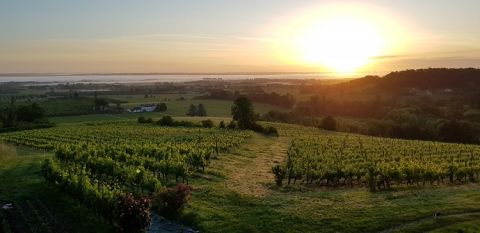
As I walked the vineyards in the twilight yesterday evening, I saw a white rectangle down one of the vine tracks. It was a disposable mask. Mask waste has even reached the pristine vineyards of Saussignac. Team Feely have reusable cotton masks. I picked it up, disposed of it and washed my hands thoroughly. It felt like a good place to start. For sustainability, washable mask trumps disposable.
What is sustainable wine? What is sustainable farming?
I had come to detest the word ‘sustainable’ given how many vineyards used it to describe themselves while happily dousing their farm in systemic pesticides. A few years ago, Monsanto (now owned by Bayer), creator of Roundup and many other systemic pesticides had the tagline ‘the sustainable agriculture company’ on their website. ‘Sustainable’ as a word was a total mockery.
We visited Benziger estate in California in 2010 and found that they had a biodynamic range, an organic range and a ‘sustainable’ range. The ‘sustainable’ vineyards could still use systemic pesticides but had to think about it beforehand, like ‘lutte raisonée’ ‘reasoned fight’ producers in France. ‘Lutte raisonée’ means you analyse your vineyards and calculate how much systemic pesticide to use, based on the risk, rather than just spraying by rote. For me using chemical herbicides and systemic pesticides is not ‘sustainable’, carcinogens, nervous system disruptors and endocrine disruptors cannot offer long-term self-sustaining solutions.
So, what is ‘sustainable’?
Before lockdown Bergerac Wine Route members met to brainstorm Sustainable Wine Tourism. We outlined three main areas for sustainable thinking –
- environment
- social
- economic
Sometimes these categories appear to be in conflict – for example – environment in conflict with economics. But that is seldom the full picture. See my thoughts on externalised costs here. At the Wine Route debate some winegrowers felt threatened by the discussion, but most people were very engaged. Each time we meet to discuss ‘sustainability’ – we learn and challenge each other. Exchange is vital.
Around that time Jancis Robinson’s newsletter picked up climate change as a topic and reminded readers of a sustainable wine article by Tamlyn Currin called 50 shades of green. According to Tamlyn’s article Steven Matthiasson, a consultant in sustainable wine defined the six areas of sustainable wine production as:
- soil conservation and health
- minimising chemical inputs (fertilisers, pesticides, herbicides, fungicides)
- increasing habitat and biodiversity
- water conservation and management
- carbon footprint
- employee safety and opportunity.
At the time I started to jot down thoughts under these headings. In this article I flesh them out putting the first three into a single category to start and sharing some of the actions we are taking at Chateau Feely as notes for myself and others interested in the subject.
Organic and Biodynamic Viticulture – soil health, minimising chemical inputs, biodiversity
Organic and biodynamic viticulture contribute to sustainability particularly in these three areas: soil health, minimising chemical inputs and biodiversity.
Chateau Feely has been certified organic with Ecocert and Biodynamic with Demeter for more than ten years. To understand more about these methods I invite you to visit the online organic and biodynamic trail we created in 2018.
As well as following organic and biodynamic practices we stopped ploughing a few years ago. We mow between the rows. Sean Feely, my partner and winegrower and winemaker, works hard to keep tractor passages to a minimum. He even trims by hand. No more rogneuse ‘vine-trimmer’ – good news for the vine’s health and for Seans. He had a tussle with the trimmer in our first year, one of several bloody encounters explored in my first book Grape Expectations.
Chateau Feely is 14 hectares with 7 hectares of vines, 2 hectares of land that is resting, a hectare of forest and about 4 hectares of wild conservation are (see this post for more on the ‘wild things’).
In 2008, after three years of organic farming, we noticed a distinct increase in biodiversity. Wild orchids appeared in the vineyards, the garden and in the areas like our conservation area.
As part of our ongoing biodiversity initiative we keep natural growth between vine rows and hedgerows between vineyard plots. When necessary we plant green manure in zones where we need more organic matter, or specific plant solutions.
Although our copper dose is less than half of the maximum allowed under biodynamic and a third of what is allowed under organic, we would like it to be even less. In this quest Sean is trialling several hybrids in his garden to see how they behave and what they taste like. This will also mean less passages with the tractor. Less passages with the tractor mean less diesel consumed and less soil compaction, good for sustainability and for vine health. Sean would rather be on foot in the vines. We handpick everything and use manual power in the winery preferring punch down to pump over. We are human scale.
We compost our grape skins with hay from our fields, chicken manure and plant waste from the gardens and kitchens. I can be obsessive. I feel guilty for throwing a few crumbs from the breadboard into the bin instead of to the chickens. We moved the chicken’s moveable run under the kitchen window so guiltfree crumbs and scraps can be swished directly out to them.
Sean grows hundreds of kilograms of vegetables and fruit on the Chateau Feely vegetable plot of about 10*10 metres. He has now extended into the first two rows of vines closest the house, a permaculture vine zone. Part of biodynamics is thinking of the farm as a living thing, something that is self sufficient and long term sustainable. We aim to live this way not just farm this way.
Water conservation and management
We dry farm the vineyards. We save the rainwater collected on the roofs of the property in tanks and use them for watering the garden and for making our sprays and teas. Winery wash water is saved in a tank to be used on decorative gardens and young trees.
Carbon print
Chateau Feely uses a green energy supplier that ensures that 100% equivalent of our energy is from renewable energy sources. We would like to generate our own local power with a solar power system and were about to sign the project when lockdown hit. The forced stop gave me time to research more, including thinking about what will happen to the panels when they reach the end of their life, something I hadn’t asked about in my requests for quotes. To be truly sustainable we must consider the waste implications of technology. Sustainable is about being something that can continually renew itself where waste becomes a useful part of a closed circuit rather than a negative side effect.
We are natural winemakers, so we avoid using unnecessary intervention (and energy use). There is no automated temperature control in the winery. We intervene on the temperature when necessary using with an energy efficient heat pump and stainless-steel radiators. We don’t have air conditioning. We invested in a new roof and insulation for the winery as part of the ongoing renovation. Part of the winery is semi underground offering some natural cooling and we open the doors early in the morning to allow cool air to circulate. We use the cold of winter for natural clarification. All these elements save electricity. As stated above we use a renewable energy supply, so our energy use has no direct generation of carbon dioxide, but the creation of these infrastructures still generates a carbon print and saving energy is good for our pockets and for the planet.
The tasting room and accommodation have been renovated with green building techniques and materials including natural insulation wood fibre in the roof, hemp and chalk on walls, natural paints, overhangs for natural heat and light management and woodwork and masonry by local artisans.
During our Route des Vins meeting on sustainable development, Muriel Landat Pradeaux, president of the Bergerac Route des Vins, asked the group if we needed to get down to concrete principles? ‘Do we go so far as to say, for example, that to not contribute further to climate change, we only hire people that live less than 50km away?’
Ironically a couple of weeks before the Route des Vins meeting I had written an article about climate crisis and what I was doing personally. The article made me realise I had to think wider for Chateau Feely too, so I had discussed the working from home with Elodie, our apprentice and the person responsible for wine tourism development. The first day of working from home went well for both of us. It saved time (about 1.5 hours of Elodie’s day) and about 11.55 kg* of CO2 (90 km saved in a day given petrol generates approximately 2.31 kg of CO2 per litre burned). We decided to do one day of telecommuting a week. Then lockdown hit and Elodie teleworked for 3 full months. We built up a set of online courses and virtual experiences so people can experience Chateau Feely without travelling to us. Lockdown helped us see that teleworking is viable even for longer periods.
To close off the commute element; for Chateau Feely, 66% of our staff (me and Sean) have no commute, the vineyards surround our home – we walk to work. The other 33%, Elodie, lives about 45km from us, just inside Muriel’s suggested 50km cut-off.
Doing these calculations made me more aware that small things add up to large things. Treehugger’s Lloyd Alter recently committed to living a 1.5° lifestyle, which means limiting his annual carbon footprint to the equivalent of 2.5 metric tonnes of carbon dioxide emissions, the maximum average emissions per capita for us to keep within a warming of 1.5% according to IPCC research. That works out to 6.85 kilograms per day. The scary news is a commute of 50 kms means this is consumed in just one direction with no CO2 budget left for food or anything else. So yes, Muriel was onto something.
See his article on what this CO2 limit means for your diet here. It’s easy to see that to live a 1.5 degree life we need to stop commuting in cars but for those of us in rural areas not served by public transport and too far from centres to walk or bike it’s not easy. That’s just one small area of the sustainable puzzle.
As far as business travel goes, we sell 60% of our wine through direct sales to end consumers, 20% to local restaurants and 20% to loyal importers in Ireland, Germany and Holland. We do no long-distance export. We don’t do any international wine shows or travel for marketing and we rely on word of mouth and repeat business. We use a Toyota Prius hybrid for our local deliveries.
Glass bottles are often the biggest generator of CO2 for a winery business. We calculate that one hectare of our forest area consumes the equivalent of all the CO2 generated by the glass bottles used at Chateau Feely. We use ‘ecova’ bottles that are engineered for energy efficiency in production and less weight. We keep pushing our suppliers to provide better solutions. For example, after years of asking for it, our label supplier was able to offer us 100% recycled paper this year. We encourage change through all our relationships as a business.
We look for ways to close the circle. When we deliver a new order, we collect our used cardboard boxes from local restaurant clients. When the boxes are too worn to reuse, we use them in the vegetable garden. We compost all our living waste. We say no to packaging that is unnecessary. We encourage clients to recycle glass bottles and our corks are made of natural materials that can be composted as is the packaging material we use.
Our virtual activities made us reflect on our digital consumption. Digital activities represent a growing part in energy consumption and are estimated at close to 10% of total global energy use today. We use new compression technology on our website to help to decrease this but doing more virtual courses and activities mean we need to keep this element on our radar.
Employee safety and opportunity
We are a small farm and hence a small team, Sean and I are the only permanent people. For the last few years, we have taken on an apprentice every year to share our ethos and to help grow the business. We see education as a key responsibility internally but also externally to clients and visitors. Our harvest workers are local, often from Saussignac village, 900m away. We offer an environment to learn about organic and biodynamic farming, wine, and wine tourism.
Conclusion
I see the future of sustainability in more natural solutions and more social links – sheep mowing the grass rather than a mower, shared systems between small farmers. Schumacher’s ‘small is beautiful’ rather than ‘bigger is better’. To farm intelligently we need to know our farms personally and intimately. Big, capital intensive, high technology solutions need energy and eventually become waste too. Say no to the waste before it enters your place. Get reusable masks instead of disposables.
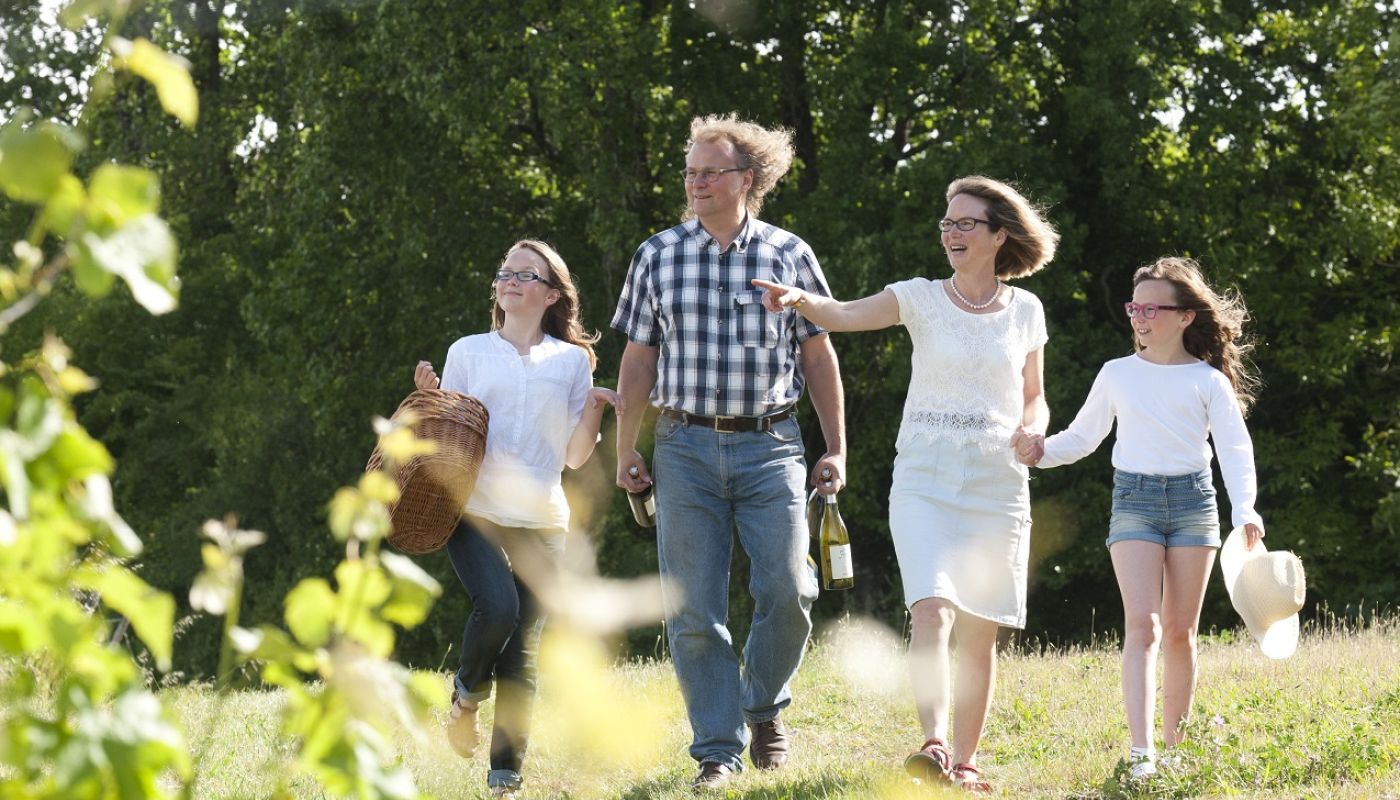
(The photo of the Feely family is by Clindoeil Studio)